
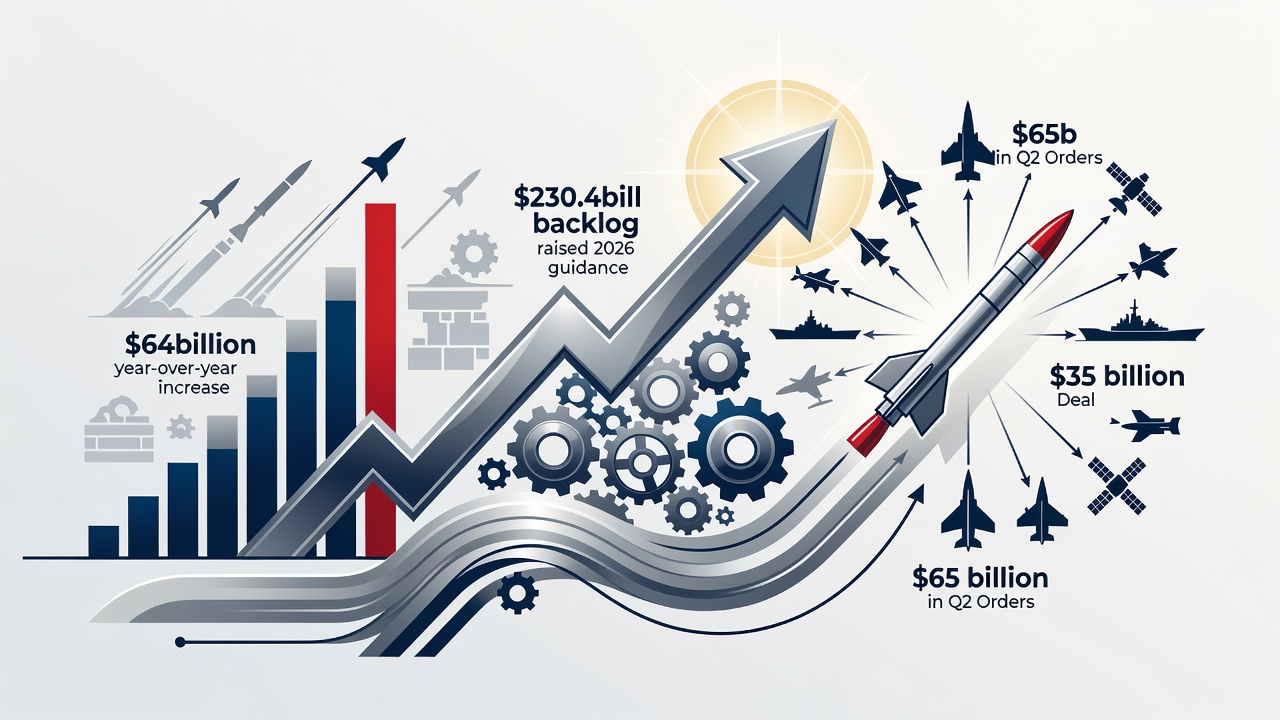
Lockheed Martin delivered a standout second quarter. Revenue climbed 11% to $20.06 billion. Earnings beat expectations handily. Yet the real headline sits in the order book.
The Bethesda-based contractor now holds a record $230.4 billion backlog. That figure swelled by $64 billion from the prior year. It reflects a world hungry for advanced weapons systems. And it promises revenue growth that stretches well into the decade.
Geopolitical Pressures Drive Unprecedented Demand
Conflicts from Ukraine to the Middle East have emptied arsenals faster than anticipated. The Pentagon now races to restock. Allies seek similar capabilities. Lockheed reaps the benefit.
In the quarter the company booked $65 billion in new orders. The book-to-bill ratio hit 3.2 to 1. A massive multiyear deal for Terminal High Altitude Area Defense interceptors contributed $35 billion alone. Another $3 billion came from Guided Multiple Launch Rocket System munitions. These wins didn’t arrive in isolation. New radar programs and space contracts added momentum across segments.
Chairman, President and CEO Jim Taiclet captured the mood in prepared remarks. “With a record backlog, strong demand for our capabilities and continued operational excellence, we are well positioned to deliver increasing value to our customers, employees and shareholders for years to come,” he said, according to the company’s earnings release.
The numbers back him up. Full-year sales guidance now sits between $79.75 billion and $81.75 billion. That’s up from the previous range of $77.5 billion to $80 billion. It tops the consensus estimate of $79.14 billion. GAAP earnings per share guidance rose to $29.95 to $30.65 from $29.35 to $30.25. Free cash flow expectations reached $7.0 billion to $7.2 billion.
Investors liked the message. Shares rose following the announcement. The update arrives as global defense budgets expand. NATO members push toward 5% of GDP on military spending in some cases. The U.S. itself eyes supplemental funding to replenish stocks depleted by support for Kyiv and operations in the Red Sea.
But execution matters. Lockheed resumed F-16 deliveries in the period. C-130 production rates climbed. Development of the Grizzly counter-unmanned aerial system advanced. These steps matter because supply chain snarls and labor shortages have slowed output in recent years. The company also poured resources into advanced manufacturing techniques, artificial intelligence applications and key partnerships. The goal remains clear. Convert that backlog into delivered platforms and profit at a faster clip.
Aeronautics, the largest segment, expects 2026 sales of $31.7 billion to $32.7 billion. Operating profit should land between $3.0 billion and $3.08 billion. F-35 production and sustainment activity drive the mid-single-digit growth projected for the second half. The program itself faces scrutiny over costs and upgrade timelines. Yet its centrality to U.S. and allied air power remains unquestioned.
Missiles and Fire Control tells a similar story. Sales guidance calls for $16.5 billion to $16.9 billion. Operating profit of $2.3 billion to $2.35 billion reflects higher munitions output. Demand for PAC-3, JASSM and HIMARS systems shows no sign of easing. The THAAD award in particular gives Lockheed multiyear visibility that few competitors can match.
Space and rotary-wing businesses add balance. Backlog there grew as well. Strategic missile warning satellites and hypersonic programs sit inside those figures. They represent the next frontier where margins can expand if technical risks stay contained.
Compare this moment to earlier periods. At the end of 2025 the backlog stood at $194 billion. By March 2026 it had dipped slightly before the Q2 explosion. The jump isn’t just one big contract. It signals structural change in demand. Reuters reported that both Lockheed and rival RTX raised forecasts precisely because Pentagon stockpiles need urgent replenishment after global conflicts.
Wall Street analysts have taken notice. Consensus now points to sustained growth. Yet valuation remains reasonable at roughly 19 times forward earnings. The dividend yield hovers near 2.7%. Buybacks continue. Capital allocation stays disciplined even as capital expenditures are guided lower to between $2.0 billion and $2.4 billion.
Challenges persist. Fixed-price development contracts carry risk if costs overrun. Congressional budget debates can delay payments. Dependence on the U.S. government for about 70% of revenue exposes the company to policy shifts. Supply chain fragility still lurks. And talent acquisition for specialized engineering roles grows harder each year.
Even so. The order book provides rare visibility. Few industrial companies can forecast multiple years with such confidence. Lockheed’s management has repeatedly emphasized production scaling as the next imperative. They invested over $3.5 billion in capacity and technology during 2025 alone. That spending continues.
Operation Absolute Resolve offered a recent demonstration. F-35s, F-22s, RQ-170 drones and Black Hawk helicopters played decisive roles. Real-world performance builds the case for further investment by customers. It also justifies the premium placed on proven systems over newer, untested alternatives.
Look at the segment backlog details. Aeronautics holds the largest share. Missiles follow closely. The balance across rotary systems and space reduces concentration risk. Bookings in the quarter included both domestic and international commitments. Export demand for F-35 and missile defense grows steadily.
Free cash flow conversion approached 100% of net income in recent quarters. That funds the dividend growth streak now at 23 years. It also supports research and development without heavy reliance on debt. Net debt remains manageable for an investment-grade name.
Analysts at investment banks have adjusted models upward. Some cite the THAAD contract as transformative for the missiles business. Others highlight the potential for F-35 block upgrades and international sales campaigns. The consensus remains constructive.
Of course markets can be fickle. Defense stocks sometimes trade at discounts to broader industrials despite predictable cash flows. Current events tend to drive attention. When tensions ease, so can valuations. Yet the structural backdrop points to prolonged demand. Depleted inventories won’t refill overnight. New threats emerge faster than legacy systems retire.
Lockheed isn’t alone in the upcycle. RTX posted similar strength. The entire sector benefits. But Lockheed’s scale, program diversity and execution track record set it apart. The $230 billion backlog isn’t just a number. It represents committed future revenue. It buys time to solve production bottlenecks. And it positions the company to capture additional upside as budgets expand further.
Management reaffirmed commitment to operational excellence and risk management. That matters when so many programs involve complex integration. The Q2 earnings release highlighted resolution of prior contract losses that had weighed on margins. Normalized profitability now sits near 10.8% at the segment level. Room for improvement exists. The backlog gives breathing room to pursue it.
So what comes next? Higher F-35 delivery rates. Accelerated munitions output. Continued space wins. Potential new international partnerships. Each element feeds the next. The company that once worried about sequestration now navigates how to ramp production fast enough.
Investors will watch quarterly backlog updates closely. Any softening in book-to-bill could shift sentiment. Sustained ratios above 1.5 would reinforce the bull case. Cash flow delivery remains the ultimate proof point.
For now the picture looks strong. Record orders. Raised guidance. Geopolitical tailwinds. Lockheed Martin has rarely enjoyed such clear visibility. The coming years will test whether it can translate that backlog into consistent, profitable growth. Early signs suggest the foundation is solid.


 WebProNews is an iEntry Publication