
Swiss athletic brand On has spent years chasing faster times on the track and trail. Now its engineers chase something else. Speed in the factory.
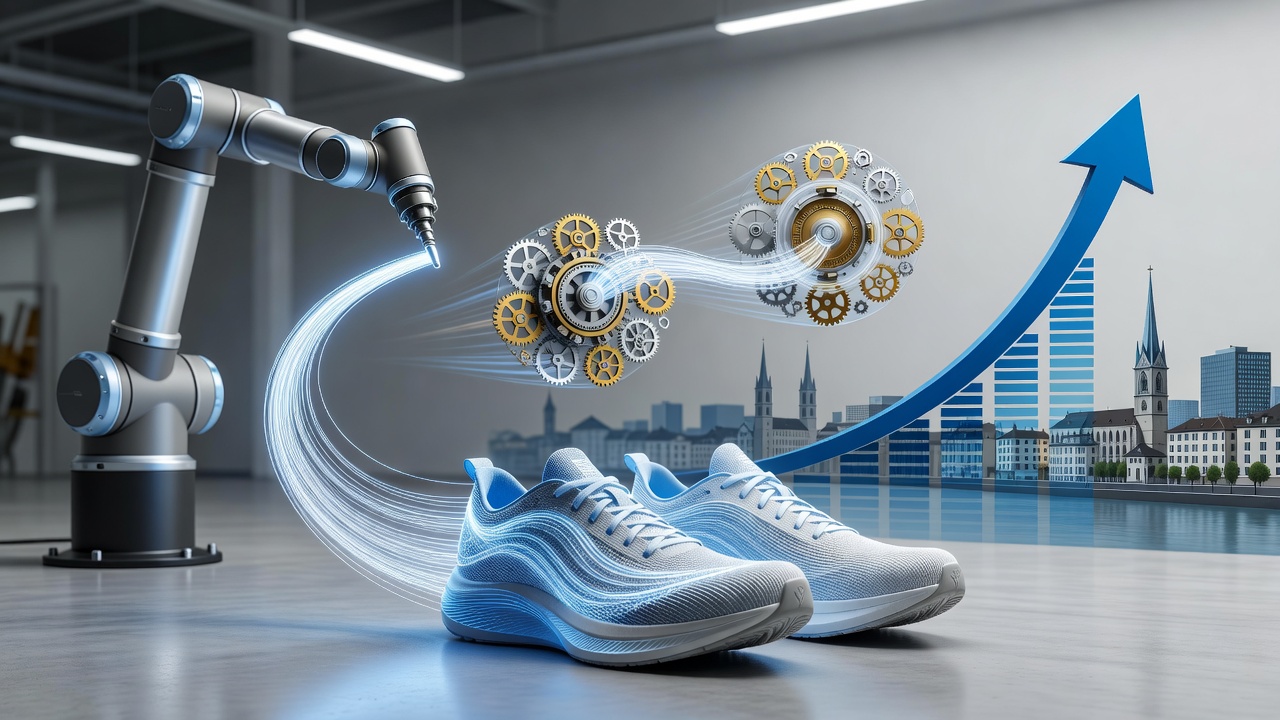
Robots in a new Zurich facility turn out shoe uppers in three minutes flat. The process slashes what used to take hundreds of human work hours. On calls the system LightSpray. Four robotic arms spray a special filament onto a mold, building a one-piece upper from nearly nothing. The result feels almost weightless yet holds up under pounding miles.
Co-founders David Allemann, Olivier Bernhard and Caspar Coppetti stood together at the plant opening in early July 2025. They watched the machines move with precision no hand could match. On’s official announcement described the moment as a return of manufacturing to Switzerland. The company started here in 2010. For years it sent production overseas like everyone else. Now automation brings part of the work home.
Traditional shoe uppers require some 200 separate steps. Yarn gets spun in one country. Fabric woven in another. Pieces cut, stitched and glued across borders before final assembly. LightSpray collapses that chain into a single automated station. A robot arm uses about 1.5 kilometers of filament per upper. The entire operation fits in a compact space. Time saved reaches dramatic levels. One analysis in Fortune put the human labor reduction at up to 300 hours per pair.
But the story runs deeper than raw speed. On’s team spent years iterating on the chemistry and mechanics. Benjamin On, who serves as chief technology officer, pushed the project forward. The filament itself represents a proprietary blend. It bonds instantly yet stays flexible. Early prototypes demanded constant tweaks. Engineers tested different spray patterns, temperatures and pressures. Failure came often. Success arrived through repetition.
And the payoff shows in the product. Runners who tested early LightSpray versions noticed immediate differences. The upper conforms better. It weighs less. Breathability improves without sacrificing structure. One recent wearer in Portland described the new Hyper Lightspray model as delivering noticeable energy return, especially during tempo runs. The shoe felt lightweight and soft at once. Cool to the touch. That feedback arrived via social media just days ago, underscoring how the technology already reaches consumers.
On built its reputation on CloudTec cushioning. Those distinctive pods underfoot absorbed impact while providing propulsion. The innovation helped the brand expand from niche Swiss runner favorite to global player with hundreds of stores. Revenue climbed. Athletes at the highest levels began choosing On shoes for races and daily training. Yet the company never stopped hunting for advantages in materials and construction.
LightSpray builds on that momentum. It targets the upper, long a stubborn area for automation. Most shoe factories still rely heavily on manual labor for stitching and lasting. On’s approach sidesteps those bottlenecks. The robot sprays filament in a continuous motion. Layers form organically. No seams. No excess waste. The process generates far less scrap than traditional cut-and-sew methods.
Industry observers took notice. WWD reported on the July opening, highlighting how the four-robot setup can supply uppers for the entire performance running line. The article quoted the founders emphasizing scalability. Future plants could multiply the output without proportional increases in space or energy. That matters as On grows its portfolio beyond running into lifestyle and outdoor categories.
Still, challenges remain. Scaling from lab to full production rarely goes smoothly. The filament must perform consistently across climate conditions and runner weights. Quality control demands new protocols. On invested in sensors and cameras that monitor each spray in real time. Artificial intelligence adjusts parameters on the fly. A slight variation in humidity might otherwise ruin the bond. The system learns and adapts.
Executives describe the technology as the product of patient experimentation. They avoided grand pronouncements. Instead they pointed to data. Build time measured in minutes. Labor hours measured in hundreds saved. Environmental impact measured in reduced transport miles and material waste. The Zurich plant sits close to the company’s headquarters. Engineers can walk from their desks to the production floor. Iteration happens faster.
Competitors watch closely. Nike, Adidas and newer entrants have poured resources into automated footwear lines for years. Some focused on 3D printing midsoles. Others experimented with knit uppers. On’s spray method carves a distinct path. It combines elements of injection and additive manufacturing but in a novel form. Patents protect key aspects. The company intends to defend them.
Runners care little about factory drama. They want shoes that disappear on the foot. LightSpray delivers that sensation more completely than earlier generations. The upper feels like a second skin. It stretches where needed and supports where demanded. Early Cloud models won loyalty through cushioning. Newer versions add this engineered fit.
The broader shift carries implications for the industry. Decades of offshoring hollowed out manufacturing skills in developed markets. On’s move suggests a partial reversal is possible when automation reaches sufficient maturity. Switzerland offers high labor costs but also top engineering talent and stable infrastructure. The math starts to favor local production for premium products.
Not every shoe will come from Zurich. On maintains partnerships in Asia for volume lines. The LightSpray facility targets performance models where margins justify the investment. Over time that balance could tilt. Additional robots mean additional capacity. The company already plans expansions.
David Allemann reflected on the journey in interviews tied to the opening. The co-founder and CEO noted how the technology condenses complex supply chains into a single room. Three kilometers of filament replace multiple suppliers and weeks of lead time. The simplicity appeals. So does the precision.
Outside analysts see potential for On to license elements of the process or form new partnerships. Footwear remains a tough category for pure technology plays. Consumer preferences shift. Marketing budgets run high. Yet tangible product advantages still drive sales. If LightSpray produces measurably better shoes at competitive costs, the brand stands to gain share.
Recent coverage captured the excitement. CNBC revisited the concept in video segments, showing the spray gun in action. The visual strikes viewers. A robotic arm moves gracefully, depositing filament that hardens into fabric-like material. The transformation looks futuristic yet happens today in a Swiss industrial building.
Of course the future holds unknowns. Can the process handle the full range of performance demands from marathon racing flats to maximalist daily trainers? Will the filament prove durable over hundreds of miles? Early indications say yes. Real-world testing continues. Runners log the data every day.
On’s bet rests on the belief that superior manufacturing yields superior products. The company avoided hype. It focused on opening the doors and letting the machines run. Observers who toured the site came away impressed by the quiet efficiency. No crowded assembly lines. No rows of sewing machines. Just robots and filament and finished uppers emerging at regular intervals.
That image may define the next chapter for athletic footwear. Speed on the track still matters. So does speed from concept to consumer. On found a way to accelerate both.


 WebProNews is an iEntry Publication