
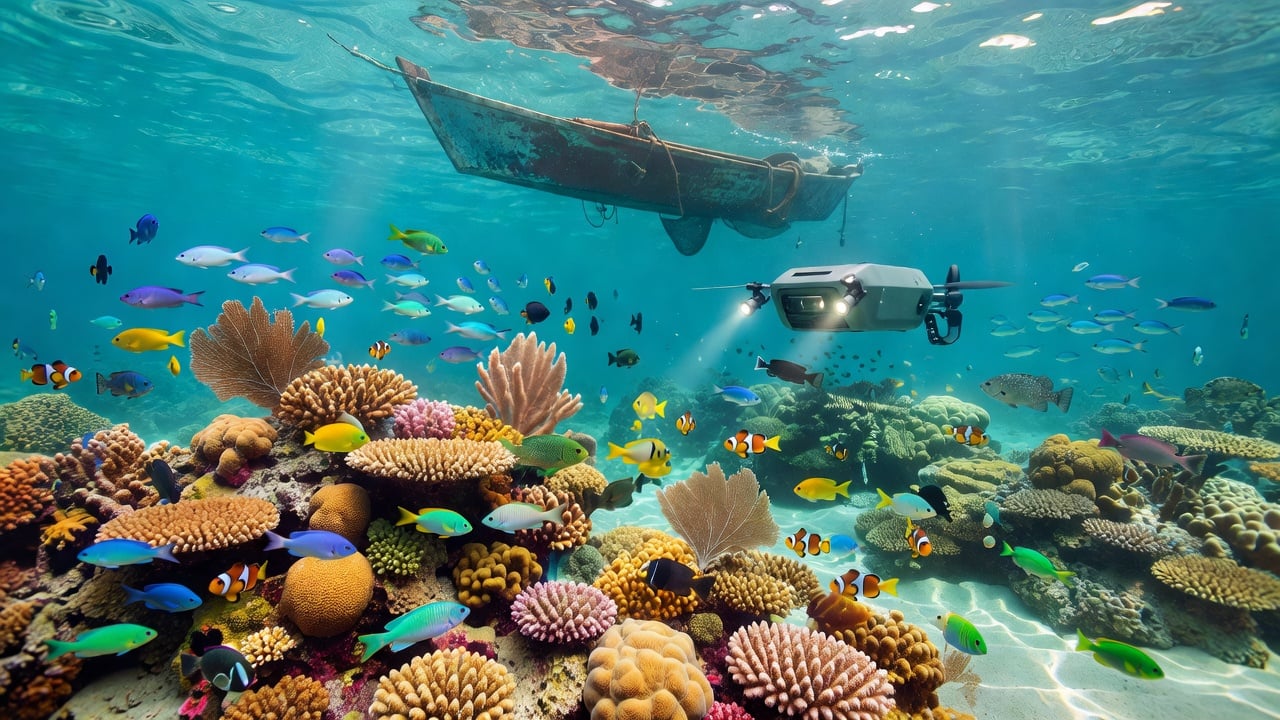
Benin has taken a significant step toward marine conservation by designating its first coral reef as a protected area. The West African nation, long overlooked in global ocean protection discussions, now safeguards a vibrant underwater habitat that supports diverse marine life and local communities. This decision marks a turning point for a country whose coastline has faced mounting pressures from overfishing, pollution, and coastal development.
The newly protected reef lies off the coast near the town of Ouidah, stretching across approximately 140 square kilometers of ocean floor. Scientists discovered this coral formation only in recent years, challenging the long-held assumption that meaningful reef systems did not exist along this stretch of the Gulf of Guinea. Researchers from the University of Abomey-Calavi and international partners documented more than 200 species of fish and dozens of coral varieties within the area. The Yale Environment 360 report highlights how this unexpected discovery has shifted scientific understanding of West African marine biodiversity.
Local fishers have known about the reef for generations, referring to it in Fon language as a place where fish gather in unusual abundance. Their traditional knowledge proved essential in mapping the area and identifying key ecological features. Rather than viewing the reef as an untapped resource for extraction, many community leaders advocated for its protection once they learned about the threats facing similar habitats worldwide. This collaboration between scientists and fishers created a foundation of trust that strengthened the protection effort from the beginning.
The Beninese government acted quickly after receiving the scientific assessment. In late 2023, authorities formally established the protected status through a presidential decree, placing the reef under the management of the National Center for Fisheries and Oceanic Research. The designation prohibits industrial fishing, seabed mining, and coral extraction while allowing traditional fishing methods in designated zones. This balanced approach recognizes the economic needs of coastal villages while prioritizing long-term ecological health.
Protection of this reef carries particular significance because of its location in the Gulf of Guinea, a region experiencing rapid warming and acidification. Ocean temperatures here have risen faster than global averages in recent decades, stressing marine organisms already adapted to marginal conditions. The Benin reef serves as a potential refuge for species displaced from more equatorial waters. Its survival could provide important genetic diversity for coral populations across the eastern Atlantic.
Conservationists point to several unique characteristics that make this reef especially valuable. Unlike the massive barrier systems of the Indo-Pacific, this is a patchy reef built on ancient sandstone and laterite formations. The corals grow in isolated colonies rather than continuous structures, creating a mosaic habitat that supports both reef-associated and open-water species. This structural complexity offers numerous niches for invertebrates, fish, and marine mammals.
The area also functions as a critical nursery ground for several commercially important fish species, including groupers, snappers, and croakers. Local markets depend heavily on these catches, making the reef’s health directly connected to food security and economic stability for thousands of families. Studies show that protected areas typically experience spillover effects, where fish populations increase inside the no-take zones and then move into adjacent waters, benefiting nearby fishers.
Benin joins a small but growing list of African nations prioritizing marine protected areas. South Africa, Kenya, and Tanzania have established substantial ocean reserves, yet West Africa has lagged behind. The Benin initiative could inspire similar efforts in neighboring Togo, Ghana, and Nigeria, where comparable reef systems may exist but remain poorly documented. Regional cooperation will prove essential since ocean currents do not respect national boundaries, and fish stocks migrate across these waters.
Funding for the protection effort comes from multiple sources. The government allocated initial resources from its environmental budget, while international partners including the World Bank and the Blue Action Fund provided technical support and additional financing. These resources will support monitoring programs, patrol boats, and community education initiatives. Sustained funding remains a concern, however, as many conservation projects in developing nations struggle after initial enthusiasm fades.
Scientists plan to establish permanent monitoring stations across the reef to track changes in coral cover, fish abundance, and water quality. Early data collection has already revealed concerning signs of bleaching during recent heat waves, though the colonies appear more resilient than many Pacific reefs. Researchers attribute this resilience partly to the corals’ adaptation to naturally fluctuating temperatures and high nutrient levels from river outflows.
Education programs now reach coastal schools and fishing communities, explaining the connection between healthy reefs and productive fisheries. Children learn about marine food webs through interactive workshops that use local examples rather than distant tropical paradises. Fishermen participate in workshops that demonstrate sustainable practices and alternative income sources such as guided snorkeling tours for visitors.
The reef’s protection has already sparked economic opportunities beyond traditional fishing. Several cooperatives have begun developing small-scale ecotourism ventures, training young people as marine guides and investing in basic equipment for snorkelers. While visitor numbers remain modest compared to Caribbean destinations, the potential exists for carefully managed tourism that generates revenue while maintaining ecological integrity.
Challenges persist despite these positive developments. Illegal fishing vessels from distant nations occasionally enter Beninese waters, testing the enforcement capacity of a country with limited naval resources. Plastic pollution from the coastal cities and river systems continues to threaten marine life. Coastal erosion, accelerated by upstream dam construction and mangrove clearing, affects both terrestrial and marine environments.
Addressing these threats requires coordinated action across multiple government ministries and international borders. Benin has begun discussions with neighboring countries about establishing a larger marine corridor that would connect protected areas across the Gulf of Guinea. Such transboundary management represents an ambitious but necessary approach to conserving migratory species and maintaining genetic connectivity between reef systems.
The scientific community has taken keen interest in this relatively unexplored reef. Unlike the extensively studied Caribbean and Indo-Pacific systems, the Benin corals offer opportunities to understand how reefs function under marginal conditions. The findings could inform restoration projects in other regions facing climate stress. Several universities have expressed interest in establishing long-term research partnerships with Beninese institutions.
Traditional beliefs also play an important role in the reef’s protection. Many local communities view certain sections of the reef as sacred sites associated with water spirits in Vodun cosmology. These cultural values have helped foster respect for the marine environment and discourage destructive practices. Conservation efforts that integrate rather than replace traditional knowledge tend to achieve stronger community support and compliance.
As climate change accelerates, the value of protecting every remaining reef system increases. Even small areas like the one off Benin can serve as stepping stones for species migration and sources of larvae that help repopulate damaged habitats elsewhere. The global scientific consensus emphasizes the need to protect at least 30 percent of ocean areas to maintain ecological function, making every new marine protected area a meaningful contribution toward that target.
Benin’s achievement demonstrates that nations with limited resources can still make substantial conservation commitments when scientific evidence, community support, and political will align. The country has shown that coral reefs exist in unexpected places and that their protection yields multiple benefits for biodiversity, fisheries, and coastal economies. This West African success story offers encouragement to other nations seeking to balance development pressures with environmental stewardship.
Ongoing research will determine whether the protected status successfully reverses negative trends observed in preliminary surveys. Early indications suggest fish populations are already responding positively to reduced pressure in no-take areas. Coral recruitment appears stable, though continued monitoring will be necessary to assess long-term trajectories under changing ocean conditions.
The story of Benin’s coral reef protection illustrates how local knowledge, scientific discovery, and government action can combine to preserve important natural heritage. For a nation facing numerous development challenges, choosing to protect this marine treasure reflects a forward-thinking approach that recognizes the ocean’s role in supporting human wellbeing. As more countries follow similar paths, the cumulative effect may help maintain the ocean’s capacity to sustain life for generations to come. The Benin reef stands as both a scientific surprise and a conservation victory, reminding us that important discoveries still await in places long overlooked by global attention.


 WebProNews is an iEntry Publication