
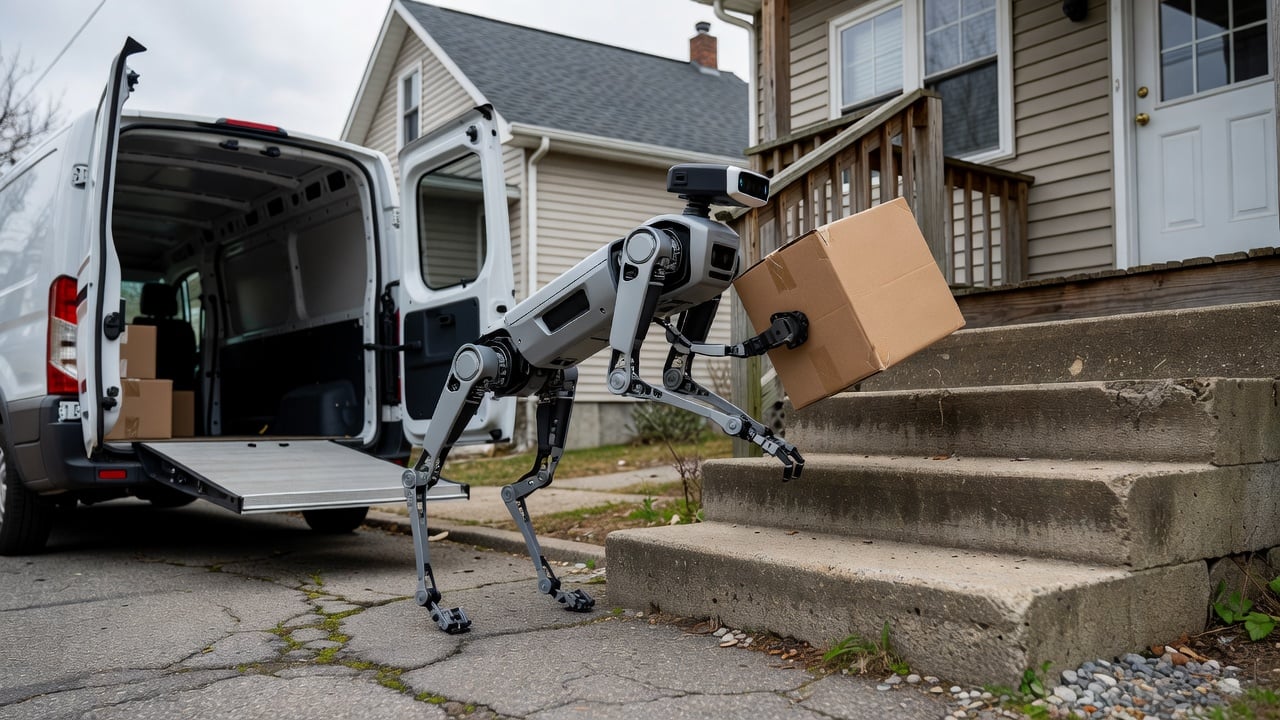
Boston Dynamics has introduced a new capability for its Spot robot that allows the four-legged machine to bridge gaps between delivery vehicles and home entrances, addressing one of the persistent challenges in automated last-mile delivery. The development, covered by The Next Web, shows the company adapting its agile platform for practical commercial applications beyond industrial inspection and entertainment.
The system works by having Spot climb out of a delivery van, traverse the distance to a customer’s porch, and place packages directly at the door. Traditional delivery robots often struggle with stairs, uneven surfaces, or the physical separation between street-level drop-off points and elevated home entrances. By extending its reach with precise leg movements and body positioning, Spot can effectively close that final gap that has frustrated many automated delivery concepts. This advancement builds on years of refinement in the robot’s balance algorithms and terrain navigation systems, which originally gained attention through viral videos of the machine performing backflips and dancing routines.
Engineers at Boston Dynamics focused on practical delivery scenarios during the development process. They observed that many residential addresses feature steps, porches, or landscaping elements that create barriers for wheeled robots. Spot’s ability to step over obstacles and adjust its stance allows it to deposit packages in locations that feel more secure and convenient for recipients. The robot uses a combination of visual sensors and mapping technology to identify the optimal path from the vehicle to the delivery point, calculating each step with consideration for stability and package safety.
This delivery-focused adaptation represents a shift in how Boston Dynamics positions its technology. While the company first developed Spot for hazardous environments like construction sites and oil refineries, expanding into consumer-facing applications opens new commercial opportunities. Delivery companies face increasing pressure to reduce costs and address labor shortages, making robotic solutions more attractive despite the initial investment required. Spot’s design, with its distinctive yellow frame and articulated limbs, already carries a level of public recognition that could help ease acceptance in neighborhood settings.
The technical foundation for this porch-bridging capability comes from extensive work on dynamic balancing. Each of Spot’s legs contains multiple actuators that work together to maintain equilibrium even when the robot extends beyond its normal center of gravity. When approaching a porch edge, the system calculates weight distribution across all four limbs while extending one or two legs forward to place the package. This process happens with remarkable stability, as demonstrated in testing footage where the robot maintains composure even on narrow surfaces or when carrying moderately heavy loads.
Integration with existing delivery workflows presents both opportunities and challenges. For carriers, the system would require modifications to standard vans to accommodate the robot’s docking station and charging equipment. The robot needs to communicate with the vehicle’s navigation system to know when it has arrived at the correct address and which packages to retrieve from the cargo area. Boston Dynamics has developed software interfaces that allow fleet operators to program specific delivery behaviors, including how the robot should handle different types of packages and what actions to take if obstacles appear.
Customer reception remains a significant factor in determining whether robotic delivery achieves widespread adoption. Some homeowners express concerns about privacy when cameras and sensors approach their property. Others worry about potential damage to landscaping or the security implications of leaving packages with a machine rather than a human delivery person. Boston Dynamics has incorporated features that address these issues, including the ability for the robot to announce its presence and purpose through speakers, as well as options for customers to specify preferred drop-off locations through a mobile application.
The development occurs against a backdrop of broader industry experimentation with autonomous delivery. Companies ranging from startups to major retailers have tested various approaches, from sidewalk robots to aerial drones. Each method carries distinct advantages and limitations. Wheeled platforms work well on smooth surfaces but falter on stairs. Flying vehicles face regulatory hurdles and weather constraints. Spot’s legged design offers versatility across different environments, though its complexity and cost present barriers to mass deployment.
Testing has shown promising results in various weather conditions and terrain types. The robot’s sensors can detect slippery surfaces after rain and adjust its gait accordingly. Thermal imaging capabilities help it avoid obstacles in low-light situations, potentially allowing for expanded delivery windows. These features could prove particularly valuable in regions with challenging climates or during peak seasons when delivery volumes surge.
Economic considerations play a central role in evaluating the technology’s viability. While a single Spot unit represents a substantial investment, its potential to complete multiple deliveries per hour without fatigue could generate returns over time. The robot requires minimal maintenance compared to vehicles and can operate continuously with appropriate charging schedules. Fleet operators would need to calculate the total cost of ownership, including training personnel to oversee robotic operations and maintaining the sophisticated hardware.
Safety protocols form an essential component of the delivery system. Spot can detect approaching people or animals and pause its movements to avoid collisions. The robot’s size and distinctive appearance help distinguish it from potential threats, while its programming includes instructions to retreat if it encounters aggressive behavior from pets or humans. These safeguards reflect lessons learned from earlier deployments in public spaces where unexpected interactions occasionally occurred.
The technology also raises questions about employment in the delivery sector. While robots may handle routine drop-offs, human oversight remains necessary for complex situations or customer service interactions. Many industry analysts predict a hybrid model where automated systems manage straightforward deliveries while delivery personnel focus on specialized tasks or serve as backup when robots encounter difficulties. This evolution could transform job descriptions rather than eliminate positions entirely.
Boston Dynamics continues refining the system based on real-world testing data. Engineers collect information about success rates on different porch configurations, package weights, and environmental conditions. This feedback loop helps improve both hardware durability and software decision-making algorithms. The company has indicated plans to expand the range of compatible packages, potentially including larger items or those requiring specific handling instructions.
Public demonstrations have generated mixed reactions, with some viewers expressing excitement about technological progress while others voice skepticism about replacing human delivery workers. The robot’s somewhat unsettling appearance, a holdover from its industrial origins, sometimes creates an impression of intrusion rather than assistance. Future iterations may incorporate design modifications to appear more approachable while maintaining the functional requirements for mobility and stability.
Regulatory frameworks will likely influence how quickly such systems can scale. Different municipalities maintain varying rules regarding autonomous devices on sidewalks and private property. Some areas have embraced testing programs while others maintain cautious approaches pending further study of safety and privacy implications. Boston Dynamics works with policymakers to establish appropriate guidelines that balance innovation with public protection.
The porch-gap solution addresses a specific pain point that has limited previous delivery robot designs. By combining advanced mobility with practical delivery functions, Spot demonstrates how specialized capabilities can transform general-purpose platforms into targeted tools. This approach may serve as a model for other robotics companies seeking to move beyond demonstration projects into sustainable commercial applications.
As testing continues and partnerships develop with delivery services, the technology’s true potential will become clearer. Success will depend not only on technical performance but also on creating positive experiences for both customers and operators. The ability to reliably bridge that final distance between vehicle and doorstep represents more than a mechanical achievement. It reflects a growing sophistication in how robots can integrate into everyday human environments while performing useful tasks.
Future enhancements may include improved battery life for longer operation periods, enhanced manipulation capabilities for handling varied package types, and more sophisticated interaction features for communicating with recipients. Each improvement builds upon the core mobility platform that has distinguished Spot from other delivery concepts. The technology’s evolution will likely continue as real-world data informs successive generations of the system.
This development from Boston Dynamics illustrates how persistent engineering challenges in robotics can yield practical solutions when focused on specific use cases. The ability to cross gaps between delivery vehicles and home entrances may seem like a modest advancement, yet it addresses one of the fundamental barriers to automated delivery adoption. As the system matures and gains operational experience, it could contribute to meaningful changes in how packages reach their destinations across varied residential settings. The coming years will reveal whether this particular approach gains traction among delivery providers and the communities they serve.


 WebProNews is an iEntry Publication