
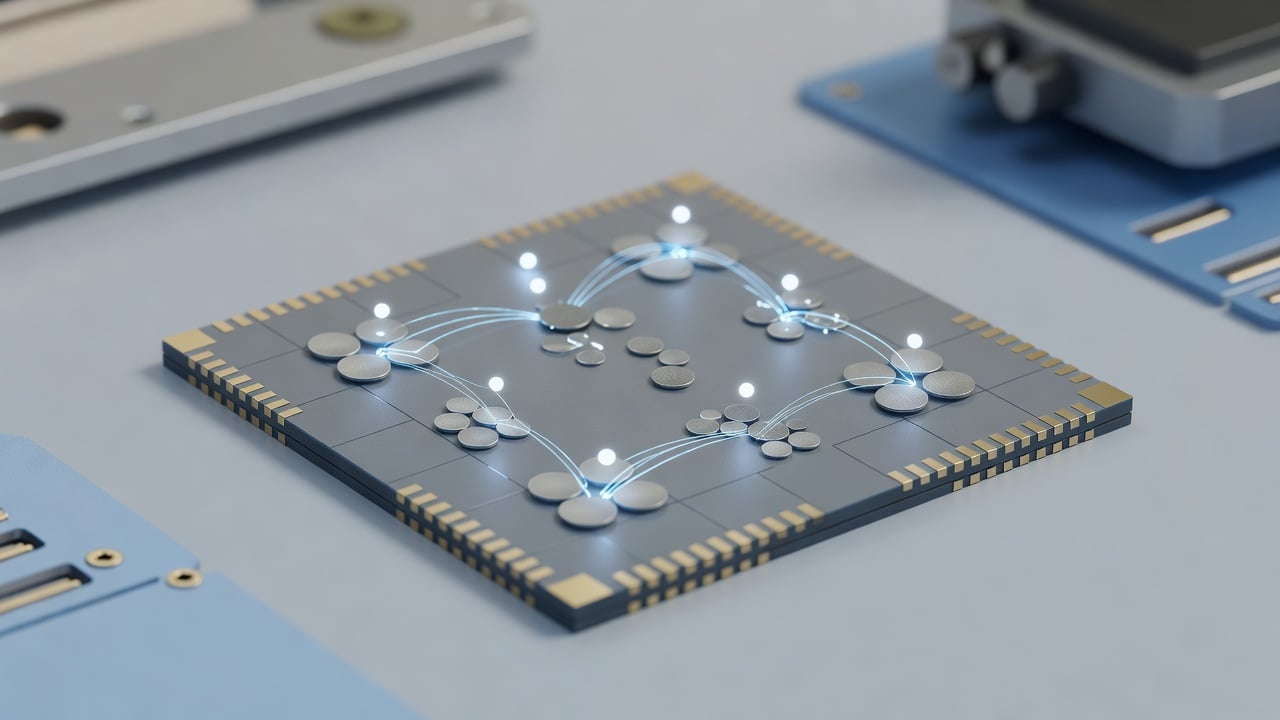
A fingernail-sized quantum processor developed by researchers at the University of Colorado Boulder has demonstrated a novel method for storing quantum information using mechanical vibrations rather than traditional electromagnetic signals. The device, which measures just a few millimeters across, marks a significant step toward building practical quantum computers that can operate at larger scales while maintaining coherence for useful periods of time.
The chip relies on phonons, the individual packets of vibrational energy that travel through solid materials much like sound waves. By trapping these vibrations within tiny mechanical resonators fabricated from piezoelectric materials, the team created stable quantum states that can represent information in a quantum system. This approach differs from most current quantum hardware, which typically encodes information in the states of superconducting circuits, trapped ions, or photons. The Boulder experiment shows that mechanical motion at the quantum level can serve as a viable memory element, potentially offering advantages in size, power consumption, and integration with other technologies.
Scientists have long recognized that quantum mechanics applies to mechanical systems, but controlling those systems with enough precision for computing has proven extraordinarily difficult. Vibrations tend to decay quickly as energy leaks into the surrounding environment, destroying the delicate quantum states needed for calculation. The Colorado team overcame this challenge through careful engineering of the resonator structures and their coupling to superconducting circuits that control the quantum operations.
At the heart of the device sits a thin film of aluminum nitride, a material that converts electrical signals into mechanical motion and vice versa. The researchers patterned this film into a series of drum-like resonators, each measuring roughly 10 micrometers across. When cooled to temperatures near absolute zero, these tiny structures can sustain vibrations in their ground state, where quantum effects dominate. By applying microwave pulses through nearby electrodes, the team can excite specific vibrational modes and transfer quantum information between the mechanical elements and superconducting qubits.
The processor contains multiple such resonators arranged in a two-dimensional array, allowing the researchers to demonstrate basic quantum operations including state preparation, coherent control, and readout. They successfully stored quantum information in the mechanical modes for periods exceeding 100 microseconds, which represents a respectable coherence time for early-stage mechanical quantum systems. While this duration remains shorter than the best superconducting qubits, the compact size of the mechanical memory elements suggests they could function effectively as quantum registers in hybrid architectures.
One notable achievement involved creating entangled states between two separate mechanical resonators. Entanglement, the phenomenon in which the quantum states of distant objects become correlated, forms the foundation for many quantum algorithms and communication protocols. The Boulder group showed that they could generate and verify entanglement between vibrations in two physically distinct drums separated by several hundred micrometers on the chip. This result confirms that mechanical systems can participate in the non-local correlations that make quantum computing powerful.
The small physical footprint of the device stands out as particularly promising. Traditional superconducting quantum processors require substantial space for control wiring, readout resonators, and isolation structures. Because mechanical resonators can be fabricated using standard semiconductor processes and occupy minimal area, they could enable much denser integration of quantum components. A fingernail-sized chip containing thousands of mechanical memory cells might eventually replace systems that currently fill entire server racks with dilution refrigerators and control electronics.
Thermal management remains a critical consideration for any quantum technology. The Colorado device must operate at millikelvin temperatures to suppress thermal noise that would otherwise overwhelm the quantum vibrations. However, the mechanical approach may offer routes to somewhat higher operating temperatures compared with purely superconducting circuits, which are extremely sensitive to stray thermal photons. The researchers observed that their mechanical resonators maintained coherence even when the surrounding environment contained slightly elevated thermal populations, suggesting potential resilience that could simplify future cryogenic engineering requirements.
Integration with existing semiconductor infrastructure represents another advantage of the vibration-based approach. The fabrication techniques used to create these quantum acoustic devices closely resemble those employed in the production of conventional microelectromechanical systems found in smartphones, automotive sensors, and medical devices. This compatibility could accelerate the scaling of quantum hardware by allowing manufacturers to adapt established production lines rather than developing entirely new processes from scratch.
The research team, led by physicists at the University of Colorado Boulder, published their findings in a recent issue of TechRadar, highlighting both the technical achievements and the broader implications for quantum information science. Their work builds upon earlier demonstrations of quantum control over mechanical oscillators but extends those results to a fully functional multi-element processor capable of basic quantum algorithms.
Beyond simple memory storage, the mechanical resonators can also serve as quantum transducers that convert information between different physical platforms. For instance, the same structures that store vibrational quantum states can couple efficiently to optical photons traveling through integrated waveguides. This capability opens pathways toward quantum networks that distribute entanglement over long distances using light while performing local processing with mechanical or superconducting components. Such hybrid systems may prove essential for building quantum repeaters and distributed quantum sensors.
The choice of phonons as information carriers brings interesting physical properties that complement other quantum platforms. Mechanical vibrations travel at the speed of sound in the material, much slower than electromagnetic signals. While this might seem like a disadvantage for computation speed, it actually provides natural protection against certain types of noise and allows for more precise timing control in some operations. The relatively large mass of the mechanical elements also makes them less susceptible to certain electromagnetic interference that plagues superconducting circuits.
Challenges certainly remain before mechanical quantum processors can compete with leading superconducting or trapped-ion systems. The fidelity of operations must improve substantially, and the number of mechanical elements needs to scale from dozens to thousands or millions. Error correction techniques specifically tailored to phonon-based systems will require development, as will efficient control electronics that can address individual resonators without introducing excessive heat or crosstalk.
Despite these hurdles, the demonstration of a working quantum processor based on mechanical vibrations expands the toolkit available to quantum engineers. Rather than viewing different physical implementations as competing technologies, many experts now anticipate that future quantum computers will combine multiple modalities within single devices. Superconducting qubits might handle fast logic operations while mechanical resonators provide dense, long-lived memory. Optical links could connect separate modules, and spin-based systems might offer stable qubits for specific algorithmic subroutines.
This modular approach mirrors the development of classical computing, where specialized hardware accelerators work alongside general-purpose processors to optimize performance for different tasks. Quantum acoustic devices could find initial applications in quantum sensing, where their extreme sensitivity to tiny displacements makes them ideal for detecting gravitational waves, dark matter particles, or minute changes in material properties. The same technology that stores quantum information can also function as an ultraprecise accelerometer or force detector.
The University of Colorado Boulder experiment also advances fundamental understanding of quantum mechanics in macroscopic systems. The mechanical resonators used in the processor contain trillions of atoms yet still exhibit clear quantum behavior when properly isolated and cooled. This bridges the gap between the quantum world of individual particles and the classical world of everyday objects, providing a testbed for studying the quantum-to-classical transition and potential limits of quantum coherence in larger systems.
Manufacturing these devices at scale will require advances in materials science to reduce internal losses within the piezoelectric films and mechanical structures. Impurities and surface defects currently limit coherence times, but techniques borrowed from gravitational wave detector technology and ultra-high-Q optical cavities are already showing promise for improving mechanical quality factors. As these materials challenges are addressed, the coherence times of quantum acoustic systems may eventually surpass those of competing platforms.
The control infrastructure needed to operate such a processor also demands attention. Each mechanical resonator requires precise microwave pulses delivered at specific frequencies corresponding to its vibrational modes. As the number of elements grows, the complexity of the control system increases dramatically. Multiplexing techniques and on-chip signal processing may help manage this complexity, potentially incorporating classical CMOS electronics fabricated on the same substrate as the quantum elements.
Looking forward, the successful demonstration of this fingernail-sized quantum chip suggests that mechanical quantum technologies deserve serious consideration alongside more established approaches. The ability to store quantum information in vibrations offers a compact, fabricable, and potentially robust alternative that could accelerate progress toward useful quantum computation. While substantial engineering work remains, the fundamental physics has now been validated in a functioning multi-qubit processor.
The research community has responded with increased interest in quantum acoustic systems, spawning new collaborations between condensed matter physicists, electrical engineers, and materials scientists. Funding agencies have begun supporting dedicated programs aimed at scaling mechanical quantum platforms, recognizing their potential to complement existing investments in superconducting and ion-trap quantum computers.
As quantum hardware continues to mature, hybrid systems that combine the best characteristics of multiple physical implementations appear increasingly likely to provide the most practical path toward large-scale quantum information processing. The tiny vibrating structures on the University of Colorado Boulder chip may one day form the memory banks of quantum computers that solve problems beyond the reach of conventional machines, all while fitting within the same physical footprint as a guitar pick. This convergence of quantum physics and mechanical engineering opens new possibilities for computation, sensing, and communication that extend far beyond traditional boundaries between scientific disciplines.


 WebProNews is an iEntry Publication