
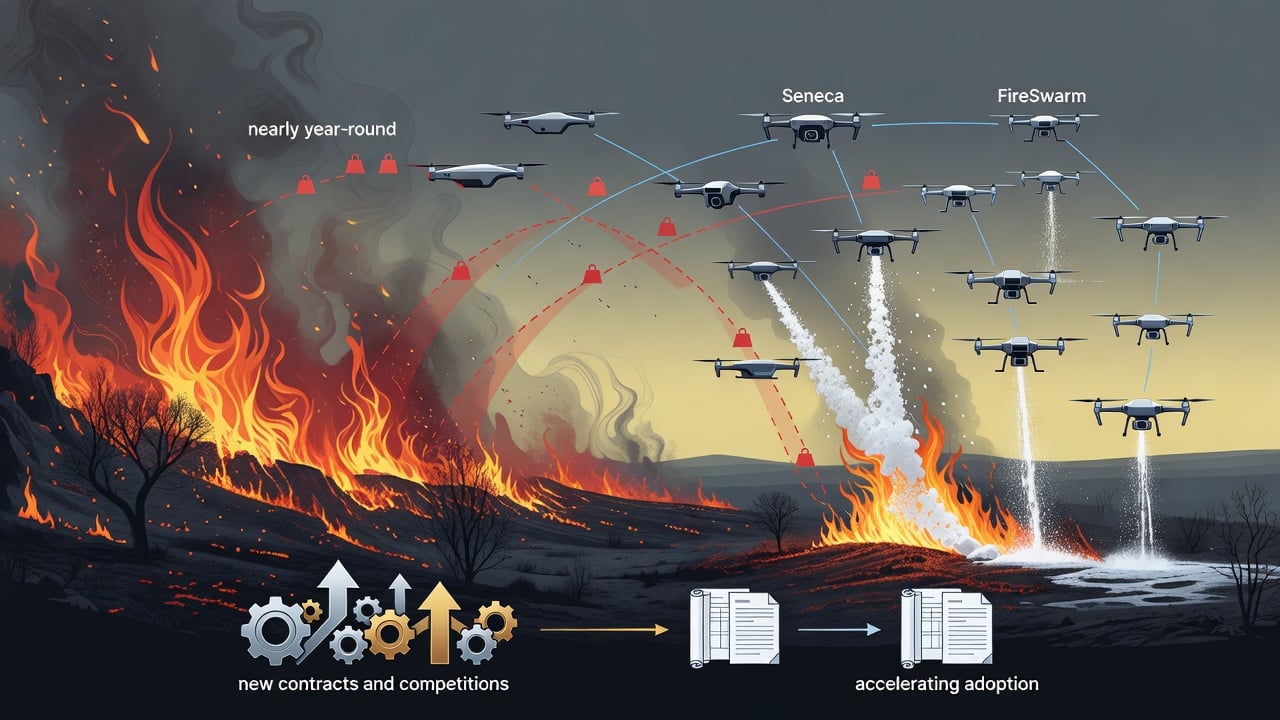
Wildfires now threaten communities across the United States almost without pause. Climate-driven heat and drought have stretched what was once a distinct summer danger into a persistent hazard that demands fresh answers. Traditional aircraft drop thousands of gallons in single passes. Yet they arrive too late for many ignitions. Smaller, smarter machines may change that equation.
Companies and agencies have spent this summer testing drones designed to strike fires while they remain small. The results hint at quicker intervention. But significant limits remain. And the path from prototype to widespread adoption is anything but certain.
On July 15, California firefighters watched five autonomous drones release foam across a controlled burn site. The test, run by the California Department of Forestry and Fire Protection with partners FireWERX and Seneca, delivered between 500 and 1,000 gallons. Ars Technica reported the demonstration as part of broader efforts to contain blazes before they explode in size. Seneca, a San Francisco startup, aims to sell its systems commercially later this year.
Each Argo-1 drone carries up to 100 pounds of water or retardant. Four to six units operate together. After dispatchers feed GPS coordinates, the craft fly out, detect heat signatures with onboard sensors, adjust hover height and spray in sequence. Average speed hovers near 30 miles per hour. Round-trip range stays under 10 miles. That means crews must preposition the drones or haul them by truck. Two people can carry an empty unit. Refilling payload and swapping batteries takes roughly two minutes. The entire package fits in the bed of a standard pickup.
Seneca showed similar equipment to San Bernardino County Fire officials in December 2025. This summer the company secured a five-year, multimillion-dollar agreement with the Aspen Fire Protection District in Colorado. The deal brings five drones and a mobile base to the district’s regular operations. Stuart Landesberg, Seneca’s chief executive, sees the technology delivering initial attack capability within minutes of detection. “We build autonomous suppression copters, which work as a system,” he told FOX Weather in an interview featured in a video segment on high-tech wildfire response.
Yet these machines will not replace the big airtankers. Payloads remain modest. Flight endurance lags behind crewed platforms. The real promise lies in speed against nascent fires that might otherwise grow unchecked. Federal data show the wildfire season now stretches longer in many regions. Some areas face elevated risk nearly every month.
An XPRIZE competition has added urgency and funding. The $11 million Wildfire prize drew dozens of teams. Finals took place in June outside Fairbanks, Alaska. One entrant, Germany’s Dryad Networks, deployed its Silvaguard drone alongside a network of solar-powered sensors mounted on trees. The sensors detect smoke, relay alerts through a wireless mesh and trigger a prepositioned drone housed in a spherical pod. The Silvaguard then confirms the fire with infrared and optical cameras before releasing up to 26 gallons of suppressant. The test area spanned 1,000 square kilometers. Ars Technica detailed how the system aims for full autonomy from detection to suppression.
Other developers push similar boundaries. FireSwarm pairs heavy-lift drones with Bambi Buckets that carry roughly 105 gallons of water. The craft can plan their own water sources, coordinate with fellow units and operate at night or in low visibility. A partnership with Strategic Natural Resource Group, announced earlier this year, moves the platform toward real deployments. Civil Engineering Source covered the collaboration in July 2025, noting the drones’ ability to fill gaps where traditional aircraft cannot fly.
Autonomy marks a decisive shift. Human pilots face fatigue, smoke and terrain risks. Machines do not. Carnegie Mellon University researchers built a drone that navigates dense smoke to generate real-time maps of fire perimeters and hotspots. The system uses advanced sensors to maintain orientation where visual references vanish. Separate projects explore swarms that divide tasks between observation and direct attack. UAV Coach highlighted these advances in an April 2026 guide that also flagged market growth. The U.S. firefighting drone sector reached $302.7 million in 2024 and could hit $638 million by 2033.
Public agencies already fly thousands of missions each year. The U.S. Forest Service logged more than 17,000 drone flights in 2024, up from 734 in 2019. Most gather imagery, identify hot spots or support prescribed burns. The agency credits the systems with lowering risk to ground crews and improving situational awareness. But unauthorized hobbyist drones continue to disrupt operations. Incidents in Utah and Montana forced temporary stand-downs of manned aircraft. Officials now stress education campaigns and temporary flight restrictions. PreventionWeb examined both the progress and the persistent interference in a September 2025 analysis.
Commercial players sense opportunity. Seneca raised $60 million and displayed its suppression drones at the Red Sky Summit in San Francisco this summer. Each unit carries 100 pounds of Class A foam, fires at 100 PSI and uses artificial intelligence to plot routes and target flames. The company plans expansion beyond U.S. borders if early results hold. Windracers, a U.K. firm, entered the XPRIZE contest with 30-foot wingspan drones that have already delivered cargo in Ukraine. The same platforms can monitor wide areas and drop suppressants. Lancashire Fire and Rescue tested them last year and praised response times measured in minutes rather than hours. NBC News tracked the startup race in a January 2025 report that remains relevant as new contracts emerge.
Integration with existing systems adds complexity. CAL FIRE operates the world’s largest aerial fleet, more than 70 crewed aircraft. It also deploys AI-powered cameras and supports the FireSat satellite constellation backed by Google. Drones must mesh with this network rather than operate in isolation. Data links, airspace rules and maintenance schedules all require attention. Refueling infrastructure for electric or hybrid models must appear near high-risk zones. Battery life, payload weight and weather tolerance still constrain performance.
Regulatory questions linger too. The Federal Aviation Administration sets strict limits on beyond-visual-line-of-sight flights. Many autonomous operations need waivers or new approvals. Public safety agencies worry that widespread civilian drone use near fires could create collisions or force costly delays. Several states now broadcast warnings to keep recreational craft at least six miles from active incidents.
Despite the obstacles, momentum builds. Tests in California and Alaska this year produced encouraging data on detection speed and suppression accuracy. Early strikes on small fires could reduce the number of blazes that demand massive response. That shift might ease pressure on budgets already strained by longer seasons and larger incidents. Land managers also see value in post-fire assessments and fuel-load monitoring between events.
Seneca’s deal with Aspen marks one of the first sustained municipal commitments. The district will integrate the drones into daily readiness. If the five-year trial succeeds, similar contracts could follow in other fire-prone communities. FireSwarm’s heavy-lift tests with Strategic Natural Resource Group point toward utility-scale applications on federal and state lands. Dryad’s sensor-plus-drone combination offers a closed-loop solution that could protect remote timber holdings or wildland-urban interfaces.
Challenges remain substantial. Cost per flight hour must come down. Reliability in high winds, heavy smoke and steep terrain needs further proof. Training for ground crews who will service and direct the systems cannot be overlooked. Yet the alternative, waiting for crewed tankers that may take hours to arrive, grows less acceptable each year.
Recent coverage shows the conversation accelerating. A July 20 report from KMPH FOX26 described CAL FIRE’s latest trials with Seneca and FireWERX as a direct effort to reach difficult terrain faster. Wildfire Today highlighted Seneca’s $60 million raise and demonstration at the Red Sky Summit, emphasizing the goal of sub-10-minute response. These accounts reinforce the sense that prototypes are moving toward operational use faster than many expected.
The technology will not extinguish every fire. Nor will it erase the underlying drivers of larger, hotter burns. It does, however, offer firefighters another tool at the moment when every minute counts most. As agencies and companies refine the hardware, software and doctrine around these systems, the balance between detection, rapid attack and traditional suppression may tilt toward prevention. The coming fire seasons will test how far that tilt can go.


 WebProNews is an iEntry Publication