
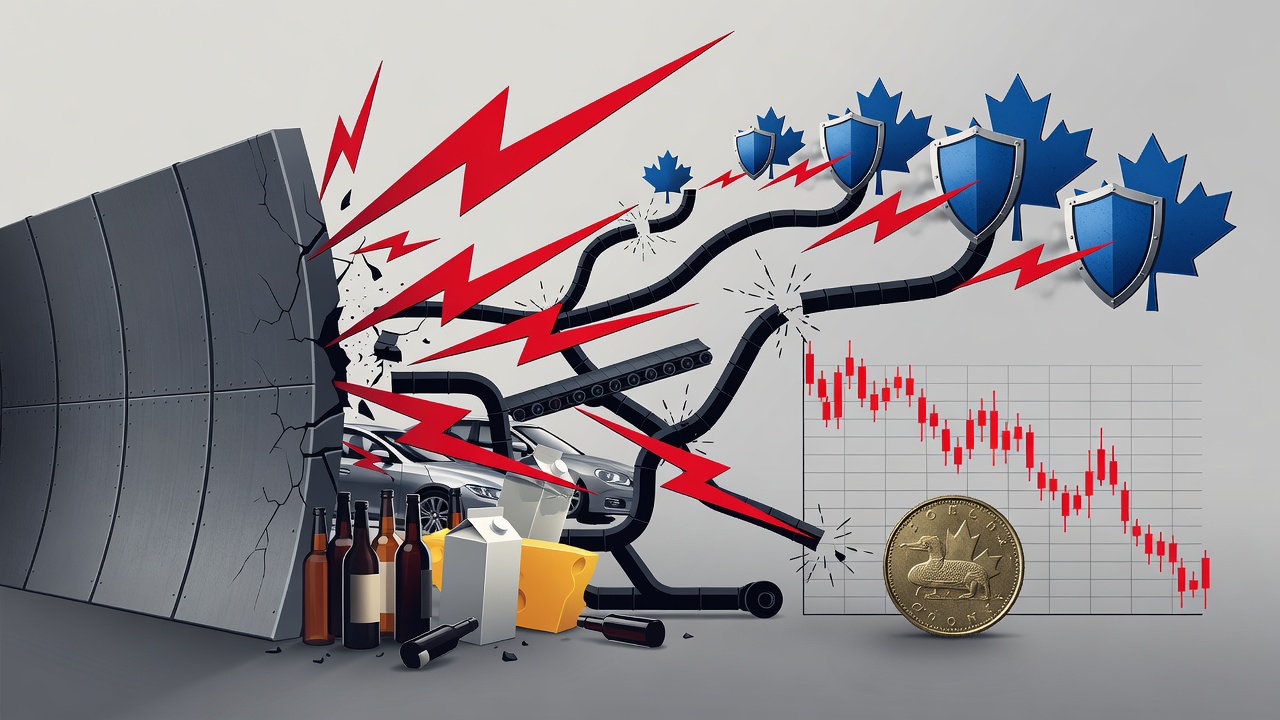
President Donald Trump signed three proclamations Monday that slap an additional 50% tariff on a broad array of goods imported from Canada. The move, executed under an obscure provision of the Tariff Act of 1930, marks a sharp escalation in tensions between the two neighbors. It comes after months of complaints from Washington that Ottawa has treated U.S. products unfairly in sectors ranging from autos to alcohol.
Senior administration officials laid out the case on a conference call. They pointed to Canadian tariffs and quotas on American cars that do not apply to vehicles from other countries. From April 2025 through March 2026, imports of U.S. motor vehicles into Canada dropped 22 percent, or $5.6 billion, compared with the prior year. The numbers tell a story of shrinking market access. But they also raise questions about whether the response matches the scale of the grievance.
Alcohol faced even steeper pressure. Most Canadian provinces and territories halted purchases, distribution or retail of U.S. beverages without similar steps against other nations. The result was an 81 percent plunge in imports, or $582 million, between March 2025 and February 2026. Dairy drew scrutiny too. Canada’s tariff-rate quotas on U.S. cheese have proven more restrictive than those applied to shipments from the European Union. Officials called these actions discriminatory. They invoked Section 338 to justify the new duties.
The tariffs take effect in 30 days. They cover items from wine and hockey sticks to cement, construction materials, clothing, furniture, technology components and car parts. Energy, potash, fish, critical minerals and goods already hit with Section 232 tariffs escape the new levies. Yet the proclamations apply even to products that comply with the U.S.-Mexico-Canada Agreement. That detail signals a willingness to sidestep existing trade rules. And it sets the stage for legal challenges.
Canada wasted little time responding. Prime Minister Mark Carney vowed to intensify trade talks while preparing countermeasures. CNBC reported that the Canadian dollar weakened immediately, trading near 71 U.S. cents. Business leaders north of the border voiced alarm. The president of the Automotive Parts Manufacturers’ Association, Flavio Volpe, warned that the levies threaten integrated supply chains that have operated smoothly for decades. A single production line often spans the border multiple times. Extra costs could ripple through factories in Michigan, Ontario and beyond.
But the administration sees this as overdue correction. Trump has long argued that Canada takes advantage of the U.S. market while shielding its own industries. The decision not to renew the USMCA in its current form, mentioned in the White House statement, underscores that view. Negotiations with Mexico are already underway. Canada now finds itself under similar pressure. The proclamations cite specific harms. They also reflect a broader skepticism toward multilateral trade pacts that Trump has voiced since his first term.
Economists quickly weighed in. Many noted that the two economies remain deeply intertwined. Bilateral trade exceeds $800 billion annually. Tariffs of this magnitude could disrupt everything from lumber to auto assembly. Short-term pain for consumers on both sides appears likely. Higher prices for Canadian wine or American cheese might seem manageable. Scaled across thousands of products, however, the cumulative effect grows. Supply chains built on just-in-time delivery leave little room for error.
Reactions on X captured the divide. Some users cheered the move as necessary pushback against unfair practices. Others called it petty escalation that harms allies. One post from a market commentator highlighted the potential for this dispute to influence broader macro trends if retaliation spirals. Another simply declared support for Canadian neighbors amid the policy clash. Public sentiment, like the policy itself, splits along familiar lines.
Legal experts predict court battles. Section 338 has rarely been used for tariffs of this size. Challenges will likely test the limits of presidential authority in trade matters. Congress delegated broad powers decades ago. Yet courts have begun to scrutinize such delegations more closely in recent years. The outcome remains uncertain. In the meantime, companies must prepare for higher costs or rerouted shipments.
Background matters here. The U.S. and Canada have managed disputes before. Softwood lumber, dairy access and steel quotas have all sparked friction. Previous administrations often resolved them through negotiation or panels under trade agreements. Trump’s approach favors direct pressure. He imposed tariffs on Canadian steel and aluminum early in his first term, only to lift them after concessions. History suggests this round could follow a similar path. Yet the scale feels different. Fifty percent is five times the rate applied in some earlier cases.
Markets reacted swiftly. Canadian stocks in affected sectors fell. The loonie’s slide adds pressure on importers who pay in U.S. dollars. American manufacturers that rely on Canadian parts face their own headaches. A car assembled in the Midwest might incorporate components that cross the border three times before completion. Each crossing now risks extra duty. The math gets complicated fast.
Canadian officials have signaled they will not simply absorb the blow. Retaliatory measures could target U.S. agricultural goods or energy exports. Such steps would further strain relations. They might also invite additional American action. The cycle risks feeding on itself. And that worries industries caught in the middle.
Trade data underscores the stakes. Canada sends roughly three-quarters of its exports to the United States. The U.S. market is simply too large to replace quickly. For Washington, the goal appears to be forcing concessions rather than permanent barriers. Officials emphasized that talks remain possible. U.S. Trade Representative Jamieson Greer heads to Mexico this week to discuss USMCA revisions. Canada will likely seek inclusion or parallel discussions.
Still, the proclamations carry a harder edge than routine negotiations. By applying duties regardless of USMCA compliance, the administration effectively puts the agreement on notice. Compliance alone no longer shields goods from penalty. That shift could unsettle investors who counted on predictable rules. It also raises questions about the future of North American economic integration.
Business groups on both sides of the border urged calm. They called for swift dialogue to prevent lasting damage. The integrated auto sector offers a prime example. Parts cross the border more than seven times on average before a vehicle rolls off the line. Tariffs at each step compound. Consumers ultimately pay. So do workers whose jobs depend on seamless flows.
Political calculations play a role too. Trump faces pressure from domestic industries that feel squeezed by Canadian policies. Dairy farmers in Wisconsin and New York have lobbied for stronger enforcement. Auto unions worry about job losses tied to import surges. The tariffs address those concerns directly. Whether they solve the underlying issues is another matter.
Canada, for its part, maintains that its measures comply with trade obligations. Provincial control over alcohol sales dates back decades. Quotas on dairy reflect long-standing supply management systems. Ottawa argues these are not targeted at the U.S. but part of broader policy. The White House disagrees. It sees selective enforcement that disadvantages American producers.
The coming weeks will test both sides. Companies will scramble to adjust contracts, inventories and sourcing. Governments will exchange formal notices and perhaps offers to negotiate. Courts may see early filings challenging the proclamations’ legality. And markets will watch every development for signs of de-escalation or further hardening.
One thing seems clear. The era of frictionless trade between the U.S. and Canada has ended, at least for now. The question is how long the disruption lasts and at what cost. Both economies have thrived on cooperation. Undermining that foundation carries risks neither can fully control. Yet each appears willing to test the other’s resolve. The tariffs are only the opening salvo.


 WebProNews is an iEntry Publication