
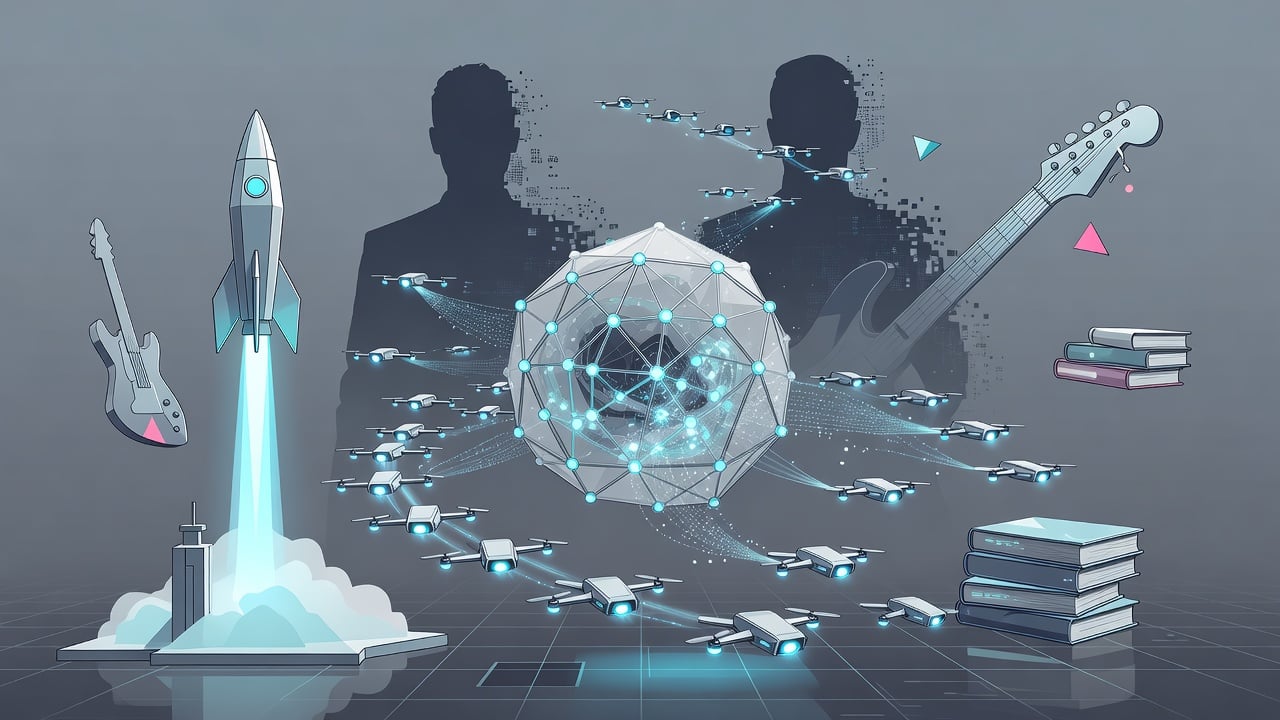
Yang Zhilin once fronted a rock band named after a data structure. Now the 34-year-old runs Moonshot AI, the Chinese startup whose Kimi K3 model just rattled boardrooms from San Francisco to Beijing. Short. Direct. And impossible to ignore.
Born in 1992 in Shantou, Guangdong province, Yang grew up in a region known for its entrepreneurial drive. He studied at Tsinghua University. Then he headed to Carnegie Mellon University for a Ph.D. under Ruslan Salakhutdinov and William Cohen. His professors saw something special early. “He is absolutely brilliant,” Salakhutdinov posted on X after the K3 launch, according to The National.
During his time at CMU, Yang interned at Google Brain and Meta. He co-authored papers on language models. But he didn’t stay in the U.S. After completing his studies, he returned to China. Personal choice, he has said. Not politics. Not pressure. Just the pull of building at scale back home.
Before Moonshot, Yang worked on Huawei’s PanGu project and the Beijing Academy of Artificial Intelligence’s Wu Dao model. He also co-founded Recurrent AI. Those experiences shaped his view. Scale first. Algorithms second. “If you can solve it with scale, don’t solve it with a new algorithm,” he once told a colleague, as reported in the July 18 Business Insider profile.
Moonshot AI started in early 2023. Yang brought along three fellow Tsinghua alumni: Zhou Xinyu, with whom he once jammed in the rock band Splay; Wu Yuxin, focused on computer vision; and Zhang Yutao, the chief technology officer handling systems. The name Moonshot itself nods to Pink Floyd’s The Dark Side of the Moon. Yang has quoted the album’s spirit in interviews. “The far side of the moon has always captured humanity’s curiosity. It is not truly dark. It simply always faces away from us, leaving endless room for imagination,” he explained in one talk highlighted across recent X discussions.
The company’s first major model, Kimi, gained attention for its long context window. Kimi K2 pushed into the trillion-parameter range. But K3 marks a sharper leap. Released this month, the 2.8-trillion-parameter open-weight model rivals closed systems from OpenAI and Anthropic while running at lower cost. Early benchmarks show it competitive on reasoning, coding and agent tasks. One claim stands out. Kimi K3 reportedly became the first open model to lead on certain web engineering evaluations, according to Vercel CEO Guillermo Rauch’s comments referenced in industry chatter.
Yang doesn’t chase one smarter agent. He builds swarms. In a recent 39-minute talk that spread rapidly on X, he laid out the approach. “Everyone’s trying to build one smarter agent. Many agents hit a wall fast, so instead of making it smarter we just made more — one boss, a thousand workers.” The strategy relies on strong base models, reinforcement learning on sub-agents, and long context. He credits the base model quality as the foundation. “Claude didn’t win on reasoning — they bet everything on agents. But the layer everyone skips — a great agent needs a great base model. That’s all we do at Kimi 3.”
Investors have taken notice. Alibaba and Tencent back the company. Valuation estimates have climbed into the billions though exact current figures remain closely held. The model release has also stirred debate on hardware demand. One X post from Saturday noted potential impact on GPU and HBM memory needs in China as adoption grows.
Yang often cites David Deutsch’s The Beginning of Infinity. “Problems are inevitable. Problems are soluble. We are at the beginning of an infinity of progress, and we shall always be at the beginning.” That mindset drives the company’s focus. He sees the ultimate AGI company dwarfing today’s tech giants. “The ultimate AGI company will dwarf today’s giants — double, triple the scale. Not necessarily OpenAI, but such a company will exist,” he said.
His former professor Salakhutdinov called the K3 release a victory for the open-source community. Ethan Mollick, the Wharton professor and AI observer, has pointed to Moonshot’s progress as evidence that frontier capabilities are spreading faster than many expected. And Vinod Khosla weighed in on the broader talent picture. “Even bigger issue is the brilliant talent we are scaring away from other countries with our immigration policies,” the venture capitalist posted, tying it to cases like Yang’s decision to build in China.
But the story isn’t only about one founder. It reflects deeper patterns in Chinese AI development. Guangdong province has produced other standouts, including DeepSeek’s Liang Wenfeng. Both men hail from the region that fueled China’s private-sector boom after reform and opening. Shenzhen and Guangzhou built IT, semiconductor and electronics clusters. The culture favors rapid iteration. Make first. Sell first. That mindset shows in Moonshot’s output.
Recent coverage highlights how Moonshot achieves competitive performance with notable efficiency. A detailed analysis of Yang’s workshop talk appeared in community threads on Saturday, emphasizing engineering choices that avoid over-reliance on single-agent complexity. One widely shared post described the session as “the clearest explanation yet of the engineering behind China’s cost-efficient yet highly competitive AI models.”
Yang’s path from rock singer to AI chief executive surprises some. But the through line is curiosity. The band name Splay came from the splay tree algorithm. The company name from a Pink Floyd record. The model name Kimi from his own nickname. These choices reveal a personality that blends technical depth with broader cultural references.
Today Moonshot pushes on multiple fronts. Agent systems. Long-context applications. Open-weight releases that invite community improvement. The K3 launch has already prompted comparisons not just to American labs but to the pace of progress across borders. And the conversation continues. On Saturday alone, X filled with threads dissecting the model’s architecture, its implications for hardware markets, and Yang’s philosophy.
He shows no sign of slowing. The ambition remains fixed on that far side of the moon. Exploration. Imagination. Solutions. Problems that yield to persistence and compute. In a field crowded with hype, Yang’s approach stays pragmatic. Scale what works. Fix what doesn’t. Keep building.
The AI race has many contenders. Moonshot AI and its founder just reminded everyone that talent pipelines from Tsinghua to CMU and back can produce serious challengers. The models keep getting better. The questions keep multiplying. And Yang Zhilin keeps answering with code, not slogans.


 WebProNews is an iEntry Publication