
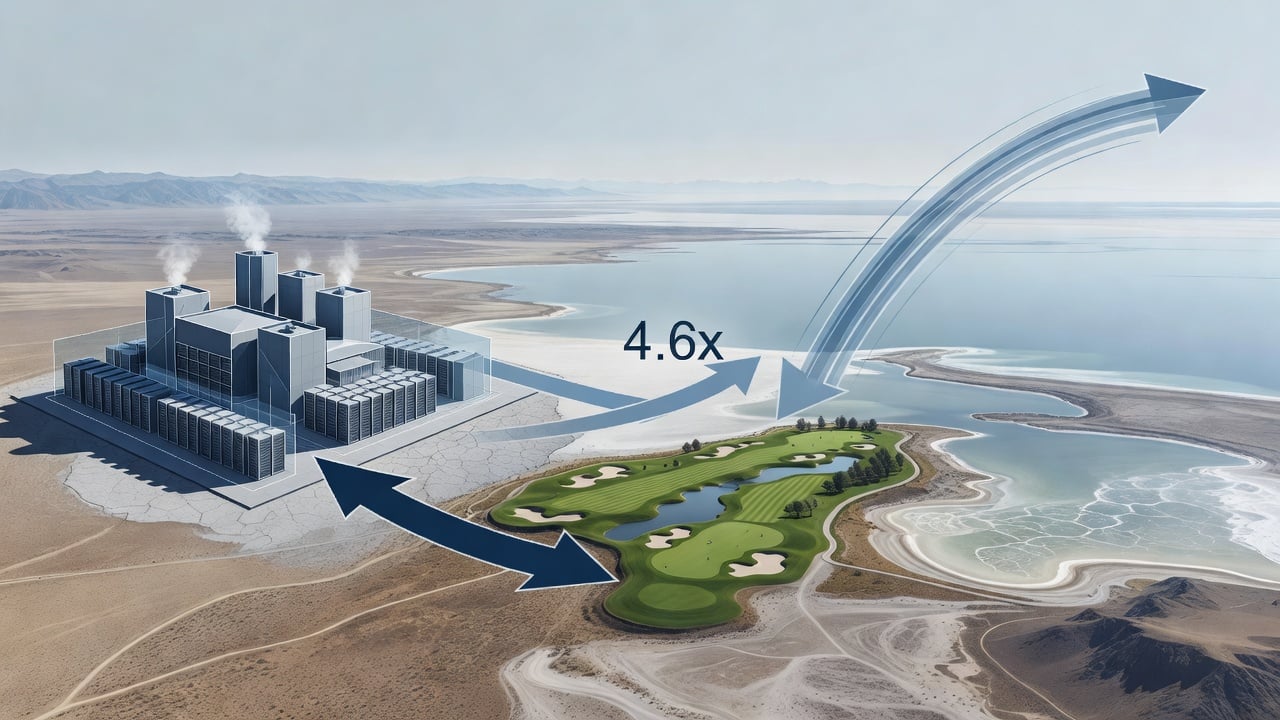
Kevin O’Leary sees a simple story. The Business Insider captured his words from a recent Glenn Beck radio appearance. New data centers, he said, use no more water than a golf course. “Any new data center now is like a golf course.” The Shark Tank investor repeated the line while defending his scaled-back Stratos project in Utah. He insists modern facilities have left behind the thirsty designs of 15 years ago.
Numbers back him up. For now. US golf courses consume 2.08 billion gallons of water daily for irrigation. Data centers draw roughly 449 million gallons a day for cooling. That creates a 4.6 times gap. The Golf Course Superintendents Association of America supplied the golf figure. The Florida Water & Pollution Control Operators Association provided the data center estimate. The Next Web laid out the arithmetic on July 18, 2026.
Yet the comparison lands flat for critics. Golf course demand stays flat or declines. Operators adopt drought-resistant grasses and recycled water. Data center thirst climbs fast. Artificial intelligence training and inference workloads drive exponential growth. Projections show data center water use passing golf totals around 2026 or 2027. By 2028 the figure could hit 590 billion gallons against golf’s steady 425 billion. One curve rises. The other does not.
O’Leary’s original Stratos vision called for 40,000 acres near the shrinking Great Salt Lake. Backlash forced a 75 percent cut to 10,000 acres. Utah Governor Spencer Cox signed Executive Order 2026-03 in May. The order sets a higher bar for data center development. It demands protection for water resources and the Great Salt Lake basin. A second water rights application for the project was withdrawn in May. O’Leary claims the facility will run on a closed-loop chilling system with no continuous draw. Experts at Virginia Tech say insufficient data exists to verify that assertion. ABC4 reported the executive order details in late May 2026.
Local resistance runs deeper than spreadsheets. Residents worry about single facilities claiming scarce aquifer resources in stressed basins. A Nashville zoo fought a proposed data center sited 50 yards from animal enclosures. Communities organize against projects that bundle massive water, power and land demands. Nobody plans 9 gigawatts of fresh golf courses beside the Great Salt Lake. The relevant tension sits between national averages and local reality.
O’Leary holds an environmental studies degree. He understands the distinction. Still he leans on the golf analogy. On Beck’s show he argued his first 1.4-gigawatt phase would match a golf course in consumption. He also pushes data centers that generate their own power and return excess to the grid. “If I’m going to bring a data center anywhere, I’ve got to bring my own power,” he told listeners. The stance reflects his broader push through O’Leary Ventures for projects in Utah and Canada.
But O’Leary’s rhetoric has sparked legal trouble. He asserted without evidence that Chinese-funded professional protesters fueled opposition to Stratos. He and Fox News now face a defamation suit over those statements. His attorney called the case a cash grab. O’Leary later clarified he lacked proof of foreign backing. The episode illustrates how quickly data center debates turn personal.
Erin Brockovich offers a sharper counterpoint. In recent interviews and her reporting site she highlights individual facilities that consume millions of gallons daily. One hyperscale campus can draw up to 5 million gallons a day. A Georgia data center allegedly drained nearly 30 million gallons without notifying the county or paying fees. Wells ran dry for nearby residents. Her map at BrockovichDataCenter.com collected thousands of community reports on water, noise and transparency failures. A July 2026 YouTube clip of her remarks circulated widely on X, amplifying concerns just as O’Leary defended his approach.
OpenAI CEO Sam Altman dismissed similar worries. He called water consumption claims “totally fake” for models like ChatGPT. The company moved away from evaporative cooling. Yet industry-wide trends tell another story. A Business Insider investigation found certain data centers use more water per day than 49,000 average Americans. Cooling demands rise with compute density. Even closed-loop systems lose water to evaporation over time. Projections that once seemed alarmist now look conservative.
Power compounds the pressure. Data centers already strain electrical grids. Many new builds require dedicated generation. That infrastructure often relies on water-intensive sources. Natural gas plants and some renewables draw cooling water too. The full resource footprint stretches beyond direct facility use. And AI growth shows no sign of slowing. Hyperscalers race to train larger models. Inference loads multiply with adoption. Each leap tightens the resource knot.
Operators experiment with fixes. Some pursue air cooling or advanced fluids that cut water needs. Others locate in cooler climates or near abundant supplies. Yet these choices shift burdens elsewhere. Rural areas with cheap land and power suddenly face industrial-scale neighbors. Noise from fans and generators disrupts sleep and wildlife. Heat islands form. Real estate values swing. Transparency remains the top complaint in Brockovich’s crowdsourced data. Residents want clear numbers before shovels break ground, not press releases afterward.
O’Leary’s golf course line offers political cover. It frames data centers as just another familiar land use. Golf courses dot American suburbs without mass protest. Why single out silicon? The analogy works until scale enters the picture. A single golf course draws far less than a gigawatt-scale AI campus. Multiply those campuses across states chasing economic development incentives and the aggregate picture changes fast. Texas, already facing drought and population growth, eyes hundreds more facilities. A state analysis projects $174 billion needed over 50 years to avoid water crisis. Data centers add one more claimant on strained supplies.
So the debate sharpens. Defenders stress economic upside. Jobs, tax revenue, AI leadership. Critics demand accountability for externalities. They ask whether national security or technological edge justifies local sacrifice. Regulators respond with reporting rules. Utah’s HB 76 requires water transparency from large centers. Other states weigh similar measures. Yet enforcement lags. Some facilities still operate with limited disclosure.
Technology may ease the bind. Advances in chip efficiency reduce waste heat. Less heat means less cooling. Magnetic or spintronic designs could cut power draw and therefore water needs. These gains arrive unevenly. Near-term builds rely on today’s hardware. Projections baked into 2028 forecasts already incorporate expected efficiency improvements. Even optimistic scenarios show water demand overtaking golf within two years.
O’Leary remains undeterred. His projects promise closed systems and self-generated power. He frames opposition as misinformed or orchestrated. Communities counter with lived experience. Dry wells. Brown tap water. Surging utility bills. The golf course comparison, once deployed, invites scrutiny. It forces examination of the underlying curves. Flat versus exponential. National statistic versus aquifer-specific impact. Past performance versus future trajectory.
Neither side holds a monopoly on facts. Data centers do use less water today than golf. AI facilities can adopt designs that conserve resources. Yet unchecked growth risks real ecological and social costs. The conversation has moved past deflection. It now centers on measurement, mitigation and meaningful local voice. How society balances those demands will shape where, and whether, the next wave of AI infrastructure lands.


 WebProNews is an iEntry Publication