
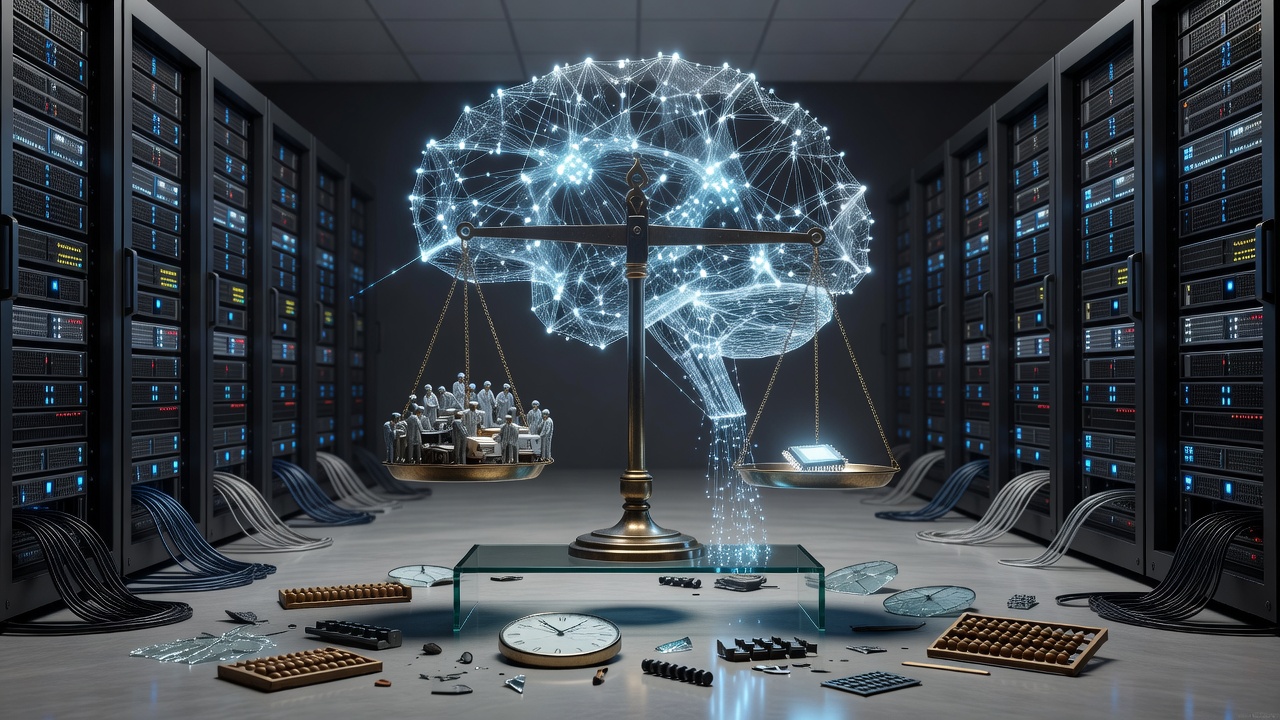
Economists have issued a stark warning. Nearly 200 of them, joined by tech executives and researchers, say artificial intelligence could upend the workforce faster than any technology before it. The message comes in an open letter released this week. It urges immediate action from policymakers.
The statement, titled “We Must Act Now,” paints a picture of economic change on a scale bigger than the Industrial Revolution. But this time the shift happens in years, not decades. “AI may become radically more powerful over the next 10 years,” the signers wrote. That acceleration “could drive an unprecedented transformation of our economy.”
Risks stand out. Large-scale job displacement tops the list. Opportunities exist too. Major gains in living standards could follow. Yet the letter stresses neither outcome arrives automatically. Societies must prepare. Futurism first reported the letter, noting its signatories include 16 Nobel laureates.
Among them sit Daron Acemoglu and Simon Johnson of MIT. Michael Spence from New York University added his name. Tech figures appear as well. Eric Schmidt, once Google’s chief executive, signed on. So did Jack Clark, co-founder of Anthropic, and Sarah Friar, chief financial officer at OpenAI. The breadth surprises. Optimists and skeptics stand together.
Erik Brynjolfsson helped organize the effort. A Stanford economist, he told The New York Times that the economics profession has shifted. “There’s been a notable change in the profession,” Brynjolfsson said. He worries about readiness. A tsunami approaches, in his view.
Acemoglu struck a sharper tone. He pointed to robots in manufacturing. Their impact proved disruptive. AI could mirror that effect but in far less time. “If AI does something equivalent in a more compressed time period, that would be really disruptive, really costly for people’s livelihood,” he added to the Times.
Recent predictions from industry leaders amplify the concern. Dario Amodei, chief executive of Anthropic, forecasted that AI might wipe out half of all entry-level white-collar jobs within five years. Unemployment in the United States could climb to 10 or 20 percent as a result. AIMultiple compiled these expert forecasts, drawing from Amodei’s 2025 remarks and similar comments by others.
Geoffrey Hinton, often called the godfather of AI, offered his own take. The Nobel-winning computer scientist said AI would boost unemployment while channeling profits upward. He blamed capitalism, not the technology itself. Kai-Fu Lee echoed parts of Amodei’s warning, suggesting displacement of 50 percent of jobs by 2027.
Yet data on the ground tells a mixed story so far. No mass unemployment has appeared in official labor statistics. Companies report productivity gains from AI. Some even add headcount. A study from MIT Sloan tracked AI adoption between 2010 and 2023. It found that when AI handles most tasks in a job, employment share in that role drops about 14 percent at adopting firms.
But firms using AI grew overall. They produced more without necessarily cutting staff. Lawrence Schmidt, an economist at MIT Sloan, co-authored the research. “Firms that adopt AI don’t necessarily need to shed workers; they can grow and make more stuff and use workers more efficiently than other firms,” he explained in coverage by MIT Sloan.
Goldman Sachs Research struck a cautious note last year. Its analysts expect only a modest, temporary bump in unemployment during the AI transition. A half-percentage-point rise at most. “While these trends could broaden as adoption increases, we remain skeptical that AI will lead to large employment reductions over the next decade,” wrote Joseph Briggs and Sarah Dong in the firm’s report.
The Economist weighed in earlier this year. Its leaders column asked whether an AI jobs apocalypse loomed. Evidence in labor data remains absent for now. Still, the publication advised against complacency given the speed of progress. The Economist argued preparation matters.
Wall Street Journal coverage captured the debate’s range. Three labor economists offered views. David Autor of MIT took the optimistic side. He sees AI reshaping work toward more expertise and fewer people in some roles. Anton Korinek of the University of Virginia warned of steeper downsides. The Journal piece highlighted how forecasts diverge.
Real-world examples mount. Tech giants have announced layoffs and tied them explicitly to AI efficiencies. Early-career job seekers face a brutal market. Older workers appear vulnerable too. One analysis suggested AI pushes some toward retirement sooner.
Discussions on X, formerly Twitter, reflect public anxiety. Users point to recent cuts at major firms. Some blame AI as cover for offshoring. Others note fresh water demands and energy use from data centers compound the issue. One post referenced the same letter, calling out the 16 Nobel winners.
The letter itself offers no detailed policy prescriptions. It calls for study. It demands new incentives, guardrails and institutions. The goal is steering AI to complement human labor rather than replace it outright.
History offers lessons. Past automation waves displaced workers in specific sectors. Retraining helped some. Many struggled. This time the breadth looks wider. White-collar tasks once thought safe now face automation. Coding, analysis, even creative work show early signs of disruption.
Brynjolfsson and others argue the pace creates the danger. Societies adapted to earlier changes over generations. AI compresses that timeline. Workers, companies and governments may lack time to adjust.
But. Not every expert agrees on catastrophe. Some see AI as a tool that augments skills. It could free humans for higher-value activities. Productivity surges might generate new industries and roles not yet imagined.
So the debate continues. The letter’s value lies in its consensus call for urgency. Across ideological and professional lines, these voices agree on one point. Complacency carries risk. Policymakers cannot wait for perfect data before they begin planning.
Education systems may need overhaul. Safety nets could expand. Tax policies might shift to reflect new realities of capital versus labor. Experiments with universal basic income or wage subsidies already appear in academic papers.
Industry insiders watch closely. Venture capitalists like Vinod Khosla signed the letter. They fund AI startups yet acknowledge broader consequences. Their participation signals that even boosters recognize the stakes.
Recent coverage reinforces the momentum. Business Insider examined the letter’s signatories and Amodei’s specific predictions. Mashable and others picked up the story quickly.
One thing seems clear. The conversation has moved beyond whether AI will affect jobs. The question now centers on how much, how fast and what society will do about it. Economists have delivered their warning. The ball sits in the court of leaders who must respond.


 WebProNews is an iEntry Publication