
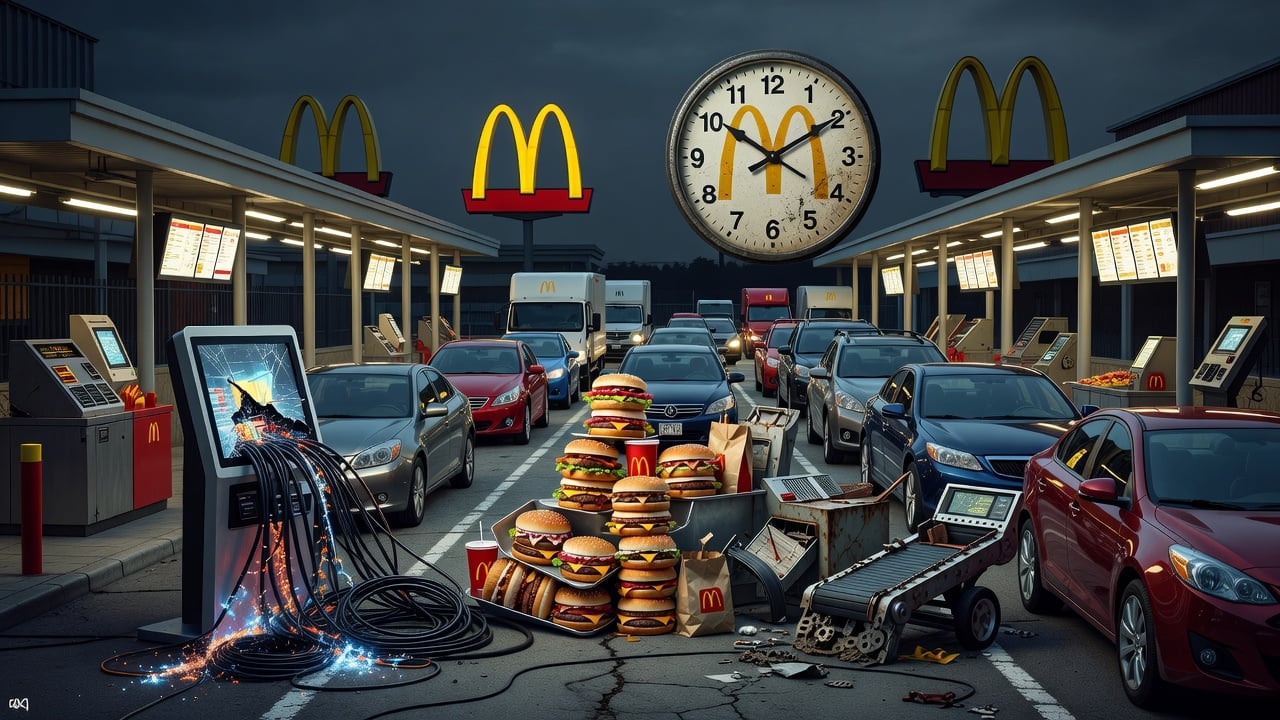
McDonald’s has built a global reputation on speed, consistency, and value, yet one persistent problem continues to undermine customer trust and operational efficiency. Long wait times at the drive-thru remain a significant frustration for consumers across the United States, according to a recent analysis from Yahoo Finance. Despite years of promises, technological experiments, and multimillion-dollar investments, the fast-food giant has struggled to resolve this core issue that affects both its brand image and bottom line.
The problem extends far beyond occasional busy periods. Data collected from various market research firms shows that average drive-thru wait times at McDonald’s locations have hovered between four and six minutes in recent years, often exceeding those of chief competitors like Chick-fil-A, Taco Bell, and Wendy’s. During peak hours, customers frequently report waits stretching beyond eight minutes, creating a disconnect between the company’s “fast food” identity and the actual experience delivered. This gap has grown more noticeable as consumer expectations for quick service have risen, particularly after the pandemic accelerated demand for contactless ordering options.
Several factors contribute to these extended delays. Menu complexity stands out as a primary culprit. Over the past decade, McDonald’s has expanded its offerings considerably, adding breakfast items available all day, premium burgers, chicken sandwiches, specialty beverages, and limited-time promotions. While this variety attracts different customer segments, it creates bottlenecks inside the kitchen. Staff must juggle multiple preparation stations, customizations, and quality checks, which slows down the entire fulfillment process. What once was a streamlined operation focused on a handful of core items now requires more coordination and time.
Labor challenges compound these menu-related issues. The restaurant industry as a whole has faced difficulties recruiting and retaining workers since 2020. McDonald’s specifically has reported higher turnover rates at many franchises, leading to less experienced teams working during busy shifts. New employees require time to master the point-of-sale systems, food preparation protocols, and the increasingly sophisticated drive-thru order-taking technology. When staffing levels fall short of demand, even the most efficient layouts and equipment cannot prevent backups.
Technology initiatives intended to solve these problems have produced mixed results. The company invested heavily in digital menu boards that can change offerings based on time of day, weather conditions, or nearby events. Artificial intelligence-powered order prediction systems were introduced to anticipate demand and pre-stage certain items. Mobile ordering through the McDonald’s app was rolled out nationwide with promises of quicker pickup times. Yet these advances have sometimes created new complications. App orders frequently jump ahead of vehicles already waiting in line, causing confusion and resentment among traditional drive-thru customers. The sophisticated kitchen display systems that route orders to different stations can overwhelm team members during rushes, leading to errors and further delays.
Physical restaurant design also plays a substantial role in drive-thru performance. Many McDonald’s locations were constructed decades ago when vehicles were smaller and order volumes lower. Today’s larger SUVs and trucks have difficulty maneuvering through tight lanes, particularly at older urban sites. Double lane configurations help at some restaurants but create their own challenges when one lane moves faster than the other or when customers accidentally enter the wrong queue. The placement of order confirmation boards and pickup windows varies widely between locations, sometimes forcing drivers to stop multiple times or blocking traffic flow.
Customer behavior has evolved in ways that add pressure to the system. More people now customize their orders extensively, requesting substitutions, allergen accommodations, or specific preparation instructions. While McDonald’s accommodates these requests as part of its service commitment, each modification requires additional time and communication between order takers, kitchen staff, and window workers. The rise of third-party delivery services has also increased the complexity of operations, as kitchen teams must prepare both drive-thru orders and separate packaging for delivery drivers who often arrive at unpredictable intervals.
Financial implications of these delays extend beyond lost immediate sales. Research from restaurant consulting groups indicates that customers who experience waits longer than five minutes are significantly less likely to return to the same location within the next month. Negative experiences shared on social media platforms can damage a restaurant’s local reputation quickly. For a company like McDonald’s that relies on high transaction volume, even small decreases in repeat business can translate into substantial revenue losses across thousands of locations.
Franchise owners bear much of the burden for addressing these operational shortcomings. While McDonald’s corporate provides technology, training programs, and marketing support, individual operators make day-to-day decisions about staffing levels, equipment maintenance, and local promotions. Some franchisees have achieved notably better drive-thru times through disciplined management practices, suggesting that solutions exist within the current system. However, implementing best practices consistently across more than 13,000 domestic locations presents a formidable coordination challenge.
Recent attempts to tackle the issue have included several approaches. The company has tested consolidated drive-thru concepts at select sites, where orders are taken at one window and food is delivered at another further down the building. This separation allows for better flow but requires additional real estate that many locations lack. Some restaurants have introduced dedicated mobile order lanes, though this strategy risks alienating customers who prefer traditional methods. Menu simplification efforts during peak hours have shown promise at certain test locations, temporarily removing slower-moving items to speed up service.
Training programs have received renewed attention as well. McDonald’s has enhanced its onboarding processes with more hands-on simulation exercises and digital learning modules. The company continues to refine its “Speedee Service System” principles that formed the foundation of its original success. Yet translating these concepts into measurable improvements across a vast network of independently operated franchises requires sustained focus and accountability measures.
Competitive pressure adds urgency to the situation. Chains like Chick-fil-A have built their business model around remarkably consistent service times, often delivering orders in under three minutes even during busy periods. Their more focused menu, rigorous staff training, and customer-first culture have set a high bar that influences industry standards. Other competitors have introduced innovations such as automated order kiosks inside restaurants or AI voice ordering systems at the drive-thru speaker. While McDonald’s has experimented with similar technologies, execution gaps have prevented them from matching the reliability demonstrated by some rivals.
Consumer sentiment data reveals growing impatience with the status quo. Surveys conducted by market research organizations show that drive-thru experience ranks among the top three factors influencing where people choose to eat fast food. Younger customers in particular expect technology to translate into faster service rather than additional complexity. When apps crash, order accuracy suffers, or wait times exceed advertised estimates, brand loyalty suffers lasting damage.
Looking ahead, McDonald’s faces important decisions about how aggressively to pursue operational changes. Major renovations of existing restaurants to improve traffic flow require significant capital investment from both the corporation and franchisees. Further menu pruning risks reducing the variety that has helped drive recent sales growth. Adopting more automation in the kitchen could improve consistency but raises questions about job displacement and substantial upfront costs.
Some industry observers suggest that the solution may lie in accepting certain trade-offs. Perhaps not every location needs to offer the full menu during peak hours. Maybe separate preparation areas for drive-thru and front counter orders would reduce crossover confusion. Others advocate for more radical approaches, such as building new restaurants specifically optimized for drive-thru service with minimal indoor seating, similar to concepts being tested by other chains.
The persistence of this problem despite considerable resources devoted to solving it highlights the complexity of modern quick-service restaurant operations. What appears on the surface as a simple matter of moving cars through a line faster involves interconnected elements of menu engineering, facility design, technology integration, workforce development, and customer communication. McDonald’s has demonstrated its ability to adapt to massive shifts in consumer behavior over its long history, from the introduction of breakfast service to the adoption of digital ordering. Addressing drive-thru efficiency represents another test of the company’s capacity for systematic improvement.
Progress will likely come through incremental advances rather than a single breakthrough solution. Better demand forecasting algorithms can help managers schedule appropriate staff levels. Refined kitchen workflows might reduce steps between preparation stations. More intuitive technology interfaces could decrease errors and training time. Stronger partnerships with franchise operators might ensure that successful practices spread more quickly throughout the system.
Customers continue to show loyalty to McDonald’s for its familiar tastes, convenient locations, and relatively affordable prices. Yet that loyalty has limits when basic expectations for prompt service go unmet repeatedly. As the company prepares for its next phase of growth, resolving the drive-thru bottleneck stands as a priority that touches nearly every aspect of its business model. The chain that built an empire on the promise of fast food must find ways to restore that fundamental promise or risk losing ground to competitors who execute more consistently on this core attribute.
Success will require honest assessment of current capabilities, willingness to make difficult operational choices, and sustained commitment to measuring and improving results. While the challenge is substantial, so too is the potential reward for getting it right. Millions of customers pass through McDonald’s drive-thru lanes each day, and their experiences shape perceptions of the brand far more powerfully than any advertising campaign. By focusing on this fundamental aspect of its service, McDonald’s has an opportunity to strengthen customer relationships and reinforce the qualities that originally distinguished it in the marketplace. The coming years will reveal how effectively the company translates its considerable resources into meaningful improvements in one of its most visible operational areas.


 WebProNews is an iEntry Publication