
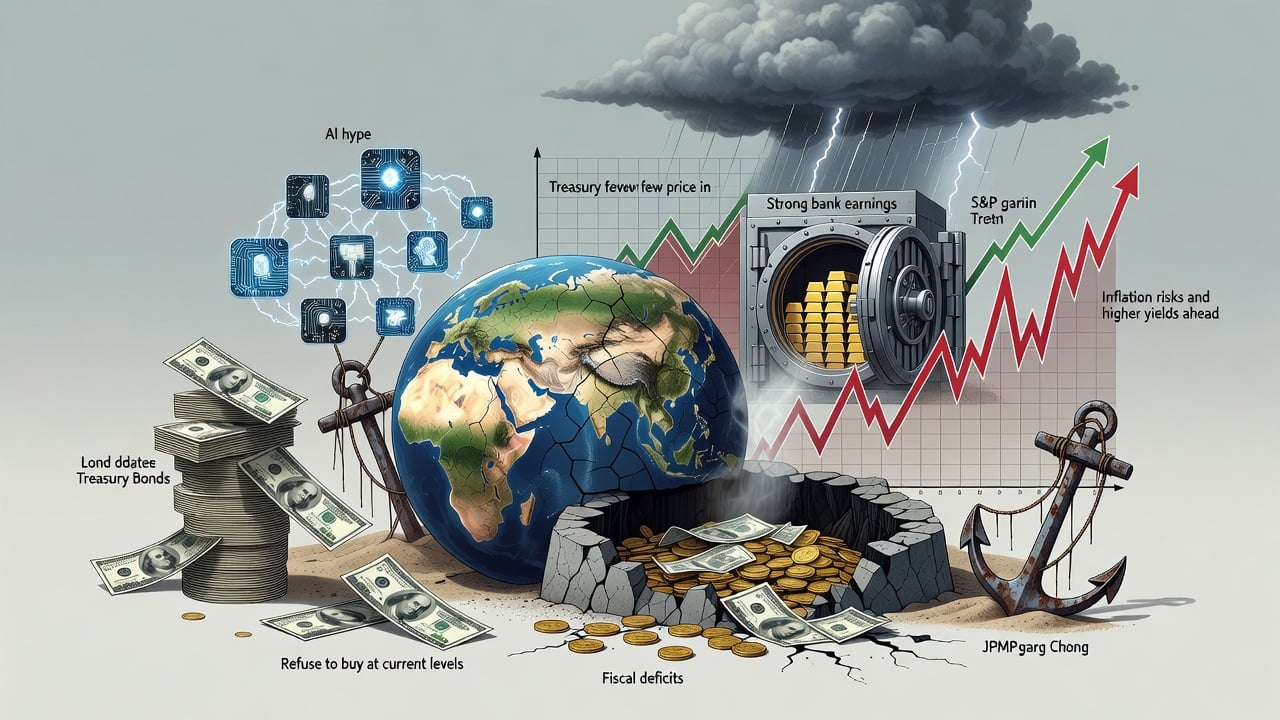
Jamie Dimon does not mince words. The JPMorgan Chase chief executive told investors in a wide-ranging interview released Monday that markets underestimate the array of threats building beneath the surface. Geopolitical tensions. Soaring government deficits. The chance that something snaps.
“I do think those risks are probably bigger than other people think,” Dimon said. He listed wars in Ukraine and the Middle East. Friction between the United States and China. Military budgets climbing while deficits mount. Nothing fully prices in the chaos that follows.
His comments land at a curious moment. The S&P 500 stands nearly 10 percent higher this year. Consumers keep spending. Inflation has cooled enough for many to declare victory. Banks just delivered blockbuster earnings, with JPMorgan Chase and peers riding a wave of trading and investment banking fees. Yet Dimon, who runs the largest U.S. bank by market value, sees scant reason to buy broad equity indexes or long-dated Treasurys right now.
And he is not alone in voicing unease. A Fortune article from July 14 captured similar caution after JPMorgan’s strong second-quarter results. Dimon described risk as “shifting below the surface like tectonic plates,” citing the same geopolitical conflicts, sticky inflation and fiscal gaps. Markets feel euphoric. He does not.
Dimon made the latest remarks during an hourlong conversation with Wilfred Frost on “The Master Investor Podcast.” He acknowledged that economies show more resilience today. Nations depend less on energy imports than in decades past. But resilience has limits. A sudden turn remains possible.
“You may need more straws in the camel’s back to cause that tipping point,” he explained. “Even this current war starting up again, maybe that’s not enough to do it.”
That measured tone masks deeper concern. Dimon has sounded alarms before. His annual letters and public appearances repeatedly flag inflation, debt and global instability. This time he ties those threads together with unusual bluntness. Markets may have baked in some probabilities. They cannot price the actual fallout.
“It’s possible something’s baked in, but what’s not baked in is what actually happens,” Dimon said.
Consider the fiscal side. Persistent U.S. budget shortfalls will demand attention. Bond vigilantes, those investors who once forced discipline on spendthrift governments, could return with force. Dimon expects higher interest rates as a result. Even if the Federal Reserve hits its 2 percent inflation target, he sees the 10-year Treasury yield settling between 4 and 4.5 percent. Little room exists for bond prices to climb from here.
When Frost asked whether he would buy long-dated Treasurys personally, Dimon answered directly. “Personally, no.” Short. Unambiguous. The kind of clarity that cuts through bullish chatter.
Stocks receive similar treatment. Dimon would examine individual names that qualify as “a great investment.” The broader market at current valuations? He passes. This stance contrasts with the surge in artificial intelligence-related shares and the widespread belief that technology spending will lift all boats.
Dimon approaches AI with tempered realism. He compares the current spending frenzy to the internet’s early days. Huge sums pour in. Some will pay off. “The amount of money being spent is huge. Will it in total pay off? Probably, just like the internet did,” he said.
But timing and outcomes will disappoint many. Early leaders such as Yahoo and Netscape lost ground. Later winners including Google and Facebook rose instead. “Will it pay off the way you expect and the timetable you expect? Definitely not,” Dimon warned.
His skepticism echoes across recent statements. In May he told business leaders that current exuberance reminded him of periods before past downturns. “There’s a lot of exuberance out there,” he observed then, according to a report in The Street. He cited 1972, 1986, 2000 and 2007. Those years did not end well.
A Wall Street Journal article published April 6 outlined five specific risks Dimon highlighted in his annual shareholder letter. Among them: potential oil and commodity price shocks that could prolong inflation. Competition from startups and smaller banks. Artificial intelligence reshaping entire workforces. Erosion of public trust in government institutions. An ineffective European Union struggling with its own challenges.
Dimon also flagged the war in Iran as a flashpoint capable of disrupting energy markets. Higher oil prices feed directly into consumer costs and corporate margins. History shows such spikes often precede recessions. The 1970s and early 1980s offer painful examples.
Recent online discussion reflects the tension. On X, traders and analysts debated Dimon’s latest interview within hours of its release. Some dismissed headlines as clickbait, noting he would still consider select stocks. Others saw validation for caution amid signs of weakness in China’s auto sales and broader retail data. One post captured the divide neatly: markets shrug and keep buying even as the head of JPMorgan signals discomfort.
Yet Dimon’s track record commands attention. He steered JPMorgan through the 2008 crisis with relative strength. His public warnings have often preceded periods of volatility, even if exact timing eluded him. Investors ignore him at their peril.
Bank earnings last week reinforced a narrative of strength. Trading desks thrived on volatility. Investment banking pipelines filled again. But those results reflect activity in the present. They say less about vulnerabilities accumulating over the horizon.
Dimon’s message carries weight precisely because it comes from inside the system. He sees flows of capital, credit conditions and client behavior up close. When he says risks sit larger than consensus believes, market participants should listen.
The Federal Reserve faces its own balancing act. Inflation moves toward target but refuses to settle cleanly. Rate cuts remain possible yet uncertain in scale. Dimon’s call for structurally higher yields adds pressure to that debate. Bond markets may need to adjust more than policymakers currently signal.
Geopolitics compounds everything. Conflicts grind on without clear resolution. Military outlays rise across multiple nations. Trade tensions with China persist. Each element alone might prove manageable. Together they raise the odds of an unexpected intersection.
So what should investors do? Dimon offers no simple blueprint. He advocates preparedness over prediction. Focus on quality. Maintain balance sheets that withstand stress. Avoid overpaying for assets whose risks remain misjudged.
His caution does not equate to outright pessimism. Economies demonstrate adaptability. Innovation continues. But adaptation takes time, and shocks arrive without warning. The camel’s back holds for now. How many more straws it can bear remains the open question.
Dimon has voiced parallel concerns throughout 2026. A shareholder letter earlier this year, dissected in an Investopedia analysis from April, described inflation that rises instead of falls as “the skunk at the party.” That scenario alone could lift rates and depress asset values. Oil shocks from Middle East turmoil would amplify the damage.
Markets currently price optimism. Dimon prices probability. The gap between those views may narrow abruptly. When it does, those who listened stand better positioned than those who did not.
His latest interview serves as both warning and reminder. Complacency carries cost. Vigilance demands discipline. In an environment awash with bullish sentiment, Dimon’s restraint stands out. Investors would do well to weigh it carefully.


 WebProNews is an iEntry Publication