
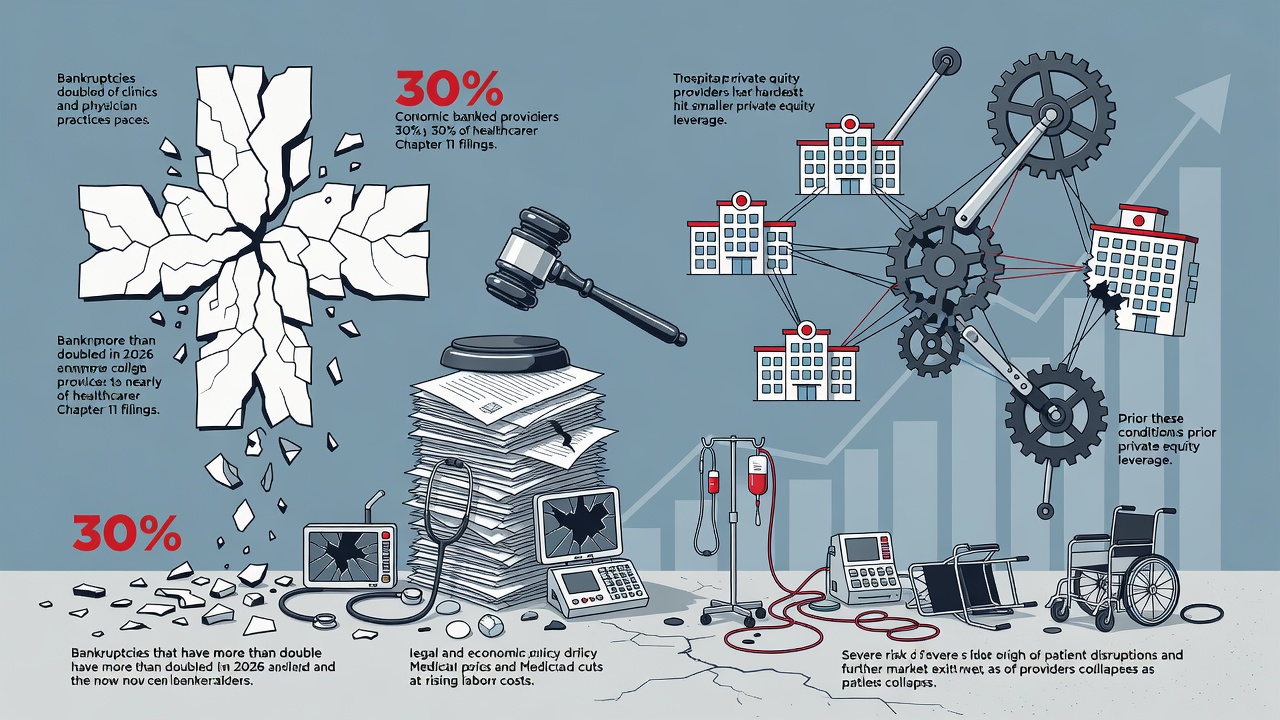
Bankruptcies among clinics and physician practices have accelerated sharply in 2026. The numbers tell a stark story. Nearly 30% of healthcare Chapter 11 filings with liabilities over $10 million in the first half of the year came from this segment. Healthcare Dive first highlighted the trend in its July 20 report. Practices now sit on pace for 14 such filings by year-end. That’s more than double the six recorded in all of 2025.
Overall healthcare bankruptcies have held steady near historic quarterly averages. Twelve companies with more than $10 million in liabilities filed in the first quarter. Fourteen followed in the second. Yet the composition has shifted. Smaller outfits drive the increase. Eighteen entities with liabilities between $10 million and $50 million have filed so far this year. That compares to 23 for the entire previous year. Larger cases remain flat or down.
The Warning Signs Emerge
Ronald Winters, principal at restructuring firm Gibbins Advisors, captured the unease. “There is a lot bubbling under the surface that will ultimately need to be resolved in some form of restructuring, though not all will be resolved in court,” he said in the Healthcare Dive article. His firm’s interim 2026 report projects 52 total healthcare Chapter 11 cases if the pace holds. A 16% jump from 2025.
But the real pressure builds in ambulatory settings. Private practices. Outpatient clinics. These smaller operations face the same gale-force winds battering hospitals and drugmakers. They simply lack the scale to absorb them. Samuel Maizel, director of Dentons’ distressed healthcare unit, put it plainly in a Bloomberg Law story published days later. “These forces are present throughout the healthcare system and they’re going to eat the smaller businesses first. As they continue, they’ll eat bigger and bigger systems.”
Federal policy changes top the list of culprits. The 2025 GOP tax law delivered the largest federal health spending reduction in history. Cuts to Medicare and Medicaid loom large. Millions stand to lose coverage. Providers then confront both lower revenue and higher uncompensated care loads. Healthcare Dive detailed the reconciliation bill’s passage and its direct effects.
Labor expenses compound the strain. Median base pay for healthcare staff positions climbed 4.3% in 2025. That follows a 2.7% rise the year before, per consulting firm SullivanCotter. Reimbursement rates have not kept pace. Add in elevated interest costs from prior borrowing. The result? Thin margins turn negative fast for independent groups.
Private equity plays a recurring role too. Roll-ups promised efficiency. Many delivered heavy debt loads instead. When patient volumes dip or rates tighten, those leveraged structures crack. One X post from a physician account referenced Envision Physician Services’ earlier troubles as emblematic. Buy. Borrow. Expand. Then watch it implode when conditions shift. No single recent filing dominates headlines. The pattern does.
Georgia ProtonCare Center Inc. stands as the outlier in size. The cancer treatment facility filed in January with more than $500 million in liabilities. It defaulted on municipal bonds. Revenue from Medicare, Medicaid, commercial payers and self-pay patients fell short of debt service. Emory University acquired the center recently. Counsel David Gordon at Polsinelli PC told Bloomberg Law the case, while complex and tied to the distressed proton therapy sector, still signals broader industry stress. Most other 2026 practice filings involved $10 million to $50 million in liabilities. They appeared in California, Texas and Virginia.
Patient impacts worry researchers most. Adrienne Sabety, assistant professor at Stanford’s health policy department, sketched a troubling sequence in the same Bloomberg Law piece. After bankruptcy, some physicians exit the market altogether. Mortality rates and emergency visits can rise. Others jump to new practices. Their patients often follow. Those left behind absorb heavier caseloads. “If you’re imagining a scenario where work is already unhappy, this is just going to put the firm into a death spiral where more and more physicians are going to try to leave,” Sabety said. “And that’s true in the bankruptcy.”
Patients who stay may grow reluctant to pay once word of the filing spreads. Harvard Business School assistant professor Samuel Antill noted that dynamic as well. Subchapter V bankruptcy has grown more attractive for smaller practices. It offers streamlined processes and benefits absent from standard Chapter 11.
So what comes next? Some consultants see digital tools as partial relief. Lauren Crawford Shaver, senior managing director at FTI Consulting, pointed to telehealth, AI-enabled models and value-based arrangements. “The faster there’s a credible, paid-for virtual physician model, the sooner that’s going to create some stability across physician groups,” she told Bloomberg Law. These approaches could generate fresh revenue streams and emphasize prevention over volume.
Yet not everyone expects a bankruptcy wave to crest. Daniel Simon, partner at McDermott Will & Emery, anticipates continued distress but fewer court filings. The process simply costs too much. Providers will “spin plates,” layering on more debt and stretching credit lines to survive another quarter. Lenders, eager to avoid losses, often extend lifelines outside formal restructuring.
The numbers from Gibbins Advisors paint a clear picture. Practices now account for a disproportionate share of healthcare distress. Policy makers trimmed safety-net programs. Costs climbed without matching revenue growth. Smaller operators absorbed the first blows. Larger systems watch warily. Left unaddressed, the trend risks exactly the death spiral Sabety described. Physicians depart. Patients scatter or go without care. Communities lose access. And the cycle accelerates.
Recent commentary on X echoed these fears. A Stanford-affiliated account flagged Sabety’s warning that unchecked bankruptcies could trigger further closures and patient displacement. Another post from a healthcare consulting profile directly cited the spike in 2026 filings. The conversation has moved beyond data tables into real-world consequences for doctors and the people they treat.
Industry veterans recall the 2023 peak, when interest rates and supply-chain shocks drove a six-year high in restructurings. Filings eased in 2024 and 2025. Now the pendulum swings again, propelled less by macro rates and more by deliberate policy choices and persistent operational pressures. How providers respond, whether through consolidation, technology adoption or advocacy for payment reform, will shape the sector’s stability for years ahead.


 WebProNews is an iEntry Publication