
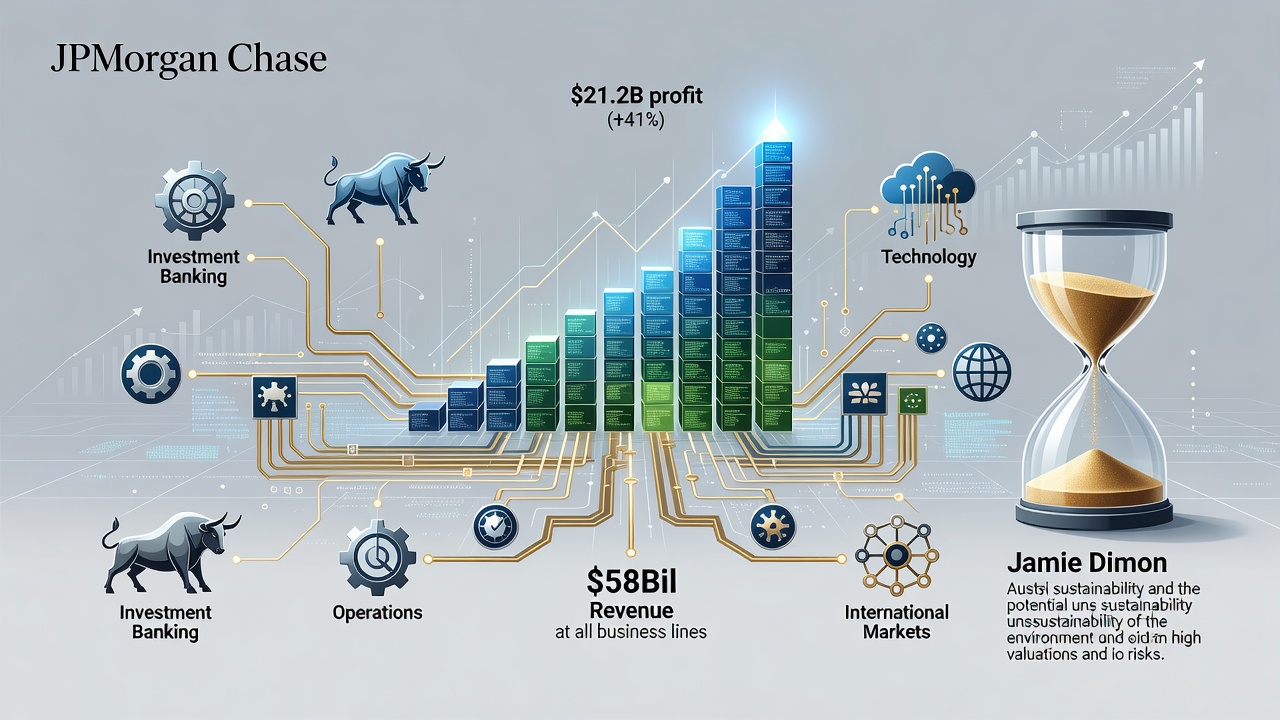
JPMorgan Chase just recorded the largest quarterly profit ever posted by an American bank. The numbers dazzle. Net income hit $21.2 billion in the second quarter of 2026. That figure represents a 41 percent jump from a year earlier. Earnings per share came in at $7.70. Even after stripping out one-time items, the bank earned $16.9 billion, or $6.14 a share.
Revenue climbed to $58 billion. Every business line set fresh records. Reuters laid out the surge in vivid detail. Investment banking fees rose 30 percent to $3.3 billion. Markets revenue jumped 35 percent. Equity trading alone exploded 86 percent to $6 billion, fueled by a wave of high-profile deals that included the SpaceX IPO.
Consumer and community banking revenue grew 8 percent to $20.27 billion. Card services and auto lending provided much of the lift. Asset and wealth management added $6.9 billion in revenue, up 19 percent, while assets under management reached $5.1 trillion. The official earnings release from JPMorgan Chase confirms these gains across the board.
Jamie Dimon sounded almost wistful on the earnings call. “We’re in a very healthy, active, exuberant market with very high prices and very high volumes, and we benefit from that,” he told analysts. Then came the pivot. “It’s getting close to as good as it gets.” He added a blunt qualifier. “We just don’t know how long it will continue.”
The Motley Fool captured the full tension in its coverage. The Motley Fool article notes that Dimon described the results as a high-water mark rather than a sustainable run rate. Trading gains and blockbuster IPOs tend to be lumpy. They don’t repeat like clockwork. A $4.6 billion one-time gain on the bank’s Visa stake further inflated the headline profit. Remove that and core earnings still crushed expectations.
Wall Street reacted with enthusiasm anyway. Shares rose nearly 3 percent after the report, pushing JPMorgan’s market value above $920 billion. The performance stood in sharp contrast to the caution Dimon has expressed for months. In his annual shareholder letter earlier this year, he warned about tariffs, inflation risks, and potential economic fragmentation. The Guardian reported on those concerns in April. Dimon urged the U.S. to strengthen ties with allies rather than pursue policies that could weaken democratic economies.
Yet the consumer has held up. Net charge-offs fell to 3.2 percent from 3.4 percent a year ago. Loan growth reached 10 percent. Dimon called the American consumer “fine” and pointed to notable resiliency in the broader economy. Fiscal stimulus and capital spending on artificial intelligence have supported business investment and hiring. MarketWatch highlighted those comments directly from the call.
Still, cracks may be forming beneath the surface. The bank raised its expense guidance for the full year to $107.5 billion. Net interest income forecasts edged higher too, but the environment feels precarious. Dimon has drawn comparisons, however carefully, to periods that preceded major corrections. 24/7 Wall St. reported his remark that conditions feel close to peaks last seen in 2007. He stopped short of predicting an immediate downturn. The message was clear enough. Enjoy the moment. Prepare for turbulence.
Geopolitical risks loom large in his thinking. Wars, U.S.-China tensions, and massive fiscal deficits could unsettle markets. Bond vigilantes might reappear if investors lose faith in U.S. debt sustainability. Dimon has avoided buying stocks or bonds at current valuations, according to recent social media discussion of his stance. Recent posts on X reflect traders parsing his every word for hints of positioning.
The New York Times placed the results in context with peers. The five largest U.S. banks together generated $49 billion in second-quarter profits. Goldman Sachs, Bank of America, and Wells Fargo all posted strong numbers too. Deal flow in mergers, acquisitions, and equity offerings for artificial intelligence companies provided tailwinds across the sector. The New York Times article noted the collective haul arrived amid fresh flare-ups in the Middle East, underscoring the disconnect between financial markets and global tensions.
Dimon plans to remain CEO for at least three more years. That continuity matters for an institution with $5 trillion in assets. His blend of record results and sober warnings has become a trademark. He celebrates the bank’s operational strength while reminding investors that exuberance carries limits. AI adoption, for instance, won’t automatically widen margins because competitors are investing just as aggressively. The technology levels the playing field more than it creates lasting advantage.
Expense growth bears watching. The bank continues to hire in select areas even as it trims roles elsewhere. One executive noted on the call that certain back-office functions saw staff reductions of 30 to 40 percent through efficiency measures. Such moves help offset rising technology and compensation costs. Yet the overall expense trajectory moved higher in the updated forecast.
Net interest income excluding markets rose 4 percent to $23.7 billion. That modest gain reflects higher loan volumes offsetting some pressure on deposit costs. The yield curve and Federal Reserve policy will dictate future trends. Dimon has long argued that interest rates may stay elevated longer than many expect. His views on tariffs have evolved but remain nuanced. Early criticism of broad duties gave way to qualified acceptance that “so far, so good” in some trade negotiations, though he continues to stress the need for comprehensive foreign economic policy.
Recent coverage shows the tension persists. Yahoo Finance reported on Dimon’s conviction that the next crisis could prove worse than markets anticipate. He has repeated that theme even as profits compound. The combination creates a rare spectacle. A bank prints unprecedented earnings. Its leader simultaneously cautions that the ground may be shifting.
Investors now face a choice. They can ride the momentum that has carried JPMorgan shares up 26 percent over the past year. Or they can heed the veteran banker who has guided the firm through multiple cycles. History suggests his cautionary notes often carry weight. The current environment offers abundant liquidity, elevated asset prices, and strong corporate activity. Those conditions rarely last forever. When they fade, the institutions with the strongest balance sheets tend to fare best.
JPMorgan’s fortress balance sheet, $375 billion in stockholders’ equity, and diversified revenue streams position it well for whatever comes next. But Dimon isn’t celebrating yet. He sees high valuations, geopolitical strain, and policy uncertainties that could compound quickly. The record profit quarter may represent a peak. Or it may signal sustained strength if the consumer remains resilient and deal flow continues. For now the data supports optimism. The CEO’s words urge prudence. Both deserve attention.


 WebProNews is an iEntry Publication