
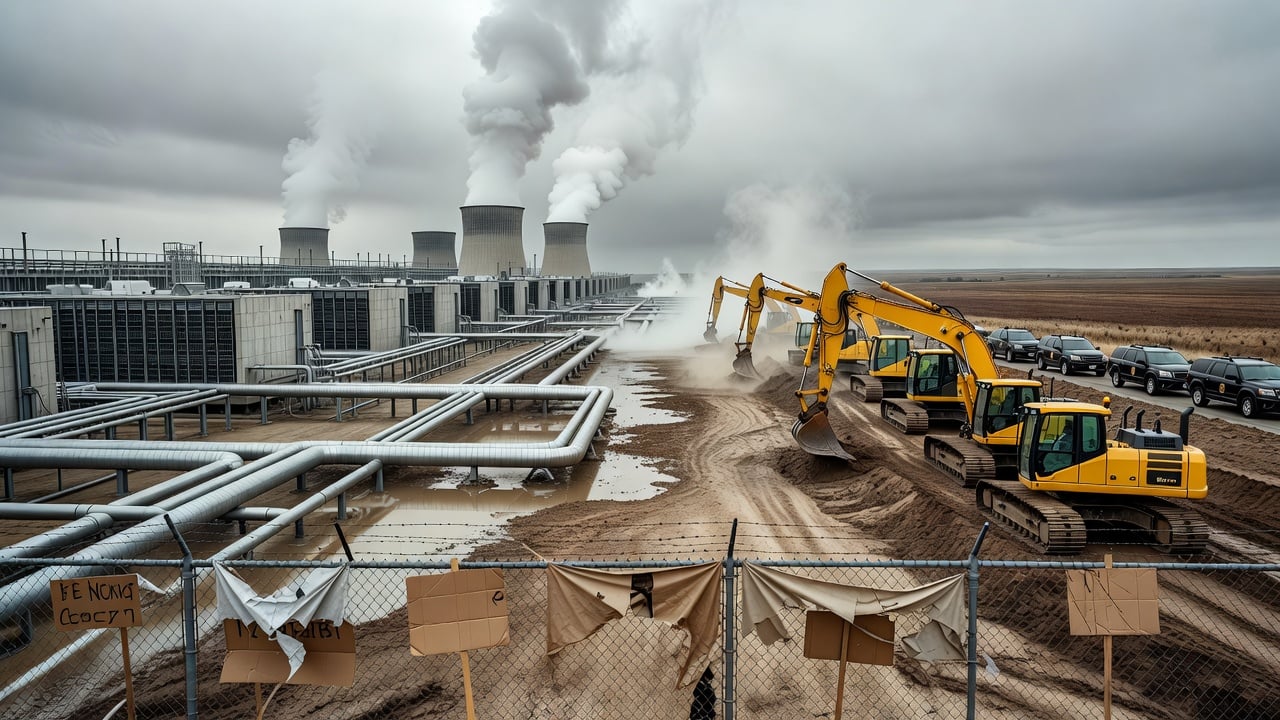
A recent survey reveals that around 70 percent of Americans oppose the construction of data centers in their local communities, citing concerns over noise, energy consumption, and environmental impact. Despite this widespread resistance, federal and state authorities have begun exercising eminent domain powers to acquire private land, clearing the way for massive facilities that support the explosive growth of artificial intelligence and cloud computing. This tension between public sentiment and government priorities highlights a growing conflict over how the United States will accommodate the infrastructure demands of the digital economy.
The TechRadar report draws from multiple polls conducted over the past year, showing consistent opposition across demographic groups and geographic regions. Residents near proposed sites frequently complain about the constant hum of cooling fans that can reach levels comparable to a busy highway, the enormous quantities of water required for cooling systems, and the strain placed on local power grids. In some cases, data centers consume as much electricity as small cities, prompting fears that everyday households will face higher utility bills or rolling blackouts during peak demand.
Data center operators argue that these facilities form the backbone of modern services that Americans rely upon daily. From streaming video to online banking, from remote work platforms to AI-powered search engines, nearly every aspect of contemporary life depends on the computational power housed in these buildings. The surge in interest for generative AI tools has accelerated demand dramatically. Companies like Microsoft, Google, Amazon, and Meta have announced plans to invest hundreds of billions of dollars in new facilities over the next decade, with many projects already breaking ground in rural counties where land prices remain relatively low.
Eminent domain has emerged as a contentious tool in this expansion. Originally intended for projects serving clear public benefit such as highways or schools, the practice now extends to commercial data centers through creative interpretations of public interest statutes. In Virginia’s “Data Center Alley,” local governments have condemned farmland to make way for server farms, offering landowners compensation that often falls short of what they believe their property is worth. Similar cases have surfaced in Georgia, Texas, and parts of the Midwest, where agricultural communities find themselves at odds with state economic development agencies eager to attract high-tech investment.
Landowners facing seizure describe the process as deeply unfair. Many have held their properties for generations, viewing them as legacies rather than mere financial assets. When government surveyors appear with appraisals based on agricultural zoning rather than the premium values that data center developers are willing to pay, resentment builds quickly. Legal challenges have multiplied, with property rights groups arguing that transferring land from private citizens to multinational corporations stretches the definition of public use beyond constitutional limits. Courts have issued mixed rulings, with some judges upholding the projects while others demand stricter proof of necessity.
Energy consumption stands out as perhaps the most pressing technical challenge. A single hyperscale data center can require 100 megawatts or more of continuous power, equivalent to the output of a large natural gas plant. With hundreds of such facilities planned, utilities face the prospect of adding generation capacity at a pace not seen since the electrification boom of the early 20th century. Renewable sources like solar and wind receive heavy promotion, yet their intermittent nature requires either massive battery storage or reliable backup from fossil fuels. Critics point out that many data centers still depend heavily on natural gas peaker plants that activate during high demand, undermining claims of carbon neutrality.
Water usage presents another flashpoint. Evaporative cooling systems, the most common method for dissipating heat from densely packed servers, can consume millions of gallons annually per facility. In drought-prone areas of the Southwest and parts of the Southeast, this demand exacerbates existing shortages. Some operators have switched to dry cooling technologies that use far less water, though these systems reduce efficiency and increase electricity consumption. The trade-offs illustrate the complex calculations that engineers must make when balancing performance, cost, and community acceptance.
Noise pollution often surprises residents who live near completed facilities. The combined sound from thousands of server fans and industrial chillers creates a persistent drone that travels for miles under certain atmospheric conditions. While operators install sound barriers and quieter equipment in newer designs, retrofitting older sites proves expensive. Municipalities have begun passing stricter noise ordinances, but enforcement remains difficult when facilities operate 24 hours a day to meet global computing demand.
Economic arguments in favor of data centers focus on job creation and tax revenue. Construction phases can employ hundreds of workers for several years, and permanent staff positions, though fewer in number, typically offer above-average salaries. Local governments receive substantial property tax payments that can fund schools and infrastructure improvements. Yet studies show that many of the high-paying technical jobs go to specialists brought in from outside the area, while the remaining positions involve security, maintenance, and janitorial work that pay closer to regional averages. The net fiscal benefit therefore depends heavily on how tax abatements and infrastructure subsidies factor into the equation.
Public opposition has prompted some companies to adopt more transparent community engagement strategies. Microsoft has established liaison programs in several states, holding town halls and offering educational tours of their facilities. Google has funded local STEM initiatives and broadband expansion projects as goodwill gestures. These efforts have softened resistance in certain communities, but they rarely eliminate opposition entirely. Many residents remain unconvinced that the promised benefits outweigh the permanent changes to their rural landscapes.
The federal government has taken a more direct role in recent months. The Department of Energy has identified data center infrastructure as critical to national competitiveness, particularly in the race with China to develop advanced AI capabilities. Policy documents suggest that maintaining technological superiority requires rapid deployment of computing resources, even when local preferences conflict with national objectives. This top-down approach echoes earlier infrastructure campaigns such as the interstate highway system, though the beneficiaries this time are primarily private technology firms rather than the general public.
Regulatory frameworks vary significantly between states. Virginia and Texas have streamlined permitting processes that favor rapid construction, while California and New York impose stricter environmental reviews that can delay projects for years. This patchwork approach creates a situation where data centers cluster in permissive jurisdictions, concentrating the burdens on specific communities while others avoid them entirely. Reform advocates call for national standards that would distribute infrastructure more evenly and require meaningful community consent before eminent domain proceedings can begin.
Technological innovations may eventually reduce some points of friction. Advances in liquid cooling, for instance, promise to cut both energy consumption and noise levels dramatically. Chip manufacturers are developing more efficient processors that generate less heat per calculation. Edge computing architectures could distribute workloads across smaller, less intrusive facilities located closer to users rather than concentrating everything in massive centralized campuses. Yet these solutions remain in various stages of adoption, and the immediate pressure to expand capacity continues to drive traditional construction methods.
The debate also touches on broader questions about the societal value of endless computing growth. As AI systems grow more sophisticated, they require exponentially more training data and processing power. Each new model iteration seems to demand orders of magnitude more resources than the last. This trajectory raises concerns about sustainability and whether current consumption patterns can continue indefinitely. Some technology ethicists suggest that industry leaders should focus on optimizing existing infrastructure rather than simply building more of it, though such calls have gained limited traction among companies locked in competitive races for market dominance.
Property owners who have already lost land through eminent domain often report lasting bitterness that extends beyond financial compensation. The sense that their personal rights were sacrificed for corporate profit lingers, affecting attitudes toward government and technology alike. Support groups have formed in several states to share legal strategies and emotional support, creating networks that span traditional political divides. Conservative property rights advocates find common cause with environmental activists concerned about habitat disruption and increased carbon emissions.
Looking ahead, the coming years will likely see continued legal battles as more projects move from planning to execution. Several high-profile cases are working their way through appellate courts, with potential to establish new precedents regarding the application of eminent domain to data centers. Legislators in multiple states are considering bills that would restrict or expand the practice, reflecting the intensity of local debates. Meanwhile, data center developers continue signing power purchase agreements with utilities and securing land options in anticipation of sustained demand growth.
The situation presents a classic conflict between individual rights and collective benefits, complicated by the fact that the benefits often flow to distant shareholders while the burdens fall squarely on nearby residents. Resolving these tensions will require more than technical fixes or public relations campaigns. It will demand honest conversations about how much computing power society truly needs, how the costs and benefits should be distributed, and what role government should play when market forces and community preferences collide. Until those questions receive satisfactory answers, the contentious process of building America’s digital infrastructure seems destined to generate more opposition, more lawsuits, and more difficult choices for communities across the country.


 WebProNews is an iEntry Publication