
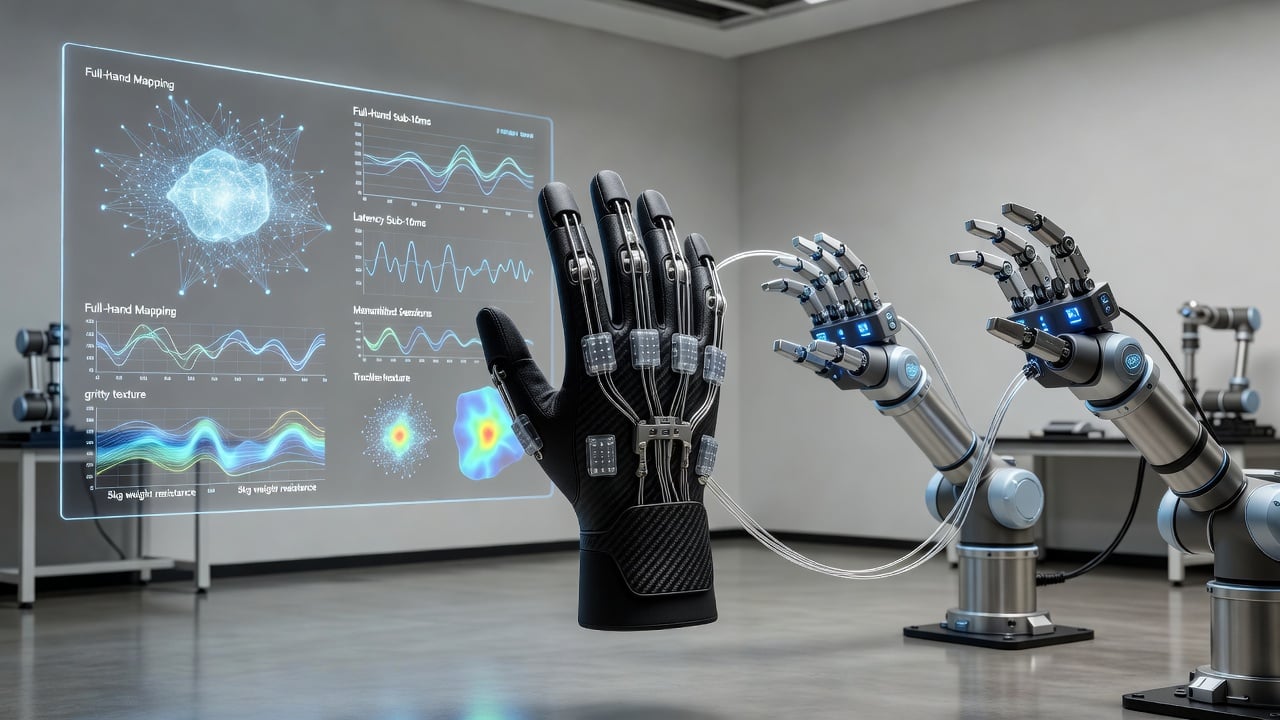
Tacta, a young robotics company based in California, has developed a haptic feedback glove that captures the subtle sensations of touch and transmits them to users controlling remote robotic systems. The technology, demonstrated in recent private sessions, allows operators to feel the weight, texture, and resistance of objects handled by distant machines with remarkable fidelity. According to a report from The Information, the glove represents a significant step forward in making teleoperation more intuitive and precise.
Engineers at Tacta spent several years refining arrays of miniature actuators embedded throughout a flexible fabric glove. These actuators press against the wearer’s skin in patterns that correspond to forces detected by sensors on a paired robotic hand. The system does not simply vibrate like many existing haptic devices. Instead, it recreates specific sensations such as the give of a foam block, the cool smoothness of metal, or the delicate tension of a thin wire. Testers who tried the prototype described picking up a fragile egg through a robot and knowing exactly how much pressure to apply without cracking the shell.
The company was founded by researchers who previously worked on haptic interfaces at major technology firms and universities. Their background in both mechanical engineering and neuroscience informed the design from the beginning. Rather than focusing solely on force feedback at the fingertips, Tacta mapped the entire hand surface, including palms and finger joints, where much of human tactile information is processed. This comprehensive approach allows the glove to convey complex interactions like sliding a hand across a surface or gripping an irregular object.
Applications for the technology extend across several industries that currently struggle with remote manipulation. In surgical robotics, doctors could potentially feel tissue resistance during procedures conducted through small incisions or even from another hospital. Manufacturing teams might use the gloves to handle delicate components in clean rooms without entering them physically. The nuclear industry has shown interest in systems that let technicians service radioactive equipment while remaining safely behind shielding. Space agencies have also expressed curiosity about tools that could make repairing satellites or exploring other planets feel more natural for ground-based operators.
Tacta has not yet disclosed full technical specifications, but demonstrations suggest the system achieves latency below 50 milliseconds, fast enough that users report the robotic hand feels like an extension of their own body. The company paired the glove with a lightweight exoskeleton that provides active resistance, allowing operators to experience weight and momentum in addition to surface textures. This combination of tactile and kinesthetic feedback sets the work apart from many competing haptic solutions that address only one aspect of touch.
Funding for Tacta has come from both traditional venture capital firms and strategic investors in the robotics sector. The company recently completed a round that values it at more than $100 million, reflecting confidence in the commercial potential of advanced haptics. Several large industrial automation companies have already signed agreements to test the gloves in pilot programs, though specific partners remain undisclosed for now.
Challenges remain in scaling the technology for widespread adoption. The current prototype requires careful calibration for each user to account for differences in hand size and sensitivity. Battery life and wireless reliability need further improvement before the system can move easily between job sites. Material durability also presents questions, as the dense network of actuators must survive repeated flexing without degrading performance or comfort.
Despite these hurdles, the core innovation addresses a longstanding limitation in robotics. For decades, machines have excelled at repetitive tasks in controlled environments but struggled with unpredictable situations that require adaptive touch. Human operators can step in for these scenarios, yet traditional control interfaces create a sensory disconnect that leads to errors and slower operation. By restoring the sense of touch, Tacta aims to bridge that gap and expand the range of tasks that can be performed remotely.
The glove builds upon earlier research in soft robotics and neuromorphic engineering. Rather than replicating the exact mechanics of human skin, the team focused on perceptual accuracy—what the brain interprets as touch. This perceptual approach allowed them to reduce the number of individual actuators while still producing convincing sensations. Machine learning algorithms help translate raw sensor data from the robotic hand into optimized patterns for the glove, adapting in real time to different materials and grip styles.
Industry observers point to parallels with the development of high-quality virtual reality headsets. Early VR systems suffered from low resolution and high latency, limiting immersion. Once displays improved and motion tracking became precise, the technology crossed a threshold where users could suspend disbelief. Haptic gloves may follow a similar trajectory. As resolution increases and costs decrease, the experience of controlling a robot could shift from operating a machine to simply doing the work oneself from a distance.
Tacta has also explored integration with artificial intelligence systems. In one demonstration, the glove provided feedback not only from the physical robot but also from simulated forces generated by AI path-planning software. This hybrid approach could let operators train on virtual tasks before attempting them in the real world, or allow multiple users to collaborate on the same robotic platform from different locations.
The company maintains an active research partnership with several academic labs studying human haptic perception. These collaborations help refine actuator placement and stimulation patterns based on the latest findings in sensory neuroscience. One particularly promising area involves conveying temperature differences through the glove, which would add another dimension to remote object identification and handling.
Market analysts expect the broader field of haptic technology to grow substantially over the next decade. Beyond industrial and medical uses, consumer applications in gaming and virtual shopping could emerge if costs come down. Tacta has indicated that its initial focus will remain on professional markets where the value of improved dexterity justifies premium pricing. The company plans to release a commercial version within the next 18 months, targeting sectors with high-stakes remote manipulation needs.
Engineers who have tested the system consistently mention the reduction in cognitive load. Without tactile feedback, operators must visually confirm every action, dividing attention and slowing decision-making. When the glove supplies direct touch information, users can look at the broader scene while their hands work more autonomously. This effect resembles how experienced surgeons can suture tissue while maintaining eye contact with the rest of the surgical field.
Intellectual property filings suggest Tacta has protected several unique aspects of its actuator design and signal processing methods. The company has also developed custom software that simplifies integration with existing robotic platforms, an important consideration for customers who have already invested heavily in hardware from other vendors.
As demonstrations continue, interest from defense contractors has increased. The ability to defuse explosives or inspect suspicious packages without placing personnel in harm’s way grows more valuable as conflicts become more technologically sophisticated. Similar logic applies to disaster response, where robots guided with full tactile feedback could search rubble for survivors more effectively than current systems allow.
Tacta continues to iterate on the design, with the latest prototypes featuring thinner materials and improved ventilation to reduce fatigue during extended use. The team has also begun exploring foot and torso feedback systems that would give operators a more complete sense of embodiment when controlling full-body humanoid robots.
The progress shown by Tacta reflects a broader maturation in robotics where sensory feedback receives as much attention as mechanical capability. For many years the field prioritized strength, precision, and autonomy. Now that basic competence in those areas has been achieved, restoring the rich sensory connection between human and machine has become a priority. The haptic glove developed by this startup may help define how that connection evolves in the coming years across factories, hospitals, laboratories, and exploration sites around the world.


 WebProNews is an iEntry Publication