
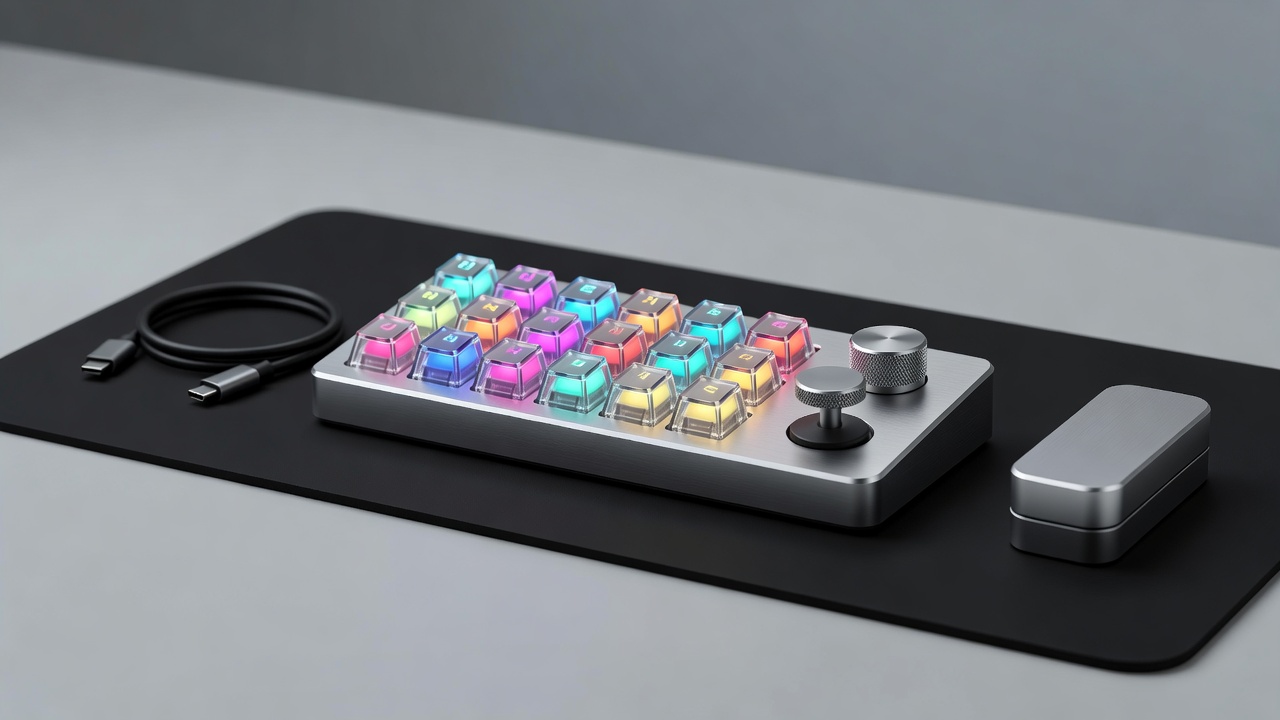
OpenAI has finally shipped physical hardware. It isn’t the ambitious AI companion developed with Jony Ive. It isn’t a speaker or a phone. It’s a compact mechanical keypad that costs $230.
The Codex Micro arrived on store shelves this week. Developed in partnership with Work Louder, the device targets developers who rely heavily on OpenAI’s Codex coding agents. And the timing feels deliberate. It landed amid reports of a legal battle with Apple over alleged trade-secret issues tied to broader hardware ambitions. TechCrunch first detailed the launch and its context.
But this isn’t some half-baked prototype. The keyboard packs 13 programmable keys, a rotary dial, and a joystick. Users map these controls to specific Codex workflows. Need to adjust an agent’s reasoning depth? Twist the dial. Want to trigger code review or debugging sequences? Flick the stick. RGB lighting shifts colors in real time. White means idle. Blue signals thinking. Green shows completion. Red flags an error. Developers monitoring multiple agent threads can glance at their desk instead of cycling through windows. Attention stays where it belongs.
Simple. Direct. Physical.
OpenAI teased the product on June 29. The official unveiling came July 15. A spokesperson told The Verge the gadget was “designed to supercharge people’s Codex usage.” Dominik Kundel, the company’s voice on the matter, kept the messaging focused. No grand claims. Just a tool for people already deep in agent-driven coding.
The hardware builds on an existing Work Louder model, the Creator Micro 2. OpenAI added custom branding, LED feedback tied to agent states, and deeper integration with pinned Codex chats. It connects through Bluetooth or USB-C. Works on both Mac and Windows. Ships with 32 interchangeable keycaps. Pre-orders started moving fast. Estimated delivery sits around July 24. Stock, as one X post noted, could return to 410 units quickly. Mashable captured early buyer skepticism, highlighting sticker shock over the price for what some called a niche peripheral.
Yet the decision to start here makes sense. Codex agents now run longer, more autonomous tasks. Human oversight becomes the bottleneck. Screens fill with tabs and logs. Switching context drains focus. A keyboard that sits under your hands, glowing with status updates, reduces that friction. It turns peripheral vision into an information channel. No extra monitor required. No constant polling of dashboards.
Practical.
Industry watchers have waited months for OpenAI’s hardware debut. Rumors swirled around a screenless, context-aware companion device code-named io. Former Apple talent joined the effort. Production targets once called for shipping 100 million units at unprecedented speed. Those plans shifted. Delays mounted over questions of personality, privacy, and infrastructure. A court filing cited in recent coverage pushes any consumer release to February 2027 at the earliest. Reuters reported on the speaker variant and ongoing legal pressure from Apple.
So OpenAI chose a narrower path first. Partner with an established accessory maker. Release a limited-run product aimed at power users. Gather real feedback. Build brand presence in the physical world without betting the company on an unproven consumer gadget. The move echoes past software giants testing hardware waters cautiously. Think Microsoft’s early Surface experiments or Google’s initial Nest acquisitions.
Reactions on X reflected that nuance. One developer noted the keyboard admits human attention is the scarce resource in agent workflows. “As coding agents run longer, supervision turns into a UI problem,” the post read. Teams will pay for anything that clarifies delegation, stalls, and side effects at a glance. Another observer called it a desktop-only novelty for heavy Codex users. Most won’t need it. Fair point. The $230 tag positions it as a premium tool, not an impulse buy.
But the signals matter. OpenAI now sells physical goods through its Supply Co. storefront. The product carries official branding. Future iterations could expand the concept. Imagine larger macro pads for data scientists or lighting systems that sync with model training status. The foundation exists.
Not revolutionary. Strategic.
Critics wasted little time. Some Reddit threads questioned if the announcement was satire. Others argued the price exceeds what a programmable keypad should command. Those voices echo earlier skepticism toward AI hardware flops. Humane’s AI Pin and the Friend pendant both faced usability complaints and weak sales. OpenAI clearly studied those failures. This device stays tethered to existing developer habits rather than asking users to adopt entirely new behaviors.
Inside the company, the launch occurs against a backdrop of aggressive AI agent development. Codex now handles complex, multi-step coding with minimal input. Agents spawn, collaborate, and iterate. The keyboard gives humans a tactile way to steer that swarm. Joystick for navigation. Keys for approval or rejection. Dial for tuning verbosity or caution. Each element addresses a pain point observed in real usage.
Analysts see this as more than a one-off. Gizmodo framed the release as OpenAI entering the hardware market to manage fleets of AI coding agents. The story fits a pattern. Software platforms eventually extend into devices that optimize their own ecosystems. Apple did it with the iPhone and App Store. Amazon with Echo and Alexa. OpenAI appears to follow suit, albeit on a smaller scale at first.
Supply chain and manufacturing details remain sparse. Work Louder, based in Montreal, handles production. The partnership lets OpenAI avoid building factories from scratch. Smart move given current scrutiny over every aspect of the company’s operations. Legal headaches with Apple only add urgency to keep this initial product straightforward.
Longer term, the keyboard could preview how OpenAI thinks about human-AI interaction. Voice alone falls short for precise control. Screens overload with data. Physical controls offer persistence. Your hands rest on the device. Status lights update without pulling focus. The approach feels borrowed from industrial control rooms more than consumer gadgets. And that may be the point. Coding with agents resembles operating machinery. Visibility and quick intervention count.
Developers already testing the Codex Micro report faster context switching. One early user mapped common prompts to single keys and used the rotary dial to scale agent autonomy on the fly. Another highlighted the RGB feedback during long-running tasks. No need to check a terminal every few minutes. The desk itself communicates progress.
Of course, success depends on adoption within the developer community. Codex remains a specialized tool. Not every programmer uses AI agents daily. Those who do, especially in larger teams managing parallel workflows, stand to benefit most. Enterprise sales teams may bundle the keyboard with platform subscriptions. That path could drive volume beyond individual enthusiasts.
OpenAI’s broader hardware story continues in parallel. The Jony Ive collaboration, once slated for 2026, now faces trademark disputes and technical challenges. Bloomberg’s reporting on a potential smart speaker added further speculation. Yet the Codex Micro proves the company can ship something tangible today. It buys time. It tests manufacturing and distribution. It plants the OpenAI name on desks worldwide.
Small step. Clear signal.
Industry insiders should watch two things. First, how quickly OpenAI iterates on the hardware. Firmware updates that tie deeper into new Codex features could turn this into a living product. Second, whether the company expands the Co-Lab model with other accessory makers. Partnerships lower risk. They also accelerate learning.
The $230 price will limit initial reach. But for teams billing hundreds of hours on AI-assisted coding, the productivity gain may justify the spend. Time saved monitoring agents compounds. Reduced cognitive load during complex projects delivers value. Early data from power users will determine if this becomes a standard desk item or a curiosity.
Either way, OpenAI has crossed a threshold. Software powerhouse now makes hardware. The first offering stays close to the company’s strongest use case. Future devices may venture farther. For now, the Codex Micro offers a focused, thoughtful entry. It solves a real problem for a defined audience. And it does so without overpromising.
That restraint, more than any flashy feature, may prove the smartest part of the launch.


 WebProNews is an iEntry Publication