
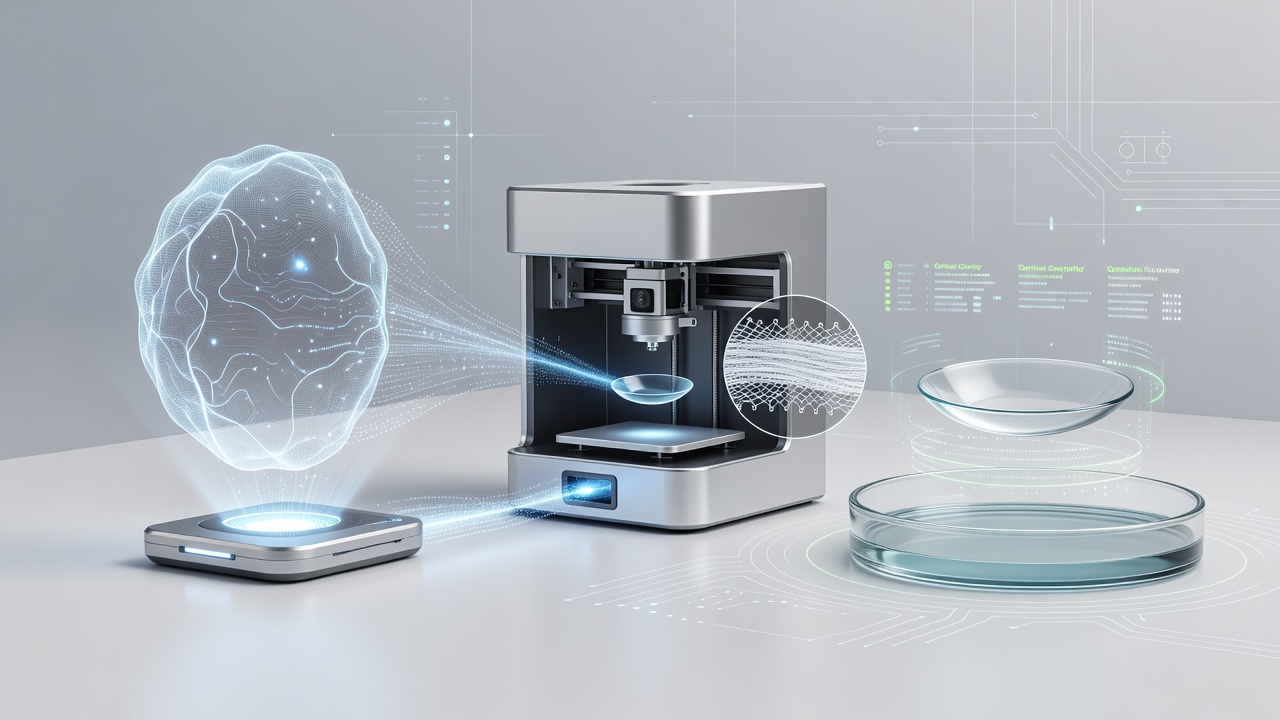
Researchers at the University of Waterloo have created a process to produce patient-specific rigid contact lenses in as little as 20 minutes. The breakthrough combines advanced 3D printing with custom software that maps the unique shape of a patient’s cornea. It stands out because it addresses a persistent pain point in eye care: the weeks-long wait and high cost for those who need hard lenses.
Traditional rigid gas permeable lenses require multiple office visits. Optometrists take measurements. Labs craft the lenses. Adjustments follow. The entire cycle can stretch out and run up bills between $500 and $1,500. But this new workflow promises to compress design, printing and finishing into a single appointment. And early tests suggest the lenses match commercial products in key performance areas.
“Our goal is for the printed lenses to perform equivalently to current commercial contact lenses in terms of surface properties, including smoothness to prevent abrasion, stability under standard cleaning and storage conditions and oxygen permeability,” Shirley Tang, one of the lead researchers in the University of Waterloo’s Department of Chemistry, told CNET.
The system starts with digital mapping. Algorithms generate a thickness profile for the lens. Software then designs an inner surface that precisely follows the patient’s cornea while the outer surface corrects vision. A digital light processing 3D printer brings the design to life using a hydrophilic silicone material. The team has filed a provisional patent on that formulation. A thin coating applied afterward smooths out the microscopic stair-stepping typical of printed curves. The result feels comfortable and delivers clear optics.
“Our software designs a lens with an inner surface that precisely matches the patient’s cornea and an outer surface that provides the required vision correction,” said Sayan Ganguly, a chemistry research associate at the University of Waterloo, according to the university’s press materials cited by multiple outlets.
These lenses target people with irregular corneas. Conditions such as keratoconus, high or irregular astigmatism, corneal scarring or post-surgical changes make soft lenses impractical. Hard lenses must fit exactly. Yet that precision has always come with delays. The Waterloo method removes much of that friction. Lab tests using human corneal epithelial cells showed the printed lenses caused no harm. Safety checks passed. The next phase involves further studies before any move toward regulatory approval or market entry.
News of the development broke this week and spread quickly. Reuters reported the lenses could reach clinics one day soon. The story highlighted how made-to-order rigid contacts might soon print on demand. Similar coverage appeared in Medical Xpress, which emphasized the combination of new silicone materials and printing technology that makes the 20-minute timeline possible. The Independent noted researchers believe the approach could lower costs and improve access.
But this isn’t the first attempt at printed lenses. An Israeli startup called Lensy Medical has worked on clinic-based 3D printers since 2021. The company aims to let optometrists produce personalized lenses in minutes inside their own offices. 3DPrint.com detailed Lensy’s plans last year, pointing to a contact lens market projected to exceed $14 billion. Lensy’s focus remains on rigid and specialty lenses much like the Waterloo project.
Other efforts explore drug delivery. Companies such as MediPrint Ophthalmics have printed lenses infused with medications like hyaluronic acid for dry eye relief. Coverage in specialty outlets last year discussed how these medicated lenses might treat conditions while patients wear them. Yet the Waterloo team’s contribution centers on speed and personalization for vision correction first.
Industry observers see broader implications. Rigid lenses already serve a niche but important segment. Faster production could expand that segment. Patients who drop out during the traditional fitting ordeal might stay in treatment. Eye care providers could reduce chair time and inventory costs. The technology also opens doors to on-the-spot adjustments. Print one lens. Test it. Reprint with tweaks in the same visit. That kind of iteration simply doesn’t exist today.
Still, hurdles remain. Regulatory pathways for 3D-printed medical devices demand extensive validation. Biocompatibility must hold up over months of wear. Oxygen transmission rates need consistent proof across batches. Surface durability after repeated cleaning requires long-term data. The Waterloo group acknowledges these steps lie ahead. Their current work establishes feasibility. Human trials will test real-world performance.
Experts outside the project express cautious optimism. Optometrists familiar with specialty fitting note that corneal topography scanners already feed data into design software. Adding a printer in the back room feels like a logical next step. Yet questions linger about material consistency between printers and long-term deposit resistance. Silicone hydrogels dominate soft lenses for good reason. Adapting similar chemistry to rigid printed formats takes careful formulation. The provisional patent suggests the team solved some of those material puzzles.
Recent coverage also points to related advances. A September 2025 article in Contact Lens Spectrum discussed personalized lenses produced in one shot and their potential for drug loading. That piece highlighted how 3D printing could embed therapeutic agents directly into the lens matrix. Such capabilities would complement the Waterloo vision correction approach. Patients with both refractive errors and ocular surface disease might one day receive a single device that corrects sight and delivers medication.
Discussions on X this week reflected public interest. Posts from news accounts and researchers shared the 20-minute claim. One video from a Canadian broadcaster showed the team explaining the process. Comments ranged from excitement about faster fittings to skepticism about when it would actually reach shelves. The buzz illustrates how quickly stories about accessible medical technology travel.
The Waterloo innovation builds on years of progress in additive manufacturing for medical devices. Dental aligners, hearing aids and even some orthopedic implants already use 3D printing at scale. Ophthalmology has lagged partly because the eye demands extreme precision and biocompatibility. A lens sits on living tissue. It must allow tear exchange and resist bacterial adhesion. Any roughness causes discomfort within minutes. The thin coating step in the new process directly tackles that requirement.
Cost structures could shift dramatically. Current rigid lens labs charge premiums for custom work. A printer in an optometry office changes the economics. Materials might run a few dollars per lens. Print time stays short. The main expense becomes the machine itself and trained staff. Over time those costs tend to fall. Early adopters in specialty practices may absorb higher upfront investment for the ability to serve complex cases faster.
Of course not every patient needs this. Soft daily disposables satisfy the vast majority of contact lens wearers. The 3D-printed option targets the roughly 10 to 15 percent who require rigid or hybrid designs. For them the difference between waiting weeks and walking out with lenses the same day could prove meaningful. Reduced chair time also frees optometrists to see more patients or focus on other services.
Looking further ahead, the same platform might support higher-order aberrations correction. Wavefront-guided designs could print with even greater customization. Scleral lenses, which vault over the cornea and rest on the sclera, present another opportunity. Their larger size and complex curves challenge traditional manufacturing but suit 3D printing well. The Waterloo team has not yet detailed plans for those extensions. Their initial focus remains on corneal rigid lenses.
Competitors will watch closely. Major contact lens manufacturers already experiment with 3D printing for prototypes and niche products. Johnson & Johnson has signaled interest in smart lenses and personalized designs. Whether big players license the Waterloo technology or develop their own remains unclear. Intellectual property around the silicone formula could become important.
For now the research team continues its work. Additional preclinical studies will gather more data on durability and physiological response. Partnerships with optometry schools or lens manufacturers could accelerate translation. The pace of progress in related fields like bioprinting and smart materials suggests the timeline to clinic might compress faster than expected.
Patients with complex corneal conditions have waited long enough for better options. This 20-minute printing capability offers a concrete path forward. It won’t replace every lens type. It doesn’t solve every eye health challenge. But it demonstrates that personalization at the point of care sits within reach. And that changes the conversation about what eye care can deliver.


 WebProNews is an iEntry Publication