
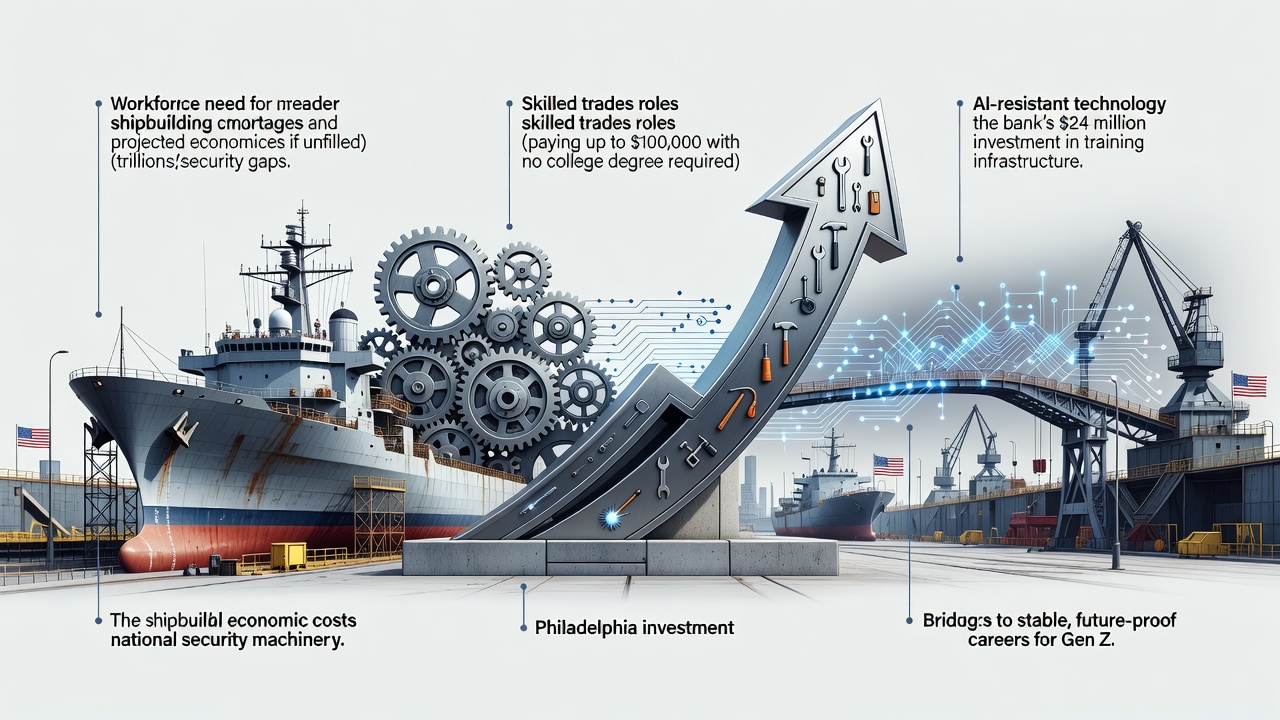
Jamie Dimon stood at the Philadelphia Navy Yard this week. He delivered a blunt assessment. The U.S. shipbuilding sector stands dangerously behind global competitors. It needs hundreds of thousands more skilled hands to catch up.
“We need 300,000 electricians, welders, etc. to build ships in the next five or 10 years,” the JPMorgan Chase CEO told CNBC. He didn’t stop there. These roles pay well. They require no college degree. And they resist easy automation.
Dimon’s message carries weight. It comes as his bank commits fresh capital to the cause. Yet the gap he describes runs deeper than one announcement. It reflects years of underinvestment, an aging workforce, and competition from sectors that pull talent elsewhere. But for a generation entering the job market, it signals opportunity.
The numbers paint a stark picture. JPMorganChase’s own PolicyCenter and Center for Geopolitics estimate demand for 250,000 new skilled shipbuilding workers over the next decade. That figure aligns closely with Dimon’s 300,000 projection when broader timelines and roles enter the equation. Philadelphia Navy Yard employs roughly 16,000 today. Dimon expects that headcount to double within five years if domestic production accelerates.
The Investment That Matches the Warning
JPMorgan Chase announced a $24 million package this week. It mixes loans, equity investments and grants. The bulk supports a new submarine manufacturing and assembly facility by Rhoads Industries at the Navy Yard. That project alone should create 450 permanent jobs. Another slice expands training and apprenticeship programs. Those efforts target thousands of prospective welders, electricians, pipefitters and related trades.
The bank also directs funds toward up to 100 small maritime suppliers. Regional collaboration gets a boost too. “America can compete and lead in shipbuilding again—it starts with more skilled workers and secure supply chains,” Dimon said in the bank’s press release. “When we build the workforce and the supply chain together, we create good careers for workers and a stronger, more resilient maritime industry that supports our national security and our economy.”
This move sits inside JPMorgan’s larger $1.5 trillion Security and Resiliency Initiative. Launched last year, the program targets industries tied to economic and national security. Shipbuilding fits neatly. Geopolitical tensions from conflicts in Ukraine and the Middle East have sharpened focus on domestic production capacity. “The arsenal of democracy has been reignited,” Dimon told CNBC’s Andrew Ross Sorkin.
Yet the challenge extends far beyond Philadelphia. Hanwha Philly Shipyard, which bought the facility in 2024 for $100 million, delivers only one to one-and-a-half ships per year. In South Korea, the parent company turns out vessels basically one a week, according to Hanwha Philly CEO David Kim. Training capacity tells a similar story. The U.S. yard prepares about 20 apprentices at a time. Korean sites handle roughly 400 simultaneously.
Virginia faces parallel pressures. The Hampton Roads region shows a current shortage of 10,000 shipyard workers. Projections put that figure at 40,000 by 2030, according to local reporting. Huntington Ingalls Industries invests more than $110 million a year in workforce development. CEO Chris Kastner highlighted progress in the company’s 2026 first-quarter earnings call. “We hired over 1,600 shipbuilders in the first quarter,” he said. “We also graduated nearly 200 apprentices from our apprentice schools this year, and our apprentice schools are now at full enrollment.”
These efforts matter. They still fall short of the scale required. A March report from McKinsey analyzed U.S. Department of Labor data. It projected a 200,000-to-250,000 worker shortfall in critical occupations such as welding, soldering and frontline management over the next decade. That estimate predates Dimon’s updated call to action. An aging cohort compounds the problem. Twenty-seven percent of current shipbuilders are 55 or older.
Broader skilled trades face similar headwinds. An analysis of U.S. Department of Education data by JLL forecasts 2.1 million unfilled positions across trades by 2030. Annual economic losses could hit $1 trillion. Construction, energy projects, data centers and semiconductor plants all compete for the same talent pool. Companies have taken notice. Lowe’s pledged $250 million to train 250,000 workers in plumbing, carpentry and electrical trades over 10 years. BlackRock committed $100 million to prepare 50,000 more. Meta launched its $115 million America’s Workforce Academy in June. The program guarantees jobs for data center technicians after five weeks of training.
“America needs hundreds of thousands of skilled tradespeople—electricians, mechanics, fiber technicians, and more—and this program creates clear, accessible pathways into those careers,” Rachel Peterson, Meta’s vice president of data centers, said at the launch.
Sen. David McCormick joined Dimon in Philadelphia. The Pennsylvania Republican, whose wife leads policy at Meta, emphasized the contrast with white-collar anxiety. Artificial intelligence has unsettled office workers. Demand for experienced welders and electricians, by comparison, runs red hot. “If you’re an experienced welder or electrician, we can’t get enough of you,” McCormick said. “We have to have a workforce that meets this incredible demand.”
Apprentices at the Philly yard echo that sentiment. Many came from lower-paying roles at Amazon warehouses or in retail. The work proves demanding. Summers scorch. Winters freeze. Conditions turn dangerous. Pay and prospects outweigh those drawbacks. A three-year apprenticeship can lead to six-figure earnings. Workers earn while they learn. No student debt accumulates.
Dimon framed the stakes clearly. “It fits what we call the American dream: getting kids skills or all workers’ skills that they have jobs that could pay 80-, 90-, $100,000 a year after you know a year or two of training. This lifts up America. It helps build the defense industry.”
The defense angle carries extra force. Less than 1% of commercial ships built worldwide fly under the U.S. flag. Domestic yards once powered wartime production. Today they struggle with high costs, aging infrastructure, inconsistent demand and supply-chain bottlenecks. JPMorgan’s report notes these structural issues. It calls for better alignment on training, supplier capacity, facility upgrades and capital access.
Philadelphia officials welcomed the announcement. Mayor Cherelle L. Parker highlighted investment in people. “When organizations like JPMorganChase invest in Philadelphia, they’re investing in our people,” she said. City Council President Kenyatta Johnson pointed to family-sustaining careers and manufacturing leadership. Private partners such as PIDC and the Greater Philadelphia Partnership stressed cross-sector coordination.
Still, systemic barriers remain. Stigma around vocational paths persists. Younger workers often prefer urban service jobs. Clearance requirements for naval work shrink the pool further. Turnover at some yards approaches 100%. Substance issues surface in isolated reports.
Dimon and his bank don’t pretend one investment solves everything. The $24 million represents a targeted start. It pairs capital with training. It links suppliers to shipyards. And it spotlights careers that deliver immediate wages, clear advancement and resistance to AI displacement.
Gen Z faces a labor market transformed by technology. Many chase tech roles that promise high pay but carry burnout risks and constant upskilling demands. Skilled trades offer a different bargain. Hands-on work. Tangible output. Compensation that can outpace entry-level office positions within a few years. Locations cluster in specific hubs. Philadelphia, Hampton Roads, Mobile, Newport News. Relocation becomes part of the calculation.
Yet the upside grows as shortages intensify. Shipbuilding sits at the intersection of national security, economic resilience and workforce development. Dimon’s warning and JPMorgan’s money underscore a simple truth. The country cannot rebuild maritime strength without workers ready to weld, wire and fit pipes. Those workers cannot emerge without deliberate investment in training pipelines that start now.
Other sectors watch closely. Data centers need electricians. Factories need machinists. The competition for talent will only sharpen. Companies that fund apprenticeships, pay during training and map clear paths to six figures stand to gain. Public policy that eases credentialing, expands vocational access and reduces regulatory friction could accelerate progress.
For now, Dimon’s Philadelphia stop serves as both alarm and invitation. The U.S. lags. The need is urgent. The pay is real. And a new generation might just answer the call.


 WebProNews is an iEntry Publication