
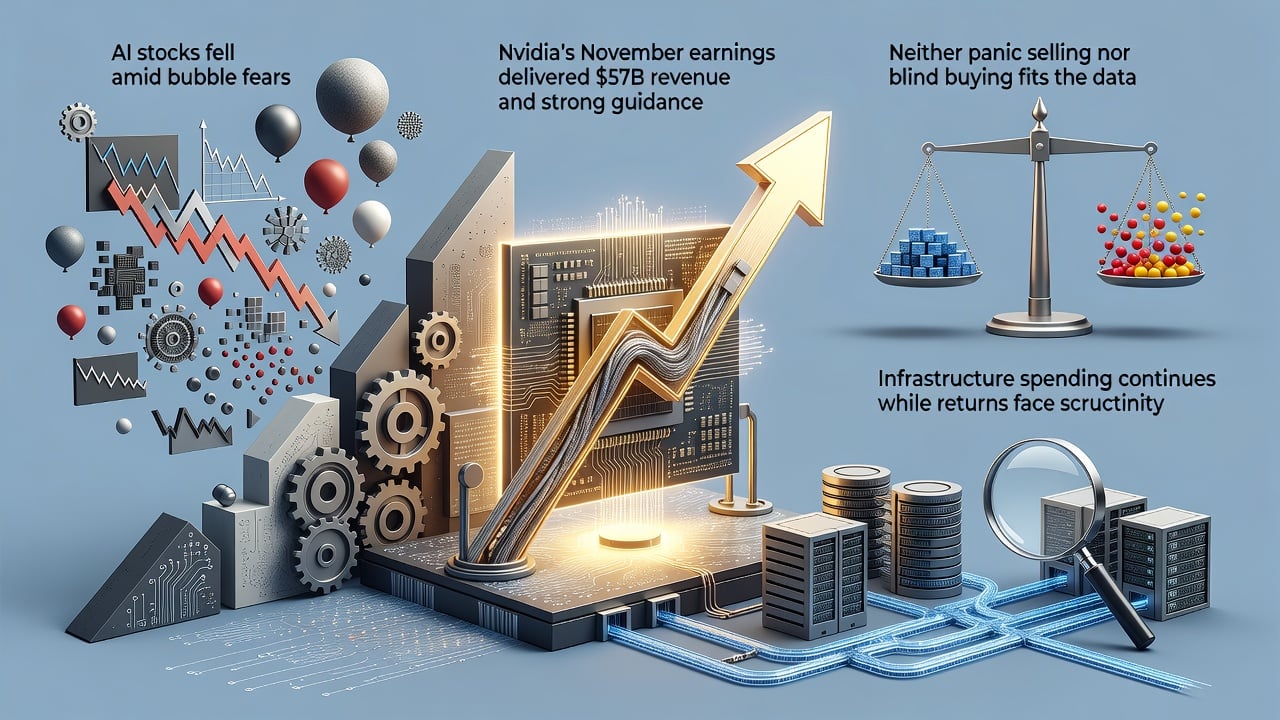
Wall Street has spent weeks on edge. AI-related shares tumbled in recent sessions. Concerns mounted that years of breakneck investment in the technology might finally be hitting limits. Yet fresh earnings reports paint a picture of demand that refuses to fade. The situation defies simple labels.
Austin Rogers laid out the case clearly in Seeking Alpha. He examined the sharp drop in stocks tied to AI infrastructure. The big question, he wrote, centered on whether this marked a bubble bursting or merely a dip worth buying. His answer surprised some. Neither.
Short sentences capture the tension. Markets swung. Valuations compressed. But the underlying forces showed little sign of cracking. Rogers pointed to Taiwan Semiconductor Manufacturing and ASML Holding. Both delivered solid results. They raised capital spending plans. No slowdown appeared in sight.
Bulls leaned on that evidence. Major cloud providers kept committing billions. The race for dominance in artificial intelligence models continued without pause. Bears countered with different data. Returns on these massive outlays looked set to disappoint. Competition among model developers had intensified. Differences between leading systems had narrowed. The payoff, they argued, might never justify the expense.
Market Reaction Meets Earnings Reality
Then came November. Nvidia reported results that silenced many doubters. Revenue for the three months ended in October reached $57 billion. That beat forecasts of $54.9 billion. Growth hit 62 percent from a year earlier. Data center sales, the heart of its AI business, climbed 66 percent to more than $51 billion. The company guided current-quarter revenue toward $65 billion. Analysts had expected less. Shares jumped in after-hours trade. BBC News captured the shift. Nvidia eased investor worries about heavy AI spending that had unsettled broader markets.
Jensen Huang spoke directly to the fears. “There’s been a lot of talk about an AI bubble. From our vantage point, we see something very different,” the chief executive said. The quote ran in multiple outlets. It underscored a simple point. Demand for high-end chips showed no signs of abating. Orders for future Blackwell systems reportedly topped $500 billion. That figure circulated widely after the release.
But the story runs deeper than one earnings beat. Reuters examined the stakes days before the announcement. “Bubble or breakout? Nvidia earnings put AI boom under the microscope,” its headline read. The piece noted that Nvidia had become the world’s most valuable company. Its results served as a leading indicator for AI-linked spending across the economy. Expectations had grown lofty. Growth rates had cooled from triple-digit levels. Yet the company had topped forecasts for 12 straight quarters. The margin of surprise had narrowed. Reuters highlighted the tension.
AP News added context on the same day. Nvidia cleared a high bar set by analysts. Its performance might calm jitters that the technology boom could turn into a bust. Sales of computing chips powering the AI surge rose sharply. Earnings per share climbed 65 percent. The report suggested feverish demand remained intact. AP News reported those details.
ABC News framed the outcome as a direct rebuke. “Chip giant Nvidia beats revenue expectations with 62% growth, rebuking warnings of an AI bubble.” The article stressed Nvidia’s role as a bellwether. Its results carried weight for the stock market and the broader economy. ABC News emphasized that angle.
NBC News took the analysis further. “What AI bubble? Nvidia’s strong earnings signal there’s more room to grow.” The piece described the report as a positive sign for markets and the economy. Huang again dismissed bubble talk on the investor call. The network noted that U.S. stock futures rose on the news. NBC News connected those dots.
So where does that leave investors? The original Seeking Alpha analysis warned against knee-jerk reactions. Buying every dip carries risk when valuations remain stretched. Selling in panic ignores the tangible progress in chip production, data center buildouts, and model capabilities. The arms race, as Rogers termed it, rolls on. Companies show no inclination to step back.
Recent social media chatter reflects the confusion. Users on X traded jokes and skepticism in equal measure. Some dismissed bubble fears outright. Others pointed to limitations in current systems. Real-time sentiment proved mixed at best. No consensus emerged.
Longer term, the picture grows more complex. Returns on AI investment will depend on breakthroughs beyond raw compute power. Enterprises must find ways to turn these tools into measurable profit. Early pilots have delivered promise in some sectors. Others report modest gains at high cost. The gap between hype and delivered value persists.
Analysts continue to debate multiples. Nvidia trades at premiums that assume decades of dominance. Suppliers such as TSMC and ASML face their own pressures from geopolitical risks and cyclical semiconductor patterns. A single quarter of strong data does not resolve every question. But it does push back the timeline for any potential reckoning.
Watch the next round of earnings. Hyperscalers will report capital expenditure plans. Chip designers will detail new product road maps. Any softening in forward guidance could revive the bear case. Sustained strength would reinforce the bull argument. The middle ground that Rogers described looks increasingly plausible. Markets may grind higher. They may consolidate. Dramatic pops or crashes appear less likely in the near term.
And that leaves portfolio managers in a bind. They cannot ignore the sector’s momentum. They also cannot dismiss the possibility that current spending levels prove unsustainable. Selective exposure to companies with clear paths to profitability offers one path. Broad index funds provide another. The data keeps coming. Interpretation remains the hard part.


 WebProNews is an iEntry Publication