
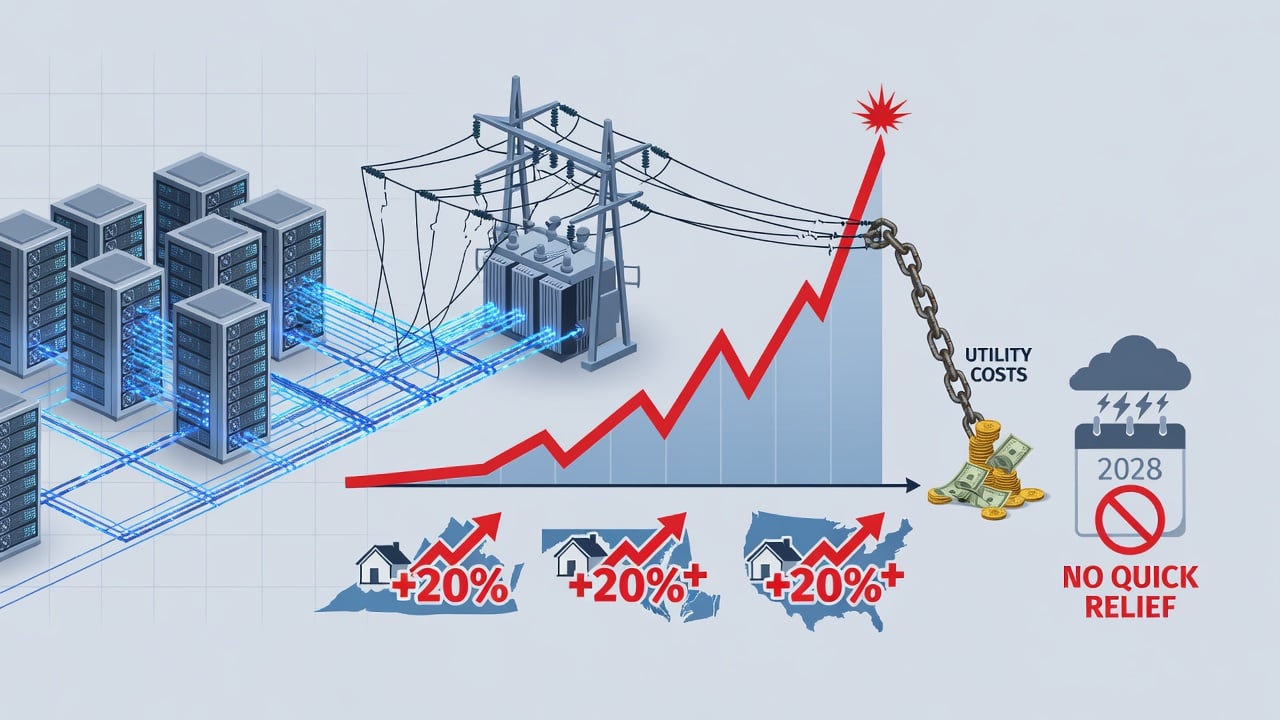
John Steinbach opened his January 2026 electricity bill and stared. $281. The month before it had been about $100. “It’s just so far beyond any bill that I’ve ever had,” he told Consumer Reports. Steinbach lives in Manassas, Va. Data centers blanket the area. He fears rates will climb further as tech giants race to build more.
His story repeats across regions. From northern Virginia to parts of the Midwest, residents face sudden spikes. The cause traces to one source. Artificial intelligence demands computation at a scale once unimaginable. That computation lives in warehouses packed with servers. Those servers devour electricity.
The Scale of Demand
U.S. data centers used 176 terawatt-hours in 2023. They accounted for 4.4 percent of national electricity. By 2028 that figure could hit between 325 and 580 terawatt-hours, or 6.7 to 12 percent. So says a December 2024 report from Lawrence Berkeley National Laboratory, released by the U.S. Department of Energy.
Global numbers paint an even sharper picture. Data centers consumed roughly 415 terawatt-hours worldwide in 2024. The International Energy Agency sees that rising to 945 terawatt-hours by 2030 under a base case. AI workloads drive most of the growth. One analysis even floats a high-end scenario near 1,050 terawatt-hours by 2026. That would rank data centers as the world’s fifth-largest electricity consumer, ahead of many nations. Details appear in a Brookings Institution piece from April 2026 that draws on IEA data.
But. These projections shift often. New models emerge. Efficiency gains arrive. Yet the trajectory holds. Demand surges faster than supply can match.
Utilities scramble. Grid operators sound alarms. In the PJM Interconnection, which covers 14 states from Illinois to the mid-Atlantic, data-center needs have already added billions to customer costs. An independent market monitor tallied more than $9.3 billion in added expenses for the 12 months through mid-2025. Later updates pushed the cumulative hit toward $23 billion by 2028. The New York Times reported on the latest auction results in July 2026. Another $6.3 billion in charges will hit over the next three years.
Wholesale prices tell part of the tale. In zones thick with data centers they have climbed as much as 267 percent over five years. Bloomberg tracked the numbers. Its September 2025 analysis linked the jumps directly to new facilities. Those costs pass through. Baltimore Gas & Electric customers saw monthly bills rise more than $17 after one auction. Another record auction in 2025 will add up to $4 more starting mid-2026.
Dominion Energy cited data-center growth when it sought rate hikes in Virginia. Average residential bills could jump about $20 a month over two years. Customers flooded regulators with complaints. Similar stories surface in Oregon, where Portland General Electric weighs new rate designs. And in Ohio, where officials have tried to make data centers cover minimum energy commitments.
Residents feel it first. Laura Evans lives near a data center in suburban Chicago. Her bill climbed 23 percent in a year. Backup generators hum constantly, 1,000 feet from her yard. She told ABC News in a February 2026 segment that budgeting has become impossible. “How do you budget when it’s changing that much in a year? You can’t.”
Tech companies promise solutions. OpenAI stated it would pay its own way at planned Stargate sites so operations do not lift local prices. Yet such pledges remain rare. Most facilities connect to the shared grid. They draw power alongside homes and factories.
Old infrastructure complicates matters. Many substations and transmission lines serve multiple customers. Utilities struggle to assign exact responsibility for new demand. Data centers optimize minute by minute. They shift loads to dodge peak charges. The original Futurism article highlighted this tactic. It compared the practice to strategies once used by Enron. Bitcoin miners in Texas have secured subsidies for load shifting without reducing overall consumption.
New York took a blunt approach. It banned certain AI data centers to protect the grid and rates. Most states chase the jobs and tax revenue instead.
Who Pays and Why It Matters
Rate structures decide the outcome. In regulated markets, utilities recover infrastructure costs from all customers. Data centers may sign special contracts. Still, upgrades for new connections often spread broadly. A Harvard Law School analysis from September 2025 noted that facilities under development will consume more power than large cities. Harvard professor of law William Boyd and legal fellow Eliza Martin co-wrote a related paper that argues ratepayers subsidize Big Tech’s expansion.
Goldman Sachs offered its own forecast in early 2026. Electricity prices rose 6.9 percent in 2025, more than double general inflation. The bank expects further 6 percent annual increases through 2027 before easing. Data centers will represent 40 percent of demand growth. Consumer spending could dip 0.2 percent. Economic growth might slow 0.1 percent. The bank spelled out the math in a February report covered by CNBC.
Some research offers counterpoints. The Electric Power Research Institute found data centers actually lowered average prices through 2024 by improving grid utilization. Asa Watten, an EPRI researcher, said residential rates would have been 6 percent higher without those facilities. That study, released in July 2026 and discussed by Marketplace, focused on the period before the latest AI boom accelerated. It also pointed to aging infrastructure, storms and natural-gas prices as bigger drivers in recent years.
Yet forward-looking models agree on pressure ahead. Bloom Energy predicted U.S. data-center demand will nearly double from 80 gigawatts in 2025 to 150 gigawatts in 2028. That equals adding Spain’s entire power needs in three years. A Fortune article from May 2026 warned that some states could see generation costs rise more than 50 percent by 2030. Virginia might face a 57 percent jump.
Tech giants pour money in. Google, Microsoft, Meta and Amazon plan to spend hundreds of billions on data centers this year alone. Northern Virginia remains the epicenter. New clusters form in Arizona, Ohio, Nebraska and beyond. Each project needs land, water for cooling, permits and, above all, reliable megawatts.
Grid reliability faces tests. A voltage fluctuation in northern Virginia in 2024 tripped 60 data centers at once. That created a sudden 1,500-megawatt surplus and forced emergency fixes. The Belfer Center at Harvard described the incident in a February 2026 analysis of AI and the electric grid. If forecasts prove too high, utilities risk building excess capacity that customers still pay for.
So utilities court data-center operators with special rates. Some states offer tax breaks. Others demand guarantees that new plants will be built. The tension grows. Public anger builds. Protests against data centers occurred in 42 states in mid-2026, according to recent posts on X. Demonstrators cite power draw, water use and constant noise.
Eric Schmidt, former Google CEO, told Congress that data centers will need 29 gigawatts of extra power by 2027 and 67 more by 2030. Anthropic projected the U.S. AI sector alone could require 50 gigawatts of new capacity by 2028. That equals twice New York City’s peak demand.
Supply lags. Power plants take years to construct. Transmission lines face even longer timelines. Copper shortages add friction. AI data centers act like electricity refineries. Power flows in. Intelligence flows out. Without abundant, affordable electricity the entire enterprise stalls.
Companies respond with on-site generation. Many install natural-gas generators. Some explore small nuclear reactors. Others buy directly from private producers. These steps reduce grid pressure but raise questions about emissions and local air quality.
Regulators sit in the middle. They must balance economic growth against household budgets. They approve rate cases. They review infrastructure plans. They hear from angry constituents. A recent Fortune piece from July 14, 2026, captured the frustration. Data centers have already driven $23 billion in higher electricity bills. “Good luck clawing that back.”
The numbers keep rising. Gartner projected data-center electricity consumption would grow 26 percent in 2026. Google admitted in its 2026 environmental report that its own power use has jumped more than 250 percent since 2019, largely from AI.
Steinbach in Virginia watches new facilities break ground. “They’re building them like it’s Field of Dreams,” he said. “Build it and the electricity will come. But we don’t see how that’s going to happen.”
His bill tells one truth. The grid tells another. The AI race continues. Everyone else pays the tab. For now.


 WebProNews is an iEntry Publication