
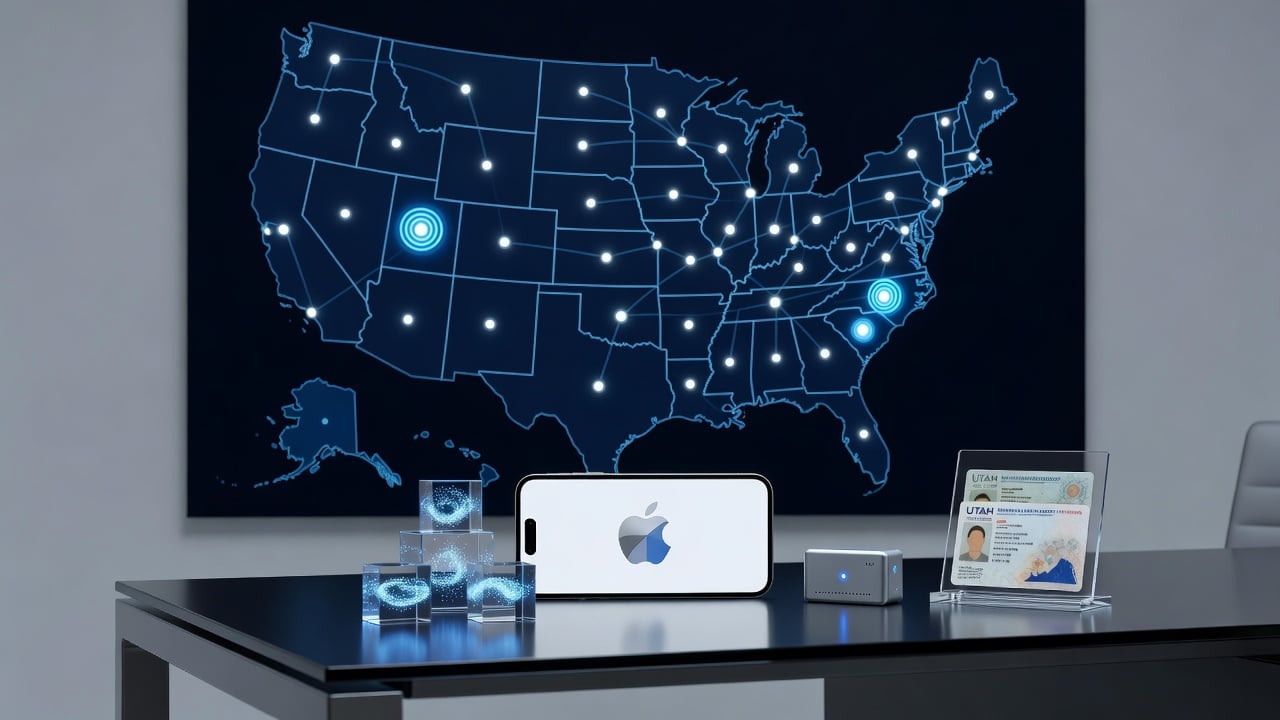
Apple’s push to turn iPhones into digital wallets for official identification just got a fresh jolt. Two more states appear ready to join the growing list of jurisdictions that let residents store driver’s licenses and state IDs directly in Apple Wallet.
Analyst Aaron Perris spotted references to Utah and Virginia in Apple’s backend code. The discovery, shared on X late Wednesday, signals that both states have cleared technical hurdles on Apple’s side. Launch timing still rests with state motor vehicle agencies. Yet the backend signals point to imminent availability. Residents there could soon pull out their phones instead of fumbling for plastic cards at airport checkpoints or age-restricted venues.
The feature has advanced in fits and starts since its 2022 debut in Arizona. Early momentum felt sluggish. Only a handful of states signed on in the first few years. Then activity picked up. Arkansas came online in May 2026. Illinois, Montana, North Dakota and West Virginia rolled out during the past year. Today the total stands at 14 states plus Puerto Rico, according to MacRumors.
That pace reflects real coordination challenges. Each state must update its licensing systems, train staff and meet federal standards for mobile driver’s licenses. Apple provides the technical framework. DMVs handle the heavy regulatory lifting. The result? A patchwork rollout that leaves millions of iPhone owners still carrying physical cards.
9to5Mac first reported Perris’s findings Thursday morning. The longtime Apple watcher, who contributes to MacRumors, noted Utah’s reference surfaced recently while Virginia’s appeared back in May. Neither integration has gone live. Their presence in Apple’s systems, however, offers the clearest indicator yet that both states have completed much of the required backend work.
Utah already offers a standalone mobile driver’s license app. That program predates Apple Wallet support. State officials have said existing users will transfer their digital IDs once Wallet integration arrives. Virginia, for its part, joined the list of committed states in early 2026 alongside Connecticut, Kentucky, Mississippi, Oklahoma, Arkansas and others. No firm dates were announced then. The latest code references suggest movement.
Here’s how the system operates. Users open the Wallet app, tap to add an ID and follow on-screen prompts. They scan the front of their physical license, hold the phone near the card to read an embedded chip, take a selfie and perform a series of head movements. The process verifies identity without sending full data to Apple. Once added, the digital version lives securely on the device.
At TSA checkpoints the phone never needs to unlock. A double-click of the side button brings up the Wallet. The user holds the device near the reader. Face ID or Touch ID authenticates. Only the specific information requested by the agent appears on screen. The traveler reviews it, approves and the transaction completes. No physical card changes hands. No sensitive details leave the phone unless explicitly shared.
That selective disclosure sits at the heart of the design. Apple cannot see when or where a user presents their ID. The company receives no copy of the data. Encryption and on-device storage keep everything local. Biometric authentication adds another barrier. These safeguards address long-standing worries about digital identity theft and mass surveillance.
Businesses have begun to adopt the technology too. Some bars and retailers now accept Wallet IDs for age verification. Select apps request identity proof without forcing users to type in details or upload documents. The list of compatible locations grows steadily though it remains far smaller than the number of TSA checkpoints already equipped. More than 250 airports across the country support the feature for domestic travel.
Apple itself highlighted the privacy architecture when it expanded the program last fall. In a November 2025 newsroom post the company noted that 12 states plus Puerto Rico had gone live. Recent additions at that time included Montana, North Dakota and West Virginia. International expansion reached Japan with support for that country’s My Number Card. Jennifer Bailey, Apple’s vice president of Apple Pay and Apple Wallet, said the feature expands ways users can store and present identity while preserving the security built into iPhone and Apple Watch. The full announcement appears at apple.com.
Yet practical limitations persist. Law enforcement in most places still demands a physical card. Digital IDs supplement rather than replace them. Travelers must carry their driver’s license for rental cars or international flights. And not every state moves at the same speed. Some DMVs cite budget constraints or legacy technology as reasons for delay. Others have embraced the change and pushed for faster integration.
Perris’s findings arrive at a moment when digital wallets feel less like science fiction and more like standard procedure. Google and Samsung offer competing systems. Several states support their IDs in multiple wallets. The competition may accelerate adoption. For Apple the stakes involve more than convenience. Each new state strengthens the Wallet’s position as the default home for sensitive credentials. Passports, insurance cards, transit passes and now official IDs all live in one place.
Industry watchers expect additional states to follow Utah and Virginia before year’s end. The full list of committed but not-yet-live jurisdictions still includes Connecticut, Kentucky, Mississippi and Oklahoma. Arkansas already launched. That leaves a clear pipeline. If the recent acceleration holds, half the country could offer Wallet IDs by late 2027.
Users in supported states report mixed but generally positive experiences. The setup takes time. Presentation at security lines moves faster once agents grow familiar with the process. Privacy-conscious consumers appreciate the granular controls. Others simply like leaving one less item in their pockets.
Of course challenges remain. Battery life worries surface during long travel days. Phone loss or theft requires immediate remote wipe capabilities. And older adults or those without compatible devices get left behind. These issues explain why states continue to issue physical cards alongside digital versions.
Still the trajectory looks clear. What began as a pilot in a few Western states has matured into a national program with international echoes. Utah and Virginia stand ready to join. Their residents will soon discover what millions already know. The future of identification fits in your pocket. It stays under your control. And it works without surrendering data you never meant to share.
The latest reports from 9to5Mac and MacRumors underscore how close that future has come. Backend readiness often precedes public announcements by mere weeks. Watch for official confirmation from Utah’s Department of Public Safety or Virginia’s DMV. When it arrives the number of Americans who can leave their wallets at home will tick upward once again.


 WebProNews is an iEntry Publication