
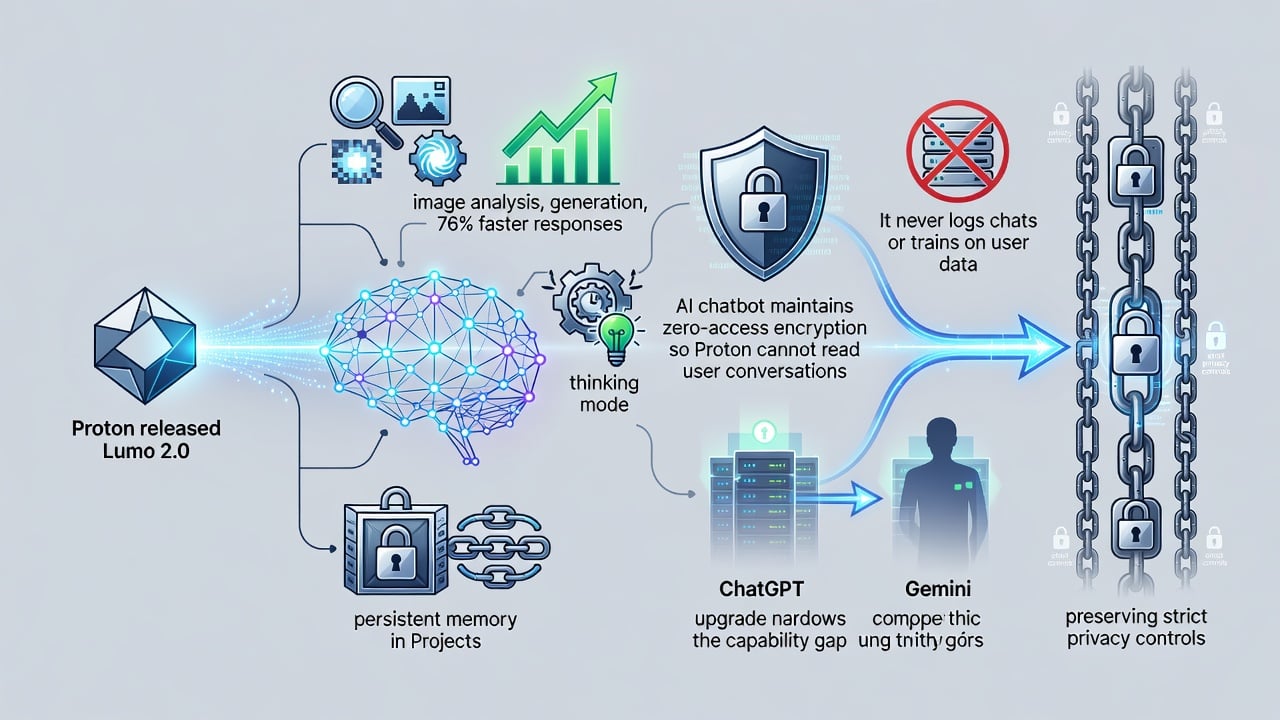
Proton just gave its privacy-focused AI chatbot a serious boost. Lumo 2.0 arrived Tuesday with image recognition, image generation, faster replies and a new thinking mode for tougher questions. The changes matter. They show a company built on encrypted email now pushing hard into artificial intelligence without compromising the one thing users expect from it: control over their data.
Privacy Architecture That Stands Apart
Lumo operates on zero-access encryption. Conversations stay encrypted in transit and at rest. Only the user holds the keys. Proton cannot read them. The company keeps no server-side logs. It refuses to train models on user chats or share information with third parties. That stance sets it against the standard practices at OpenAI, Google and others.
The approach echoes Proton’s origins. The Swiss firm started with Proton Mail years ago. It grew into a full productivity suite that competes with Google Workspace while promising users their information never leaves their control. Lumo extends that promise. TechCrunch first reported the 2.0 release and noted the chatbot now matches the usefulness of Gemini and ChatGPT in format and detail. Yet the privacy layer remains its defining feature.
And the numbers look solid. Most queries now receive answers up to 76 percent faster than before. A new thinking mode lets the system pause, reason through complex problems and deliver better results. Persistent memory inside the Projects feature remembers user preferences across sessions. Upload a document once. The bot recalls context later. Useful for ongoing work that spans email, calendar and cloud storage.
Image features expand the toolkit. Users drag in photos. Lumo analyzes them, suggests edits or generates new pictures from text prompts. The combination feels practical rather than flashy. It gives knowledge workers another option when they want to avoid feeding sensitive material into commercial models.
But here’s the tension. Many users still choose speed and capability over strict privacy. ChatGPT, Claude and Gemini improved dramatically in the past year. They handle longer contexts, produce sharper code and generate more convincing output. Lumo 2.0 narrows the gap. It does not erase it. Proton acknowledges the trade-off. The free tier works for basic tasks. Paid Plus and Professional plans unlock higher limits, more storage and priority access.
Andy Yen, Proton’s founder and CEO, made the positioning clear. “Lumo 2.0 has been re-engineered from the ground up and the introduction of thinking mode gives it powerful new capabilities,” he said. “Lumo 2.0 demonstrates that users no longer need to choose between powerful AI capabilities and meaningful privacy protections.” The quote appears in the TechCrunch article and captures the company’s core argument.
Recent coverage reinforces the message. A Verge story from last year detailed the original launch and quoted Proton spokesperson Betsy Jones on TLS encryption for data in transit and asymmetric encryption of prompts. Only the GPU servers decrypt them temporarily. Saved chats remain locked to the user’s device. The architecture survived scrutiny so far.
Open-source code for the mobile apps adds credibility. Developers can inspect it. Auditors can verify claims. Proton has long used transparency as a competitive weapon. It open-sourced parts of its VPN and email clients too. The pattern continues.
Still, questions linger. European regulators eye AI rules closely. Switzerland’s own encryption debates surfaced on X in recent months. One user noted Proton’s privacy policy references German law in case the company shifts operations. Regulatory pressure could test the zero-access model. So could law enforcement requests. Proton says it cannot comply with demands it cannot fulfill. That defense worked for its email service. It will face fresh tests with AI.
Performance feedback remains mixed. Some X users praise Lumo for simple tasks and encryption. Others say it lags behind frontier models on creative or highly technical work. One post from earlier this year admitted refunding a subscription because the model “isn’t there yet” despite its ethical design. The gap may close. Proton runs models from Mistral, Nvidia and the Allen Institute on its European servers. No reliance on OpenAI or Chinese providers. That independence appeals to governments and enterprises wary of foreign data risks.
The upgrade arrives at an interesting moment. Big tech pours billions into ever-larger models. Data privacy scandals continue to surface. Enterprises hunt for tools that meet compliance standards without sacrificing productivity. Proton bets organizations will pay for that balance. Lumo Plus costs roughly $10 to $13 monthly depending on term. The price sits below some enterprise AI offerings while delivering features that integrate with Proton’s existing mail, drive and calendar.
Analysts watch closely. If Lumo gains traction among privacy-conscious professionals, it could carve a niche much like Signal did in messaging. The product already supports document summarization, code generation, email drafting and now visual analysis. Projects turn it into something closer to a workspace companion than a pure chatbot.
Speed gains matter too. Seventy-six percent faster response times reduce friction. Thinking mode tackles the weakness many chatbots share on multistep reasoning. Persistent memory solves the forgetfulness that frustrates repeated use. These improvements address real user complaints.
Even so, Proton must keep iterating. Competitors ship updates weekly. Image generation quality will face direct comparisons to Midjourney or DALL-E. Reasoning depth will be measured against o1-style models. The privacy advantage buys time. It does not guarantee victory.
Users face a choice. Hand data to companies that monetize it through training and advertising. Or accept some performance trade-offs to keep conversations truly private. Lumo 2.0 narrows that compromise. It does not eliminate it. The product proves a point Proton has made for over a decade: privacy and functionality can coexist. The market will decide how many people value that combination enough to switch.
Proton built Lumo on its own infrastructure in Europe. It avoided third-party APIs that could leak data. The decision raises costs but protects the brand. Recent articles highlight the same discipline. A Proton blog post from the original launch spelled out the no-logs, no-training policy in detail. The 2.0 update builds directly on that foundation rather than bolting privacy onto an existing commercial model.
The timing feels deliberate. As governments debate AI regulation and companies audit their vendor lists, a European provider with audited encryption stands out. Whether that differentiation drives mass adoption remains uncertain. Early signs suggest interest among security-focused teams and individual users tired of data scandals.
Lumo 2.0 won’t replace every AI tool in a power user’s arsenal. It might become the default for sensitive work. That niche could prove profitable and strategically important. Proton already serves millions with mail and VPN. Adding a trusted AI assistant strengthens the entire account. Users stay inside the walled garden where encryption rules.
The upgrade signals confidence. Proton believes it can compete on capabilities while leading on trust. The coming months will test that bet. Faster models, better memory and visual tools give users more reasons to try it. The privacy architecture gives them reason to stay. For an industry wrestling with data ethics, that combination deserves attention.


 WebProNews is an iEntry Publication