
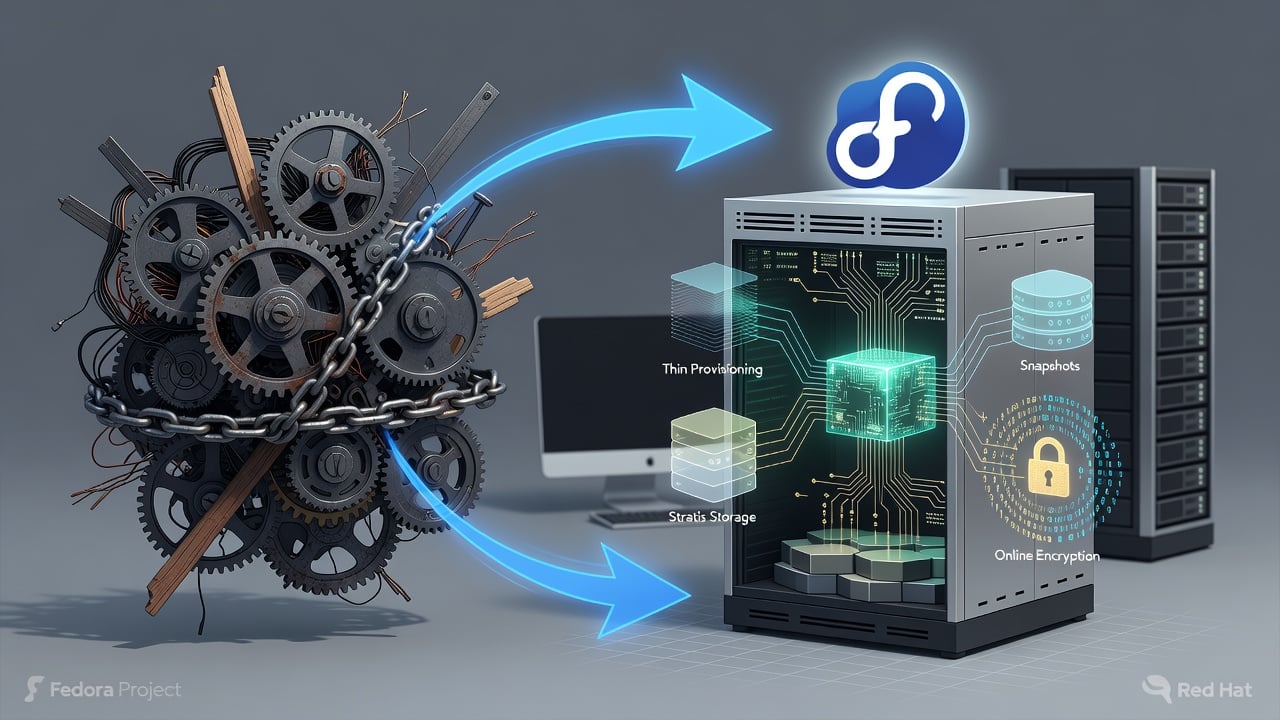
Red Hat engineers spent the better part of a decade building Stratis as a practical answer to complex Linux storage needs. Now a fresh proposal could make that work far more accessible. With Fedora 45 on the horizon, users may soon select Stratis during a standard installation and use it for the root filesystem without custom scripts or unsupported hacks.
The change, submitted by Red Hat engineer Vojtech Trefny, targets the Anaconda installer. It adds support for both automated Kickstart deployments and manual partitioning through the new Anaconda WebUI powered by Cockpit Storage. Phoronix first reported the filing on June 30, 2026. The proposal still requires approval from the Fedora Engineering and Steering Committee. Yet the momentum feels real.
Stratis has sat in Fedora repositories since version 28. Administrators could deploy it for data volumes. Root filesystem use demanded extra steps. That gap limited uptake. “While Stratis has been available in Fedora since Fedora 28, the lack of installer support has been a significant barrier to adoption: users could not use Stratis for their root filesystem without resorting to manual, unsupported workarounds,” the proposal states, according to the Fedora Discussion forum post.
The technology itself layers proven components. It sits atop XFS for the filesystem, device-mapper for volume handling, LUKS for encryption, and a Rust-written daemon for management. The result delivers thin provisioning, snapshots, cache tiers and encryption through one command-line interface and D-Bus API. No need to juggle separate tools with conflicting conventions. Stratis handles the orchestration.
Recent improvements strengthen the case. Stratis 3.9, released in April 2026, introduced online encryption, decryption and re-encryption. Pools no longer require encryption at creation time. Administrators can add or remove it later. They can rotate keys without downtime. The release also lets systems start pools even if cache devices are missing. Phoronix covered the 3.9 launch on April 27, 2026.
Earlier, Fedora 44 already shipped Stratis 3.9.0. The Register noted the update appeared quietly in sysadmin release notes. Author Liam Proven highlighted its architecture. He described Stratis as an “innovative combination” of existing Linux storage technology and recalled its original aim as a GPL-licensed option with fewer complications than some alternatives. The Register published its Fedora 44 review on April 29, 2026.
Implementation details look straightforward. The proposal adds three packages to the installer image: stratisd, stratis-cli and stratisd-dracut. Size impact stays modest. Anaconda grows by roughly 28 megabytes. The live ISO increases about 13 megabytes. Changes touch Blivet and pykickstart but leave the older GTK interface untouched. Upgrades remain unaffected. Only fresh installs gain the option.
Kickstart users will see new commands. Examples include autopart --type=stratis for automatic layouts. Manual configurations define block devices, create a pool, then carve filesystems for root and home. The WebUI flow launches the Cockpit storage editor, lets users build the pool and filesystems, then proceeds with those settings. Documentation will appear on the Stratis project site and in pykickstart references.
Benefits target both newcomers and veterans. Casual users see no difference. Default behaviors stay intact. Advanced administrators gain a simpler path to modern features. Snapshots become routine. Thin provisioning avoids over-allocation surprises. Encryption integrates without extra layers. And the single management plane reduces errors that arise when administrators stitch LVM, XFS and cryptsetup by hand.
Stratis never set out to replace every storage stack. It works within the existing Linux device-mapper framework rather than introducing a new filesystem from scratch. That choice brings stability. It also invites comparison with Btrfs, which Fedora already supports for root installs in some editions. The proposal acknowledges that tension. Observers will watch adoption numbers once the feature lands. Will workstation users embrace it? Server deployments?
Red Hat ships Stratis in current RHEL releases for data volumes. The Fedora push could accelerate testing and feedback that eventually flows upstream. Community interest has surfaced before. Older forum threads show administrators experimenting with encrypted root setups via third-party scripts. One such tool, hosted on GitHub by bmr-cymru, offered a stopgap for those willing to accept the risk.
Yet official support changes the equation. Testing becomes part of the standard QA cycle. Documentation improves. Integration with SELinux, boot loaders and dracut gains scrutiny. The proposal owner has coordinated with Stratis developers where needed. Contingency plans exist. If issues surface before beta freeze, the feature can revert without derailing the release.
Storage management in Linux has long split between simplicity and power. LVM delivers flexibility but demands attention to detail. Btrfs offers copy-on-write convenience at the cost of occasional sharp edges. Stratis tries a different balance. It hides complexity behind a consistent interface while preserving the maturity of XFS and device mapper. The Rust daemon adds memory safety to the control plane.
Success will hinge on real-world experience. Early adopters can already experiment using live images and custom kickstarts, as the Stratis team documented on their site. But native Anaconda support removes friction. It signals that the project has matured enough for default inclusion.
Fedora 45 remains months away. The proposal must pass its vote. Discussion threads show no opposition so far. Feedback periods invite input on edge cases. Performance on varied hardware. Interaction with immutable variants or container tooling. Those conversations will shape the final form.
Still, the direction looks clear. After years of availability without easy entry, Stratis stands ready for broader use. One installer change could open the door. Administrators who manage fleets or value snapshots will take notice. So will anyone tired of piecing storage solutions together command by command.
The proposal itself frames the shift modestly. Users uninterested in advanced configurations will see no difference. For those who are, a first-class option arrives. Simple as that. And in the conservative world of enterprise storage, simple carries weight.


 WebProNews is an iEntry Publication