
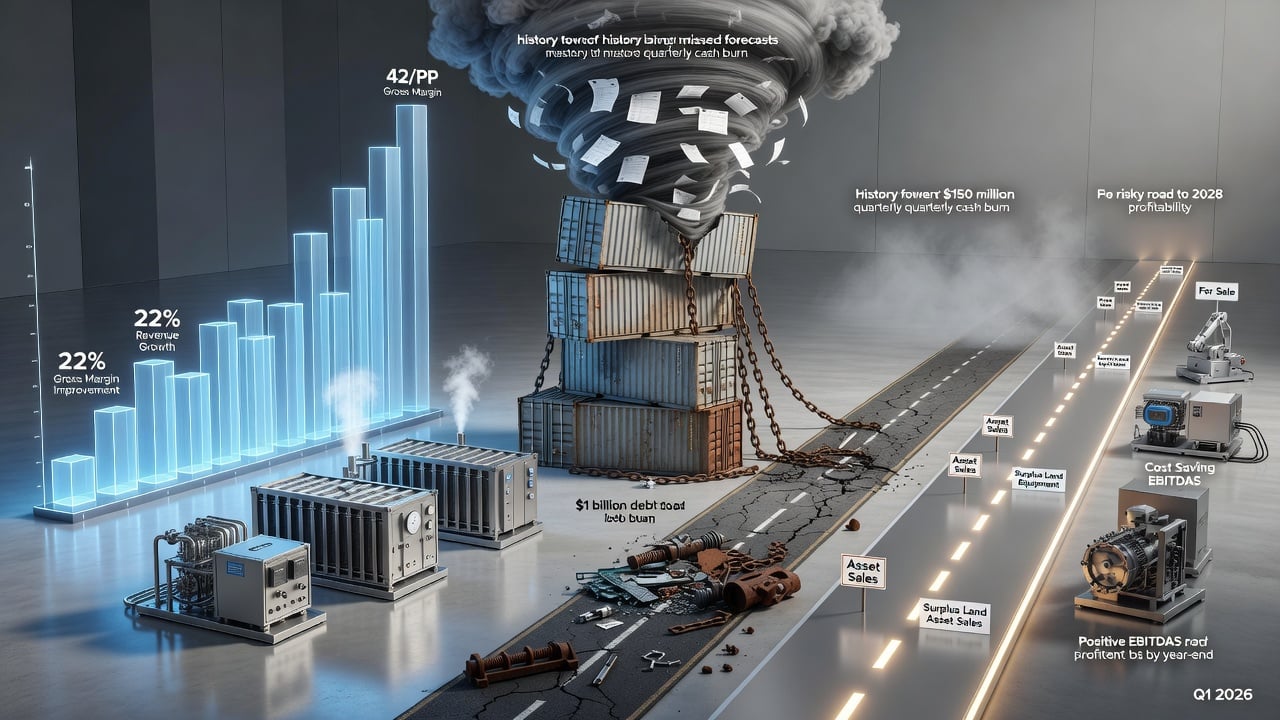
Plug Power has spent nearly three decades promising profits that never arrived. Founded in 1997, the company has never posted a full-year profit. Losses mounted even as it built a sprawling hydrogen network spanning production, delivery and end-use applications. Yet something shifted in early 2026.
Revenue climbed 22% to $163.5 million in the first quarter. Gross margin swung from negative 55% a year earlier to negative 13%. Adjusted earnings per share narrowed to an 8-cent loss from 17 cents. And management now points to a concrete milestone: positive EBITDAS in the fourth quarter of 2026.
From Perpetual Losses to a Defined Timeline
CEO Jose Luis Crespo struck a measured tone. “Our first quarter results reflect strong commercial execution and continued progress improving the underlying economics of the business and positions us to achieve our EBITDAS positive target in Q4 2026,” he said in the Plug Power Q1 2026 earnings release. The numbers back some of that optimism. Electrolyzer revenue exploded from $9.2 million to $40.8 million. Hydrogen fuel sales rose 22%. Service costs for fuel-cell units in material-handling applications dropped more than 30%.
But. History casts a long shadow. As a Motley Fool analysis published July 2, 2026 noted, Plug once forecast EBITDA breakeven in 2014. It finished that year with negative $33.6 million. A 2016 target met the same fate. Investors have heard variations of this story before. This time management offers more than a distant 2028 full-profitability goal. It lays out quarterly checkpoints and operational fixes under an initiative called Project Quantum Leap.
That program, launched in late 2024, targeted $150 million to $200 million in annual expense reductions through workforce cuts, facility consolidation, pricing discipline and capital restraint. Early evidence shows in the margin line. CFO Paul Middleton called the gross-margin swing an “inflection point” during the earnings call. He added that the company’s hydrogen production network “is built. We’re now in a leverage-the-asset-base phase.”
And yet cash continues to leave the building. Operating cash use reached $150 million in the first quarter. Total liquidity stood at $802 million, but only $223 million was unrestricted. The company expects to release restricted cash at roughly $50 million per quarter. It also anticipates $275 million from asset monetization, including a deal with a data-center developer, plus nearly $40 million from transferring investment tax credits on a Louisiana hydrogen project. Those moves buy time. They do not erase the need for disciplined execution.
Material-handling operations, long the cash engine, showed real gains. Expansions at Amazon and Walmart sites continued. Per-unit service costs fell sharply thanks to better stack reliability. Demand benefits from companies seeking to cut grid dependence amid rising electricity prices and data-center power hunger. Electrolyzers, meanwhile, sit on an $8 billion project pipeline. Deployed capacity exceeds 320 megawatts globally. Recent wins include a 100-megawatt system for Galp Energia in Portugal and a 25-megawatt project with Iberdrola and BP in Spain.
Still, hydrogen production margins remain sensitive to input costs. Plug operates about 40 tons per day of capacity across Georgia, Tennessee and Louisiana. It has struck supply deals with industrial gas providers to lower third-party fuel expenses. Volumes matter. Higher utilization spreads fixed costs. Management expects sequential margin gains through the rest of 2026 as these improvements compound.
Market reaction reflected guarded hope. Shares rose after the May earnings report. Year-to-date gains at one point exceeded 90%, though volatility remains high. Analysts track the cash-burn trajectory as closely as revenue. One Substack report from May highlighted that accumulated deficits now top $8.5 billion. The company carries roughly $1 billion in debt. Dilution risk lingers if additional equity raises become necessary.
Project Quantum Leap goes beyond cost cuts. It includes reprioritizing capital away from certain Department of Energy loan pursuits toward higher-return hydrogen network opportunities. A non-binding letter of intent to monetize electricity rights at select sites could generate liquidity while freeing balance-sheet capacity. These steps signal a shift from pure growth-at-all-costs to measured scaling.
External support helps. The finalized 45V clean-hydrogen production tax credit improves project economics. European and U.S. policy emphasis on energy security and industrial decarbonization lifts demand signals for both green ammonia and sustainable aviation fuel pathways. Plug has advanced talks in Uzbekistan on tax incentives and offtake for e-SAF.
Yet risks stack up. Project delays, permitting hurdles, fluctuating commodity prices and changes in government incentives could derail timelines. Macroeconomic pressures, including interest rates and supply-chain issues, add friction. The earnings release lists these factors explicitly in its forward-looking statements disclaimer. Actual results may differ materially.
So what would success look like? Positive EBITDAS by year-end would mark the first sustained sign that operational improvements translate to the bottom line. Positive operating income in 2027 and full profitability in 2028 remain the longer targets, as reaffirmed in recent disclosures. Meeting the near-term marker would rebuild credibility eroded by past misses.
Investors face a binary setup. If margins continue their upward path and cash burn declines as projected, the scaled platform could finally support consistent earnings. But repeated capital raises or renewed losses would likely punish the stock further. Recent X discussions among retail traders echo this tension, with some highlighting the short interest and asymmetric upside while others point to the long history of unkept promises.
Plug no longer sells a vision alone. It sells execution against concrete financial targets. The next several quarters will test whether those targets hold. The hydrogen economy may be gaining traction. For Plug Power, the question is narrower. Can it stop burning cash before the cash runs out?


 WebProNews is an iEntry Publication