
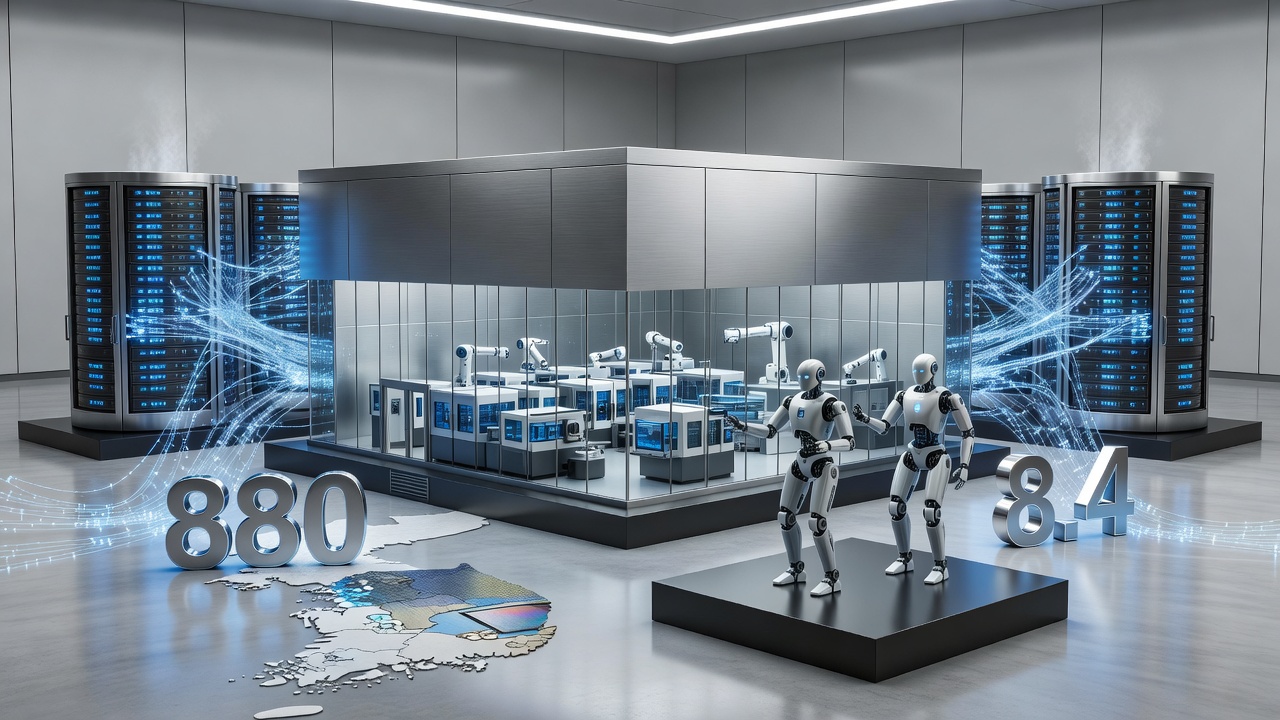
South Korea just dropped a bombshell. The government, together with its tech titans, plans to pour at least $880 billion into semiconductors, robotics and artificial intelligence over the next decade. The announcement landed Monday with President Lee Jae-myung chairing a high-stakes briefing alongside leaders from Samsung Electronics and SK Hynix. Speed matters here. Lee told executives the country must secure core AI elements faster than any rival or risk falling behind.
The figure, equivalent to 1,350 trillion won, captures commitments from private industry more than direct government outlays. Samsung and SK Hynix stand at the center. Their factories already produce the high-bandwidth memory chips that power AI training systems worldwide. Now they will build new fabrication plants in the southwest region around Gwangju and South Jeolla province. The move aims to spread economic gains beyond Seoul’s crowded metropolitan core. Rural areas have suffered from decades of industrial concentration. Lee calls it a matter of survival.
Three mega-projects form the backbone of the strategy.
First come the semiconductor hubs. Samsung will invest 400 trillion won, roughly $259 billion, in new fabs in Gwangju plus another 56 trillion won for advanced HBM production lines in Cheonan and Onyang. The company projects total domestic spending of 2,450 trillion won from 2026 through 2040, with the bulk directed at semiconductor clusters in Pyeongtaek and Yongin. SK Hynix, meanwhile, accelerates its fourth fab at Yongin, finishing by 2033 instead of the prior 2045 target. The firm commits about 400 trillion won to a new southwest production base, scaling with market demand. Overall, SK Group expects to spend more than 100 trillion won annually in South Korea for the next 10 years, according to Chairman Chey Tae-won.
These numbers dwarf previous cycles. Memory chip expertise gives South Korea an edge. The country houses the world’s two largest producers of the specialized DRAM used in AI servers. Yet competition intensifies. Taiwan’s TSMC dominates contract manufacturing. China’s SMIC advances despite export controls. The U.S. pumps subsidies into Intel and GlobalFoundries through the CHIPS Act. Seoul refuses to watch from the sidelines.
Second, the plan targets AI data centers. SK, GS Group and Naver will invest around 550 trillion won in an initial phase to create 8.4 gigawatts of capacity. Construction starts no later than the first half of 2028. Total spending could exceed 1,000 trillion won by 2035. SK Telecom eyes partnerships with global tech firms and overseas capital to fund the buildout. Data centers now consume enormous power. They also demand the exact memory chips South Korean firms excel at producing. The investments close that loop.
Third, physical AI and robotics receive fresh focus. Seoul wants to rank among the world’s top three AI robot powers and claim the number one spot in physical AI by 2030. Humanoid robots tailored to 10 major industries should reach commercialization in 2028. The government will establish data factories for training, back development of Korean foundation models, and train 10,000 specialists in AI robotics over five years. Earlier national strategies already directed hundreds of millions of dollars toward the sector. Venture capital in Korean robotics startups jumped to $340 million in 2025 from $180 million in 2023. Chaebols such as Hyundai and LG pour billions more into automation each year.
But, the scale here feels different. President Lee frames the entire package as three “mega-projects” that will drive the next phase of economic growth. His office describes it as a national “great leap.” Regional balance forms a key selling point. New chip clusters in the southwest should create jobs far from the capital. Past efforts to decentralize industry produced mixed results. This time the private sector’s skin in the game runs deeper.
Analysts see clear logic. Global demand for AI accelerators shows no sign of slowing. Nvidia’s dominance in GPUs leaves room for memory leaders to expand. Samsung and SK Hynix already supply HBM to multiple GPU makers. New fabs will let them capture more of the value chain. Yet execution carries risks. Building leading-edge facilities costs tens of billions per plant. Process yields at 2-nanometer and below remain finicky. Talent shortages plague the industry everywhere.
Markets reacted immediately. SK Hynix shares climbed after the announcement, pushing its market value above $100 billion at points. The broader KOSPI index gained on optimism that the commitments will sustain South Korea’s technological edge. Local media had previewed even larger figures. Some reports spoke of 2,000 trillion won when including all related spending through 2035 or 2040. The confirmed $880 billion still ranks among the largest coordinated industrial bets in recent memory.
The Information first outlined the 10-year, $880 billion scope targeting chips, robotics and AI. BBC News detailed President Lee’s emphasis on speed and regional equity, quoting his warning that failure to act would mean decline for rural economies. Reuters laid out the project-by-project breakdown, from the 8.4 GW data center target to the 2030 robotics ambitions and SK’s annual investment pledge. Today’s Bloomberg coverage described the effort as an orchestrated bet on infrastructure “essential to surviving the AI era.” A Reuters video briefing underscored the $576 billion slice alone dedicated to AI chip production.
Earlier signals pointed in this direction. Samsung Group reportedly prepared a separate 1,000 trillion won domestic investment roadmap. Government ministries had already launched smaller initiatives, such as 800 billion won to develop 10 homegrown on-device AI chips. The new package folds those efforts into something far larger. It also aligns with updated national robotics goals that aim for 15 percent global market share by 2028.
Challenges remain. Geopolitical tensions could disrupt equipment supplies. The Netherlands and Japan joined U.S. export controls on advanced tools to China, and South Korea participates in those arrangements. Any escalation might affect Seoul’s own access. Energy demands for the new data centers and fabs will test the national grid. Water usage in chip manufacturing adds another constraint in a country with limited natural resources.
Still. The bet looks serious. Samsung and SK Hynix aren’t promising vague future spending. They detail specific fabs, timelines and dollar amounts. The government offers tax incentives, a new investment fund and streamlined permitting. Ten thousand new robotics specialists won’t appear overnight, but the training pipeline now has a deadline.
Global technology supply chains have fragmented since the pandemic. Nations scramble for self-sufficiency in critical components. South Korea, with its proven track record in memory and displays, sees an opening in AI infrastructure. Success would cement its position as an indispensable player. Failure would hand more ground to Taiwan, the United States or an emboldened China.
Lee Jae-myung’s administration clearly chose urgency. The briefing with corporate chiefs signaled unity. Private capital, not just state subsidies, will do the heavy lifting. And that may prove the plan’s greatest strength. When Samsung and SK commit hundreds of billions, markets listen. Suppliers invest. Engineers relocate. Momentum builds.
Whether the full $880 billion materializes depends on demand, profits and execution. Chip cycles have wrecked forecasts before. AI spending, however, continues to surprise to the upside. If that trend holds, South Korea’s factories will sit at the heart of it. The southwest may finally get its industrial renaissance. And the country could enter the 2030s not just as a memory chip leader but as a comprehensive AI systems power.
So the stakes are clear. This isn’t another incremental policy tweak. It’s a decade-long mobilization with defined targets in fabs, gigawatts and humanoid deployments. Industry insiders will watch capex numbers, construction timelines and talent recruitment closely. The world will feel the effects in AI hardware costs, robot capabilities and supply chain resilience for years to come.


 WebProNews is an iEntry Publication