
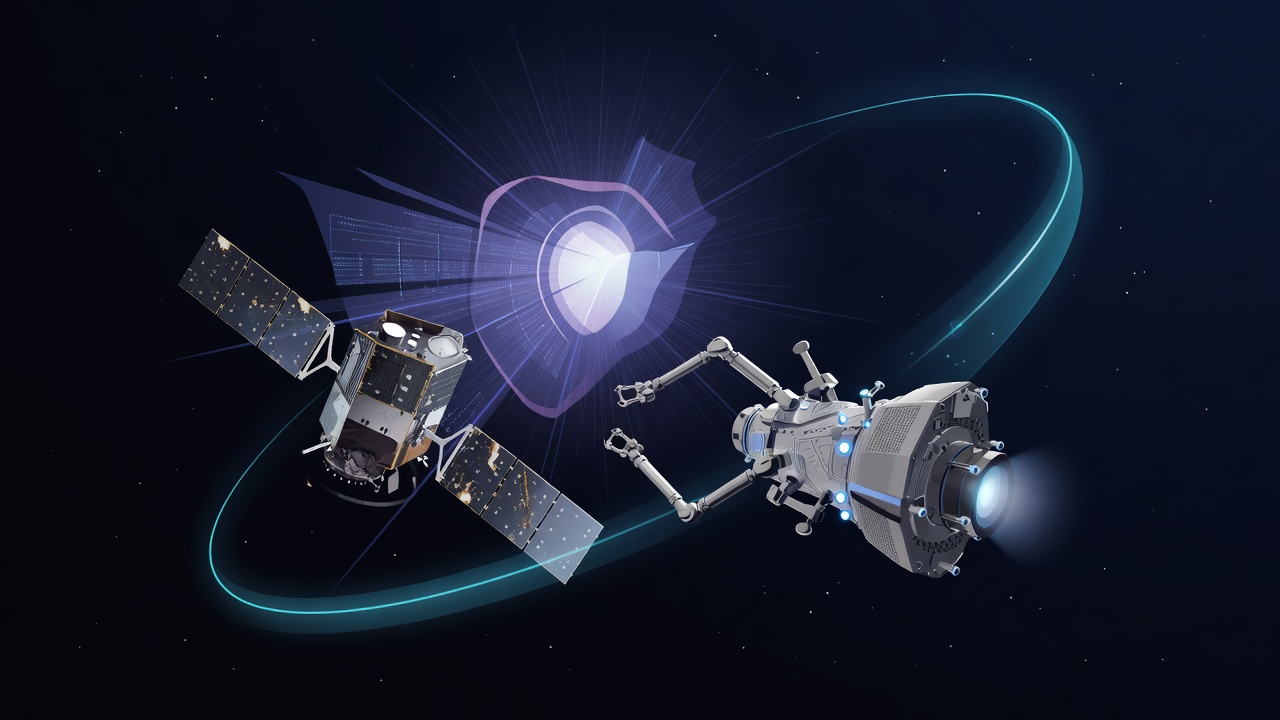
NASA faces a deadline measured in months. Its Neil Gehrels Swift Observatory, a workhorse telescope that has spotted thousands of gamma-ray bursts since 2004, sits in a decaying orbit. Without action, it will tumble back into Earth’s atmosphere later this year and burn up. The agency turned to a small startup for an audacious fix. The result is a first-of-its-kind autonomous capture-and-boost mission set to launch any day now.
The spacecraft is called Link. Built by Katalyst Space Technologies, it will ride to space on a Pegasus XL rocket dropped from an airplane over the Pacific. Once in orbit, Link will chase down Swift, grab it with a three-armed gripper, and fire its thrusters to raise the observatory’s altitude from 224 miles to 373 miles. Success means years of continued science. Failure leaves one more piece of orbital debris on a collision course with the planet. No one thought it was going to be possible.
Swift launched in November 2004. It revolutionized astronomers’ understanding of the most violent events in the cosmos. Gamma-ray bursts, black hole births, neutron star mergers. The observatory’s instruments catch these fleeting phenomena and relay alerts to ground telescopes within minutes. Data from Swift helped confirm that some bursts come from collapsing massive stars. It supported the discovery of gravitational wave counterparts. Its contributions stretch across two decades.
But fuel reserves ran low. Orbital decay accelerated. By 2024 NASA realized the telescope would reenter by late 2025 or early 2026 unless something changed. Budget realities ruled out a traditional servicing mission. The Hubble Space Telescope had received shuttle visits in its prime. Those days are gone. So the agency looked for something cheaper. Faster. Riskier.
Enter Katalyst. The California-based startup proposed a purpose-built tug. NASA awarded the company a $30 million contract in 2025. Development moved at record speed. Less than a year from contract to launch pad. Ghonhee Lee, Katalyst’s CEO, described the pace as intense. “We had to build something that had never been done before,” he told NBC News in a recent interview. The company drew on prior concepts, including billionaire Jared Isaacman’s proposals to service Hubble with a similar robotic arm system.
Link is no simple probe. It carries a sophisticated guidance system for rendezvous with a tumbling target. Its three arms will clamp onto Swift’s structure without damaging solar panels or instruments. Once attached, the combined stack will perform a series of carefully calculated burns. The entire process could take several months. Rendezvous alone is expected to require about a month. Orbit raising will follow in stages to minimize risk.
Nicky Fox, associate administrator for NASA’s Science Mission Directorate, defended the expenditure. The telescope still produces valuable data, she noted. Extending its life preserves a key asset for multi-messenger astronomy. Yet not everyone agrees. Some scientists question whether $30 million could be better spent on new missions. Others worry about the technical challenges of grabbing a satellite never designed for capture.
The mission carries real engineering uncertainty. Swift spins as its orbit lowers. Link must match that motion precisely. Any misalignment during grappling could damage both vehicles. Communication delays add another layer of difficulty. The operation relies heavily on onboard autonomy. Ground controllers will monitor but cannot react in real time.
Katalyst engineers tested the hardware in thermal vacuum chambers at NASA’s Goddard Space Flight Center. Photos released by the agency show the spacecraft during environmental testing earlier this year. The team practiced capture sequences with mockups. Still, orbital mechanics rarely cooperate perfectly. One missed burn or unexpected tumble could doom the effort.
This isn’t NASA’s first brush with satellite servicing. The agency once considered robotic refueling demonstrations. Private companies have removed defunct satellites from geostationary orbit. But capturing and boosting a live scientific observatory in low Earth orbit breaks new ground. Success would validate a new model for keeping aging spacecraft alive. One that doesn’t require astronauts or billion-dollar shuttles.
Recent coverage highlights the stakes. A Associated Press report from yesterday detailed the launch window opening as soon as Tuesday from the Marshall Islands. The article quotes mission managers emphasizing the narrow margin before Swift reaches its point of no return. Another piece in the Los Angeles Times published just hours ago explores whether the investment justifies the science return. It notes Swift’s continued role in spotting rare cosmic events that other telescopes might miss.
Science.org offered a deeper technical look last week. Its June 17 article outlined how the rescue craft will approach from below, match velocities, then extend its arms. The piece quotes project scientists who admit the timeline was aggressive. “We built this in record time,” one engineer said. The story also connects the mission to broader discussions about space sustainability. Extending satellite lifetimes reduces the need for frequent replacements and cuts down on future debris.
But questions linger about Boeing’s separate troubles with its Starliner program. While unrelated to Swift, the contrast is hard to ignore. NASA relied on SpaceX to bring home two astronauts after Starliner encountered thruster and helium leaks in 2024. That episode stretched a short test flight into a nine-month stay on the space station. Crew-9 eventually returned the astronauts safely in March 2025, as reported by NASA and covered extensively by CNN and other outlets. The agency now certifies vehicles more cautiously. That caution shapes its approach to the Swift rescue too.
Katalyst’s Link represents a different philosophy. Commercial innovation meeting government need. Small company agility replacing large contractor bureaucracy. If it works, NASA gains a template for future interventions. Telescopes, climate monitors, even defunct national security satellites could receive similar treatment. The model echoes commercial crew but on a smaller, robotic scale.
Critics point to the risk. A failed capture could create more debris. It might accelerate Swift’s reentry. Insurance and liability questions remain murky. Yet the alternative is certain loss. The telescope falls. Science stops. Another gap opens in our view of the violent universe.
Launch preparations continue at a rapid clip. The Pegasus rocket, air-launched from a modified jet, offers flexibility. No pad delays from weather on the ground. The mission team watches orbital predictions closely. Every day counts as Swift loses altitude.
Should Link succeed, astronomers will gain breathing room. Swift could operate well into the 2030s. Its burst alerts will continue feeding global observatories. New generations of scientists will analyze data from a spacecraft kept alive by a robotic arm from a startup that didn’t exist a few years ago.
The coming weeks will test years of work. Engineers, astronomers, and executives all hold their breath. One successful grapple could change how NASA thinks about its aging fleet. One slip and the gamble becomes an expensive lesson. Either way, the mission marks a shift. From accepting loss to fighting for every extra year of discovery.
And the universe keeps exploding. Swift stands ready, if Link can reach it in time.


 WebProNews is an iEntry Publication