
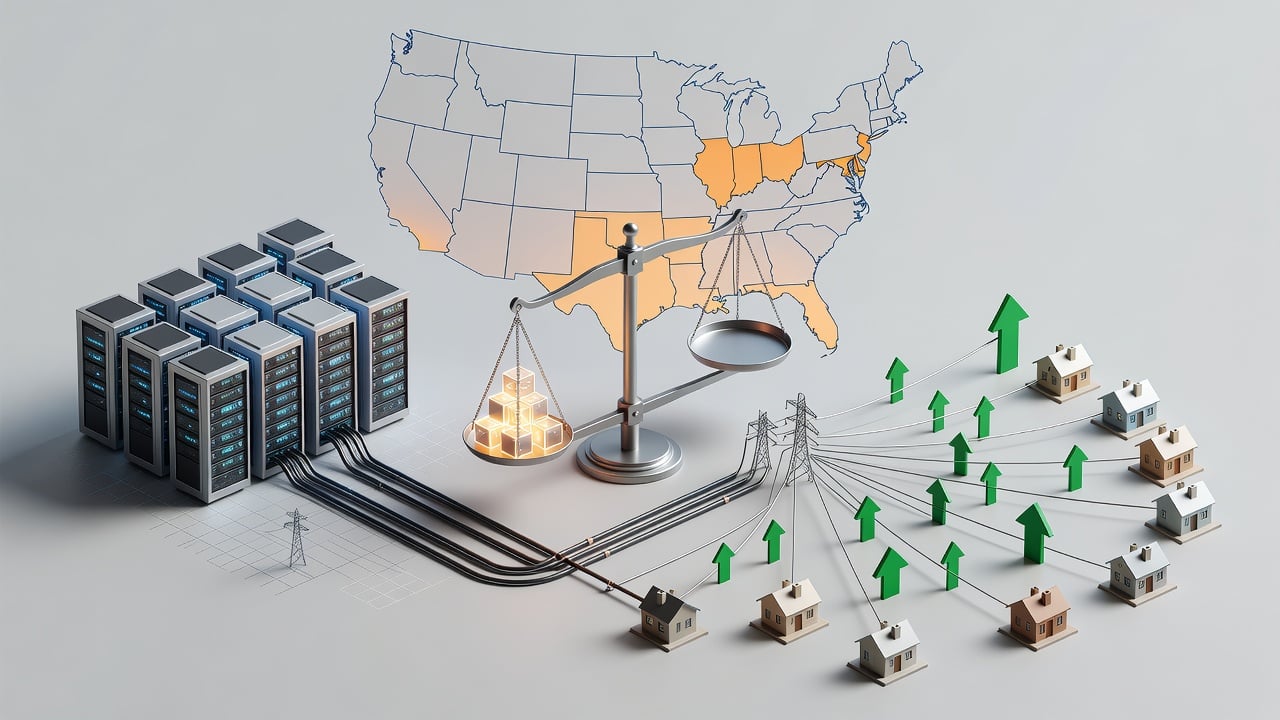
Electric bills have climbed in pockets of Colorado and Florida. Families there point to the sprawling data centers cropping up to feed artificial intelligence. Lawmakers from both parties say enough. They want the companies driving that demand to cover the upgrades instead of passing costs to everyone else.
The Ratepayer Protection Act would push state regulators to create what it calls a large load standard. Any new customer pulling 100 megawatts or more, the typical size for an AI data center, would have to pay the full incremental cost of generation, transmission lines, and other grid work. Utilities could spread recovery over many years through special rates or contracts. Yet the risk stays with the operator. If the data center scales back or shuts down, the company still owes. No surprise bills for neighbors.
Rep. Kathy Castor, a Florida Democrat, introduced the measure with Rep. Gabe Evans, a Colorado Republican. “My neighbors across Florida are grappling with skyrocketing electric bills,” Castor said in a statement on her House website. “Ratepayers should not have to subsidize wealthy corporations’ growing energy demands, especially from AI data centers.” Evans struck a similar note. “Colorado families, farmers, and small businesses should not be forced to cover the costs of new power generation driven by these developments.”
The bill builds directly on an earlier effort Castor co-sponsored, the SHIELD Act with Rep. Mike Levin of California. It also codifies key pieces of a voluntary pledge President Trump extracted from industry earlier this year. On March 4, 2026, executives from Amazon, Google, Meta, Microsoft, OpenAI, Oracle and xAI gathered at the White House. They agreed to build, bring or buy enough new power to meet their needs and to pay for all related infrastructure upgrades. The pledge, first previewed in the February State of the Union, carried no penalties. It was a handshake. This legislation aims to turn that promise into law.
House Energy and Commerce Chairman Brett Guthrie, a Kentucky Republican, backed the approach. “Families and small businesses across the country shouldn’t be left to foot the bill for this new development, though the benefits of these innovations will be felt by all of society,” he said, according to CNBC reporting on the subcommittee schedule. “The Ratepayer Protection Act is a bipartisan effort, which would ensure that the costs of grid upgrades are appropriately paid for according to demand.” A subcommittee took up the measure in late June. Momentum has grown as midterm elections near and voter frustration with higher utility rates simmers.
Data center electricity demand is no longer marginal. The Bipartisan Policy Center projected in a February 2025 report that data centers could claim 25 percent of new U.S. electricity demand by 2030. The Energy Information Administration has tracked load growth averaging 2.1 percent annually over the past five years, much of it tied to these facilities. That surge strains an aging grid already short on new generation. Utilities in some regions have delayed connections or sought rate hikes to cover upgrades. Locals notice. Projects have faced protests over noise, water use and higher bills.
But. The tech sector has not fought the core idea. Microsoft President Brad Smith wrote in a January 2026 blog post, cited by the Center for a New American Security in an analysis published in May, that profitable tech companies should pay their own way. “Especially when tech companies are so profitable, we believe that it’s both unfair and politically unrealistic for our industry to ask the public to shoulder added electricity costs for AI.” The company has already negotiated higher tariffs in places like Wyoming and Wisconsin to cover its load.
Senators have joined the conversation. In February Josh Hawley, Republican of Missouri, and Richard Blumenthal, Democrat of Connecticut, introduced the GRID Act. It would require data centers to secure separate power sources and give consumers priority on the existing grid. Their language is tougher in spots. Still, the House bill has drawn wider early support because it works through state regulators rather than creating a new federal mandate. It gives states tools. It does not dictate outcomes.
And the timing matters. AI investment shows no sign of slowing. Hyperscalers plan dozens of new campuses. Each one can equal the power draw of a small city. Without clear cost allocation, utilities may socialize those expenses across all customers. That means a farmer in rural Colorado or a restaurant owner in Tampa could see monthly increases to subsidize compute clusters training the next model. Proponents argue this breaks basic fairness. The user who creates the marginal demand should pay the marginal cost.
Critics of the bill worry about delays. Stringent financial assurances and long-term payment schedules could raise hurdles for smaller developers or slow the very innovation Washington claims it wants to win against China. Evans himself framed the measure in competitive terms. America must build the energy infrastructure to lead in AI. Yet families should not carry the tab.
The legislation also nods to reliability. Under the pledge, signatories promised to make backup generation available during emergencies. The bill stops short of requiring that but leaves room for states to add such conditions. Grid operators have warned that rapid load additions without matching supply create congestion and raise prices for all. A recent hearing before the House Energy Subcommittee on Energy, covered on YouTube by the committee, featured testimony that large loads should bear both costs and risks.
Recent coverage reinforces the stakes. A story published just yesterday by TED Magazine notes the bill, numbered H.R. 9340, would prevent residential bills from rising by shifting fixed costs back to the large users. It echoes the same quotes from Castor and Evans. Political will has clearly hardened. Similar ideas have surfaced in Illinois under the POWER Act and in other states watching PJM Interconnection’s territory.
So what happens next? The subcommittee vote in late June likely sends the measure to full committee. From there it could reach the House floor before the August recess. Senate prospects remain unclear, though the Hawley-Blumenthal bill provides a companion vehicle. Industry has signaled it can live with the framework. Many companies already negotiate special rates. The law would simply make that practice standard and protect utilities from stranded costs.
Electricity markets have operated for decades on the principle that costs follow causation. Large industrial customers have long paid demand charges and contributed to infrastructure. Data centers are simply the newest, and largest, version of that customer class. The Ratepayer Protection Act tries to update the regulatory playbook before the surge becomes unmanageable. Whether it passes in its current form or evolves, the debate has crystallized a basic question. Who pays for the power that makes AI possible? Lawmakers on both sides of the aisle now say it should not be the families, the farmers, or the small businesses watching their bills climb.


 WebProNews is an iEntry Publication