
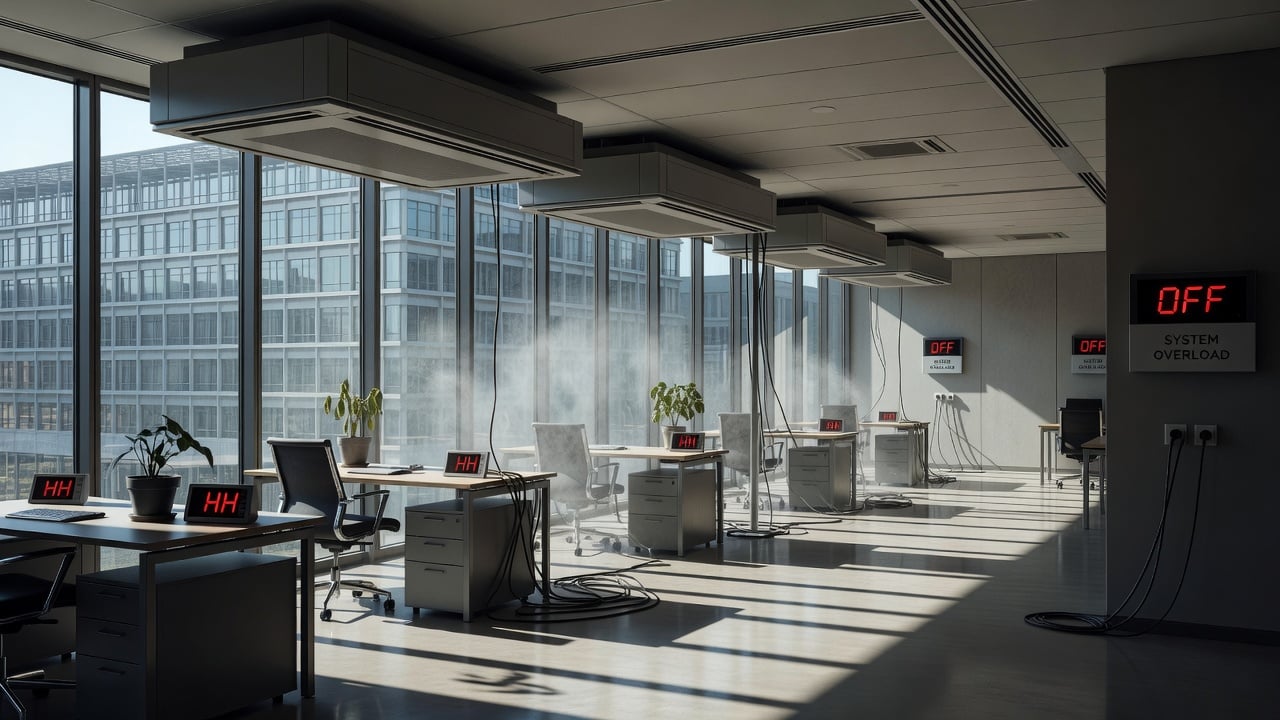
The European Commission headquarters in Brussels faced an unusual operational challenge this summer when record-breaking temperatures forced staff to shut down air conditioning systems across several buildings. According to a report from Politico, the decision stemmed from technical limitations in the cooling infrastructure that could not handle the extreme heat gripping much of the continent. Employees found themselves working in offices where temperatures climbed uncomfortably high, prompting questions about preparedness and long-term strategies for managing climate impacts on government functions.
The episode highlights a growing reality across European institutions and businesses alike. As heat waves become more frequent and intense, even modern office complexes designed with advanced climate control systems encounter limits. The Commission’s Berlaymont building and several adjacent facilities rely on centralized cooling networks that draw from shared energy grids. When external temperatures exceeded 35 degrees Celsius for consecutive days, the systems struggled to maintain safe operating levels, leading facility managers to implement temporary shutdowns to prevent equipment damage and potential power overloads.
Staff members reported mixed reactions to the situation. Some viewed the measure as a necessary precaution that aligned with broader environmental goals, while others expressed frustration over reduced productivity in sweltering meeting rooms. Internal communications encouraged workers to dress more casually, take frequent breaks, and use portable fans where available. Remote work options expanded during peak heat periods, allowing many employees to continue their tasks from cooler home environments. This flexibility demonstrated how hybrid arrangements, already common since the pandemic, can serve as practical tools for adapting to weather extremes.
Energy consumption patterns across the European Union add another layer to this story. Air conditioning accounts for a rising share of electricity demand during summer months, particularly in southern member states where such systems were once considered luxuries. The Commission itself has advocated for reduced energy use and lower carbon emissions through various policy initiatives. Shutting down cooling systems, even temporarily, reflects an attempt to practice what the institution preaches, though critics argue that such reactive measures reveal gaps in forward planning.
Brussels typically experiences milder summers than cities further south like Madrid or Athens, which has historically reduced the urgency for robust heat mitigation infrastructure. Average July temperatures in the Belgian capital hover around 23 degrees Celsius, making prolonged periods above 30 degrees relatively uncommon in past decades. Climate scientists, however, warn that these patterns are shifting. Data from the Copernicus Climate Change Service shows that Europe is warming at roughly twice the global average rate, with heat waves occurring more often and lasting longer. The 2022 summer, which saw temperatures top 40 degrees in the United Kingdom for the first time on record, served as a stark reminder of this trend.
The Commission’s experience mirrors challenges faced by other large organizations. Schools across France and Italy have closed or adjusted schedules during heat spikes. Hospitals have reported increased admissions for heat-related illnesses. Transportation networks, from railways to airports, have encountered disruptions when tracks buckle or runways overheat. In this context, government buildings represent only one piece of a much larger puzzle involving infrastructure resilience and public health protection.
Technical explanations for the shutdown point to the design of the cooling plants. Many of the Commission’s facilities use water-based chillers that circulate chilled liquid through pipes to absorb heat from office spaces. During extreme weather, the temperature differential between incoming water and outdoor air narrows, reducing efficiency. Overloading these systems risks breakdowns that could take days or weeks to repair, creating larger disruptions than a planned pause. Engineers have reportedly examined options for upgrading capacity, including the installation of additional chillers and improved insulation, though such projects require significant investment and time.
Budget considerations play a substantial role here. The European Union operates under strict financial rules, and allocating funds for climate adaptation competes with other priorities such as defense, digital transformation, and support for Ukraine. Nevertheless, the cost of inaction could prove higher if frequent heat waves lead to lost working hours, health issues among staff, or emergency repairs after system failures. Some member states have already begun incorporating heat resilience standards into new public building codes, suggesting a model that European institutions might follow.
Public perception adds political dimensions to the story. Citizens expect their government bodies to demonstrate competence in handling crises, including those linked to climate change. Images of European Union officials sweating through important meetings could undermine confidence, particularly when the Commission urges member states to adopt ambitious emissions targets. Transparency about the limitations of current infrastructure might actually strengthen the case for increased funding toward modernization projects.
Beyond the immediate discomfort, the episode raises broader questions about urban planning and architectural standards. Many office buildings constructed in the late 20th century prioritized energy efficiency for heating rather than cooling, reflecting the climatic norms of their time. Retrofitting these structures with modern heat management technologies presents engineering and financial hurdles. Green roofs, external shading, and natural ventilation systems offer complementary approaches that reduce reliance on mechanical cooling. Several newer buildings in the European Quarter have incorporated such features, though widespread adoption across the Commission’s real estate portfolio remains incomplete.
Neighboring countries provide instructive examples. Germany has invested in district cooling networks that use renewable energy sources and underground thermal storage to balance supply and demand. The Netherlands emphasizes water features and urban greening to lower ambient temperatures in cities. France has implemented heat action plans that include mandatory cooling centers and workplace regulations during extreme weather. The European Commission could draw on these national experiences to develop coordinated approaches that extend beyond its own headquarters.
Staff well-being emerges as a central concern. Prolonged exposure to high indoor temperatures can impair concentration, increase fatigue, and exacerbate certain medical conditions. Occupational health guidelines from the World Health Organization suggest maintaining workplace temperatures below 26 degrees Celsius for optimal performance. When conditions exceed this threshold for extended periods, productivity losses become measurable. Human resources departments within EU institutions have begun reviewing policies to address these risks, including heat stress training and flexible scheduling.
Technological solutions continue to evolve. Advances in smart building management systems allow for more precise control of temperature zones, directing cooling only where needed rather than treating entire floors uniformly. Sensors that monitor occupancy and adjust airflow accordingly can reduce energy waste. Some companies have experimented with personal comfort devices, such as desk fans connected to individual apps, that give workers greater control over their immediate environment. These innovations might find applications in government settings as well.
The incident also connects to larger discussions about energy security. Europe’s efforts to reduce dependence on Russian gas following the Ukraine invasion have accelerated the transition toward renewable sources. Solar and wind power, while clean, present intermittency challenges that affect cooling capacity during heat waves, which often coincide with periods of high demand and sometimes low wind. Battery storage and other flexibility measures will become increasingly vital for maintaining reliable power supplies during such events.
Looking ahead, the European Commission plans to assess its building stock more thoroughly in light of recent experiences. A comprehensive review of cooling infrastructure across all facilities could identify priority areas for upgrades. Collaboration with the European Investment Bank might provide financing mechanisms for these projects. Policy coordination with the European Parliament and Council could ensure that similar challenges receive attention across all EU bodies.
The heat wave that affected the Commission headquarters serves as a microcosm of wider societal shifts. What was once an occasional inconvenience is becoming a recurring operational factor that demands systematic responses. From infrastructure investment to behavioral changes, organizations across the continent must adapt to a climate that no longer follows historical patterns. The lessons learned in Brussels this summer will likely inform strategies not only for European institutions but for governments and businesses throughout the region facing similar pressures in the years ahead.
As temperatures continue to rise, the ability to maintain functional workplaces during extreme heat will test the resilience of modern societies. The European Commission’s experience demonstrates that even well-resourced entities with access to advanced technology can find themselves constrained by physical limits and competing priorities. Addressing these constraints requires a combination of immediate practical measures and longer-term strategic planning that accounts for the changing environmental conditions shaping daily life across Europe. The coming seasons will reveal how effectively these adaptations take shape and whether current responses evolve into comprehensive frameworks capable of handling increasingly severe weather events.


 WebProNews is an iEntry Publication