
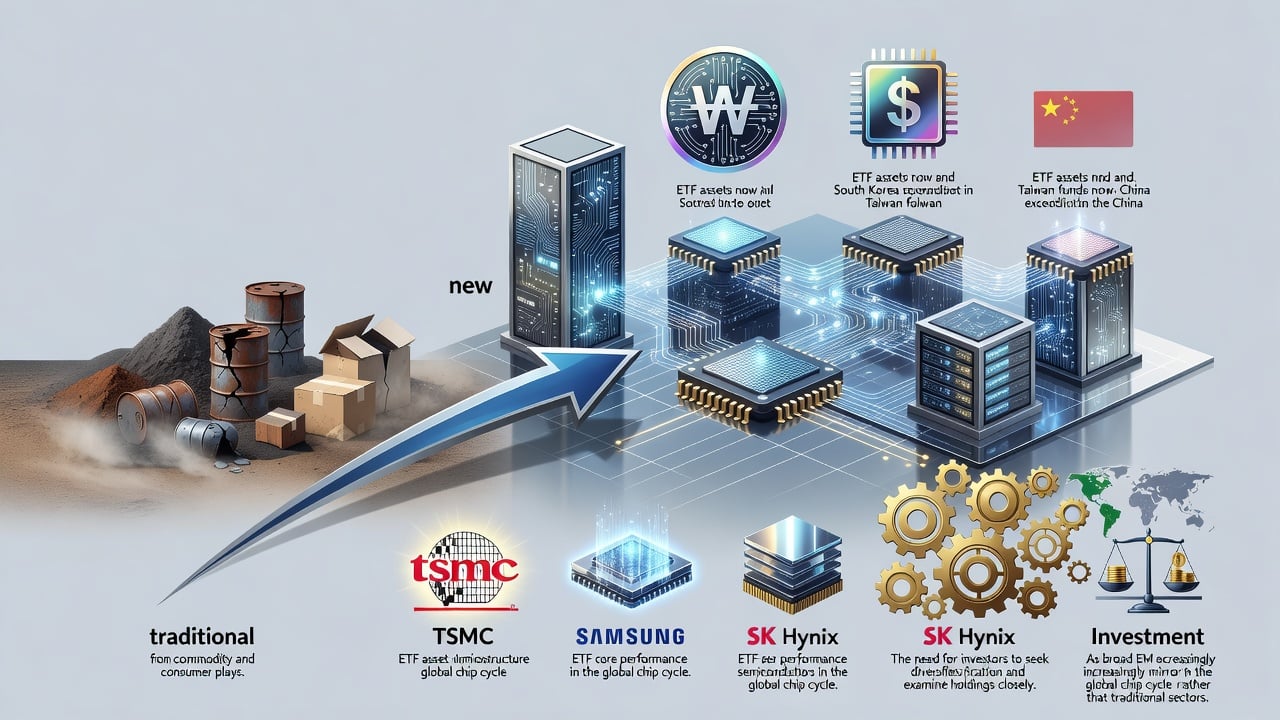
Investors once turned to emerging markets for exposure far removed from Silicon Valley’s megacaps. That separation has narrowed. A torrent of spending on artificial intelligence infrastructure now flows through foundries and memory plants in Taiwan and South Korea, pulling broad EM allocations into the same cycle that powers Nvidia and its suppliers.
The shift shows up clearly in fund flows. ETF assets tracking South Korea and Taiwan have climbed past those focused on China, according to data cited by Yahoo Finance. The change marks more than a reordering of country weights. It signals that buying a broad EM index or fund today often means acquiring indirect stakes in the hardware backbone of large language models and data center expansion.
South Korea supplies critical high-bandwidth memory. Samsung Electronics and SK Hynix dominate production of the specialized chips that prevent AI training from choking on data movement. Demand for these components has stayed tight. One recent analysis noted that high-bandwidth memory sold out through the end of 2026 as hyperscalers poured money into new facilities. Franklin Templeton highlighted how U.S. corporate results from the largest cloud providers translated into stronger orders across Asian supply chains.
Taiwan sits at the center. Taiwan Semiconductor Manufacturing Co. manufactures the most advanced logic chips that run AI workloads. Its monthly sales jumped 30 percent in May from a year earlier, Bloomberg reported, extending a string of strong prints tied to insatiable appetite for 3-nanometer and 5-nanometer processes. The company raised its full-year outlook earlier in 2026 and committed additional capital spending. Record quarterly figures and upward guidance sent its shares and the broader Taiwan index higher.
State Street Global Advisors quantified the effect. More than half of year-to-date returns for EM equities through late 2025 came from AI and related technology themes. Taiwan’s IT sector delivered roughly 130 percent returns over two years ending September 2025. The entire upstream and downstream ecosystem around TSMC benefits. Government planners in Taipei even set a target of more than $500 billion in economic value from AI-related activities over the next 15 years. State Street Global Advisors described Taiwan as the world’s leading producer of chips with unrivaled manufacturing capabilities.
But. The concentration carries risks. When semiconductor stocks slipped in recent sessions, pressure spilled into country-specific and broad EM vehicles. The same forces lifting these markets can reverse swiftly if AI spending moderates or supply catches up. And supply constraints persist. TSMC’s chief executive has warned that chip supply will trail AI-fueled demand for years.
Differences in index construction complicate the picture further. The iShares MSCI Emerging Markets ETF includes South Korea and therefore carries about five percentage points more semiconductor exposure than the Vanguard FTSE Emerging Markets ETF, which classifies the country as developed. Yahoo Finance noted that diversification now requires investors to inspect holdings rather than rely on fund labels. An EM allocation no longer delivers the clean break from U.S. tech it once promised.
South Korea’s memory giants posted letters of intent to supply chips to an American AI organization, sending shares higher. The country’s two largest chip firms drove much of its equity performance so far in 2026, Charles Schwab observed. Samsung has also seen rising inquiries for foundry services from names including Google, Tesla, AMD, and even Chinese customers seeking alternatives amid capacity shortages at TSMC. Nikkei Asia reported the surge in talks, underscoring how AI demand strains even the largest producers.
China still weighs heavily. Domestic AI chip developers gained ground as U.S. export controls limited access to leading-edge graphics processors. Yet the broader EM story has broadened. Investors who once associated the asset class with commodities, currencies, or consumer growth in the developing world now confront a heavy dose of global chip-cycle beta.
India presents a contrast. The country ranks as a major EM driver but has largely missed the hardware rally that lifted Taiwan, South Korea, and parts of China. Widespread adoption of AI tools could even pressure its services sector by automating tasks long performed by human workers. Charles Schwab pointed to this paradox as one reason India lagged the AI-fueled EM outperformers.
Valuations tell part of the tale. EM stocks trade at roughly $13.70 of market value for every dollar of earnings, compared with $22.10 in the United States. That discount looks compelling on paper. Yet volatility remains high. Only one year in the past 25 saw EM equities fall less than 10 percent. Many portfolio managers treat the asset class as a satellite holding of 5 to 10 percent rather than a core position.
Geopolitical tensions add another layer. Taiwan weighs tighter restrictions on advanced chip sales to China, according to recent reports. Any escalation could disrupt the very supply chains now anchoring EM performance. Meanwhile, South Korea’s focus on high-bandwidth memory leaves it exposed to swings in AI accelerator demand. Hyperscalers continue to order aggressively. IDC projected the global semiconductor market would expand 15 percent in 2025, driven largely by AI and high-performance computing.
The reorientation appears structural. What began as a U.S. mega-cap story has geographic consequences. Capital that once chased Chinese consumer names or Brazilian resources now chases memory stacks and advanced packaging in Northeast Asia. Emerging markets still offer diversification. The nature of that diversification has changed. It runs through the same data-center buildout that dominates technology headlines in New York and San Francisco.
Portfolio managers must therefore ask sharper questions. Does an EM fund overweight the AI supply chain or avoid it? How sensitive is the position to a pause in hyperscaler spending? And does the allocation provide genuine exposure to faster-growing economies, or simply another doorway into the semiconductor cycle? The answers matter more than the label on the fund wrapper ever did.
Fresh data continue to reinforce the link. TSMC’s first-five-months revenue for 2026 rose 30 percent from the prior year. South Korean exports posted their fastest growth in decades, powered by semiconductor shipments. The MSCI Emerging Markets index touched all-time highs earlier in the year on the back of these gains. The AI trade no longer stops at American shores. It travels through factories in Hsinchu and memory lines in Cheongju, reshaping what it means to hold emerging-market equities.


 WebProNews is an iEntry Publication