
Mark Russinovich didn’t mince words. Advances in quantum research have shifted the risk horizon, the Microsoft Azure chief technology officer said Tuesday. Cryptographically relevant quantum computers could arrive sooner than many expected. The work to prepare demands action now.
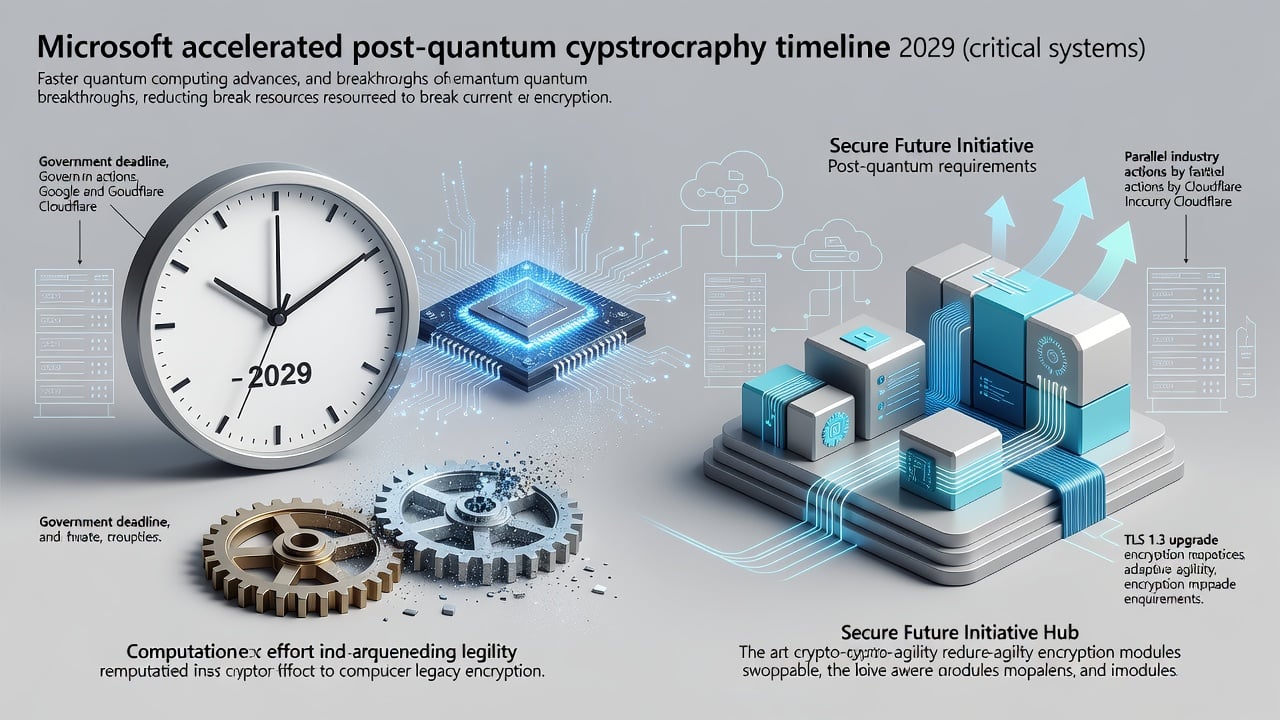
So Microsoft is moving. The company accelerated its Quantum Safe Program timeline Tuesday with a new goal: transition critical products and services to post-quantum cryptography by 2029. It will fold those requirements into its Secure Future Initiative too. The moves come as governments set their own deadlines and researchers shrink the resources needed to crack today’s encryption.
Why the sudden urgency?
Recent breakthroughs changed the math. A Google team showed it could break 256-bit elliptic curve discrete logarithm problems with fewer qubits and gates than once thought. Academics from Caltech and Oratomic outlined an error-correction method that might run Shor’s algorithm on just 10,000 reconfigurable qubits. That combination threatens RSA-2048 and P-256 curves far earlier than prior estimates suggested. The Hacker News laid out the details hours after the announcement.
Adversaries understand this. They collect encrypted data today in a “harvest now, decrypt later” strategy. Once a sufficiently powerful quantum machine appears, those archives become readable. Intelligence services and well-resourced nation-states likely already pursue this approach against high-value targets. Long-lived secrets in government systems, intellectual property repositories and financial records sit especially exposed.
President Donald Trump signed an executive order days earlier. It sets hard deadlines for federal agencies to migrate high-value assets and high-impact systems to post-quantum cryptography. The White House memorandum, available here, pushes agencies to prioritize and report progress. Microsoft cited the order as one factor in its accelerated schedule.
Other technology giants already staked out similar ground. Google committed in March to quantum-secure its infrastructure by 2029. It also rolled out certificate programs in Chrome to guard against quantum threats. Cloudflare published its own roadmap targeting the same year. The alignment isn’t coincidence. Industry leaders see the same risk signals and converging standards from NIST.
Microsoft’s plan focuses on three practical areas. First, upgrade network cryptography through broader TLS 1.3 adoption. Second, design stored data with crypto-agility so future algorithm swaps don’t require full system redesigns. Third, secure trust chains that include code signing, certificate issuance, key protection and update pipelines.
Russinovich described the integration with Secure Future Initiative as deliberate. “This brings quantum-safe readiness into the same disciplined engineering framework we use for other critical security outcomes: clear ownership, measurable milestones, and transparent progress,” he said in the company’s security blog post published Monday. “Embedding these capabilities into our platforms empowers customers to move sooner and more confidently.”
Crypto-agility sits at the center. Microsoft stressed the need to eliminate hard-coded algorithm assumptions. Systems must store enough metadata to reconstruct cryptographic context years later. Upgrades should become routine engineering work instead of crisis-driven rewrites.
“Crypto-agility requires either self-describing cryptographic metadata or versioned ciphertext formats so implementations can read legacy data while writing with the newest approved algorithms,” the company explained in its Tech Community post. “A well-designed crypto-agile system should aim to read older ciphertext formats long enough to support migration, while writing new data with the newest approved configuration.”
Windows teams already delivered pieces. Post-quantum algorithms became generally available on Windows 11 and Windows Server 2025 late last year. Recent updates added PQ TLS hybrid key exchange in preview, composite algorithms in cryptography APIs and the ability to generate post-quantum certificates through Active Directory Certificate Services. Those features appeared in a June Tech Community article detailing platform advances.
Yet the broader challenge remains inventory and migration. Enterprises hold sprawling cryptographic estates across legacy applications, cloud services, embedded devices and third-party software. Many organizations still lack complete visibility into where and how algorithms appear in their environments. Discovery tools exist but adoption lags.
Analysts point to the funding mismatch. Venture capital poured nearly $5 billion into quantum hardware last year. Tooling for post-quantum migration received a fraction of that sum. One investor noted the pattern on X: science attracts capital while the practical migration market stays underfunded. Enterprises need inventory scanners, testing frameworks and agile certificate management far more than another qubit demonstration.
The market for migration solutions is growing anyway. One research report projected the sector expanding from $15 billion in 2025 to over $86 billion by the mid-2030s. Large enterprises in finance, healthcare and defense drive demand. They face regulatory pressure and hold the most sensitive long-term data.
Microsoft’s acceleration aligns its internal targets with customer needs. Many large organizations buy from the company and also consume its cloud services. When Azure and Windows move earlier, downstream systems gain tested components and clearer migration paths.
But 2029 is not the finish line for everything. The company described the date as a milestone for critical products and services. Full ecosystem transition will stretch further. Hybrid approaches that combine classical and post-quantum methods will likely persist through much of the 2030s as compatibility issues resolve.
Standards work continues. NIST has standardized ML-DSA and SLH-DSA for signatures with FN-DSA expected soon. Additional candidates advanced in May. Implementation details and performance characteristics still require real-world validation at scale.
Organizations cannot wait for perfect clarity. The prudent step involves starting cryptographic inventories today. Map dependencies. Classify data by sensitivity and longevity. Pilot hybrid TLS configurations. Test certificate rotation at volume. Build the muscle for algorithm agility before the pressure becomes acute.
Microsoft’s announcement carries weight because of its platform reach. Windows runs on hundreds of millions of devices. Azure hosts enormous amounts of enterprise data. Active Directory manages identities across industries. Changes there ripple outward quickly.
Russinovich framed the decision as pragmatic engineering. Quantum progress is real. The defensive response must match that pace. Delaying inventory and design work only compresses the timeline later when options narrow and costs rise.
The coming years will test execution. Microsoft must deliver on its roadmap without disrupting existing customers. Enterprises must translate vendor commitments into internal programs that actually replace vulnerable keys and certificates. Governments will measure compliance against their new mandates.
One thing looks clear. The era when post-quantum cryptography remained a research topic has ended. It now sits inside disciplined product roadmaps, engineering backlogs and budget requests. The risk horizon moved. So did Microsoft’s response.


 WebProNews is an iEntry Publication