
Software teams once treated every AI suggestion with suspicion. They pored over diffs line by line. They ran tests twice. They argued in pull requests about edge cases the machine might have missed. Those days are slipping away faster than many expected.
New data shows developers now let a growing share of AI-generated code reach production with little or no separate human review. The shift comes as tools like Cursor push agents that plan, edit multiple files, run terminal commands, and iterate on their own mistakes. And the numbers paint a clear picture of changing habits.
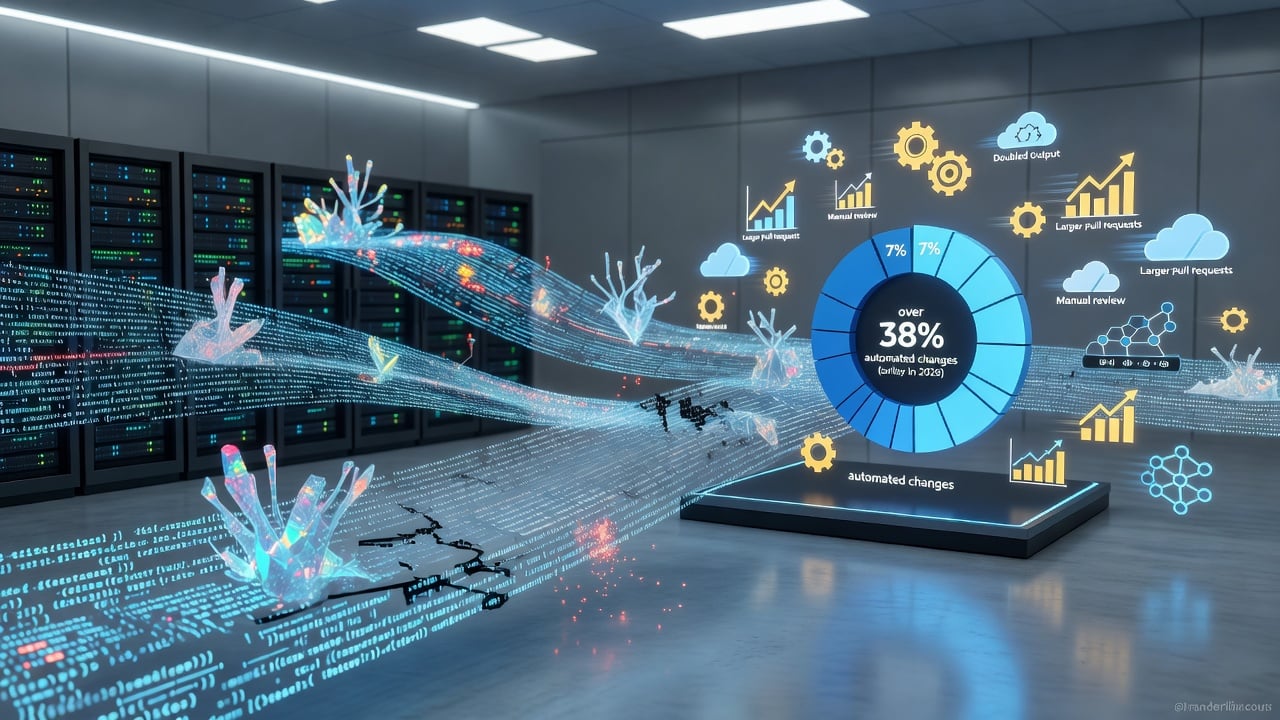
According to the Cursor Developer Habits Report, the share of AI-generated changes accepted into commits without manual review climbed from 7 percent at the start of 2026 to 38.5 percent by May. That’s more than a fivefold increase. At the same time, lines of code added per developer per week jumped from 3,600 in January 2025 to 8,600 in May 2026. Pull requests grew larger. The 75th percentile PR swelled from roughly 126 lines to 345 lines over the same period.
But here’s the rub. Survival rates for that AI code tell a more nuanced story. The portion of accepted AI-generated lines still present in the codebase after 60 minutes rose from 76.6 percent in early 2026 to 80.6 percent in May. Developers appear more willing to keep what the agents produce. Yet the report stops short of claiming higher quality. It simply notes the code sticks around longer.
Trust is building. Fast.
A Business Insider article published today highlights the same Cursor data and quotes CEO Michael Truell on the trend. It frames the jump to 36.3 percent of AI changes bypassing separate review by mid-May as evidence that developers now feel comfortable handing off larger pieces of the development process. The piece notes Cursor does not directly measure quality of fully autonomous code. Still, higher survival offers an indirect signal of reliability.
This evolution did not happen in isolation. Cursor began as a fork of Visual Studio Code but grew into an AI-first environment. Its Composer mode and agent features let users describe goals in natural language. The system then handles multi-file edits, runs tests, reads error output, and loops until the task appears complete. Recent versions support up to eight agents working in parallel on isolated Git branches, according to analyses from sites tracking the space.
Yet the tools still demand human judgment at key moments. A May 2026 analysis on Tensoria stresses that Cursor multiplies the output of a good developer rather than replacing one. Agents make mistakes. They require oversight on architecture, business logic, and final approval. The article warns against rolling the tool out to entire teams without a pilot phase.
Recent benchmarks reinforce the progress. On SWE-bench Verified tasks, models powering agents like Claude variants have posted scores above 70 percent in some tests, per comparisons published earlier this year. Cursor itself scores competitively on multi-file editing and iteration speed. A June 2026 post on Developers Digest notes major model updates, including Claude Fable 5 released on June 9, further boosted terminal and coding performance. These releases arrived just weeks ago and already appear in production workflows.
Even so, risks linger. A mid-June report from Help Net Security examined how frontier AI labs use their own agents to write code for safety systems and research pipelines. Oversight can drift. Responsibilities for pausing models or updating access policies sometimes lack clear owners. The analysis, drawing on University of Oxford and SaferAI research, warns that light human supervision between agent steps may leave critical safeguards behind.
Security experts echo the caution. One recent X discussion highlighted how malware in GitHub repositories can hide in setup instructions, tricking both developers and AI agents into running harmful commands. Speed sometimes wins over careful quality checks. When agents generate code at volume, the temptation grows to merge first and review later.
Inside companies the pattern varies. Some teams set strict gates for production changes. Others experiment with background agents that work asynchronously while humans focus on higher-level design. Cursor’s own report shows a stark power-user gap. The top 1 percent of developers produce 46 times more AI-assisted lines per day than the median. They merge 15 times more pull requests. Gini coefficients for AI activity hover around 0.75, signaling heavy concentration among a small group who have mastered prompting and verification.
Context plays a bigger role too. The ratio of input to output tokens climbed from 4.5 times to 13 times between January and May 2026. Models now consume far more codebase information upfront before suggesting changes. Cache reads account for nearly 90 percent of tokens processed, helping agents remember prior context across long sessions. This infrastructure supports deeper automation but also raises the stakes when something slips.
So what does responsible adoption look like? Industry voices call for treating AI output like contributions from a talented but inexperienced junior engineer. Automated tests remain essential. Human review of architecture and security cannot vanish. Approval gates for critical paths still matter. Yet the data suggests many teams already accept more agent work without those traditional checkpoints.
Cursor is not alone. Competitors including Claude Code, Codex CLI, GitHub Copilot, and open-source options like Aider or OpenHands offer similar capabilities. June 2026 comparisons rank them on terminal harness depth, benchmark scores, and cost per task. No single tool dominates every scenario. Terminal-first agents excel at command-line iteration. IDE-native options like Cursor shine for visual editing and multi-file awareness. Teams mix them.
Recent X conversations reflect real-world experimentation. Developers discuss swapping agents via meta-frameworks, running parallel reviews where one agent critiques another’s diff, and building self-hosted workspaces for team collaboration. One open-source project gained attention for letting users orchestrate Claude, Codex, and others in a shared session with policy controls on spend and approvals. These tools aim to keep humans in the loop without slowing the pace.
The economics also shifted. Cost per accepted line of code varies by a factor of seven across models, according to Cursor’s analysis. Higher-priced models sometimes deliver better acceptance rates, narrowing the gap. Companies watch these metrics closely as agent usage scales. Input tokens now drive 72 percent of costs in some workflows, pushing optimization toward smarter context management rather than raw generation.
Look ahead and the trajectory seems set. Larger PRs. Deeper agent sessions with more tool calls. More code reaching main branches on the strength of automated tests and spot checks rather than exhaustive human scrutiny. The Cursor report calls it a new era where AI becomes infrastructure for end-to-end automation of the software lifecycle.
Yet history offers reminders. Previous waves of automation promised to eliminate entire roles only to reshape them. Senior engineers today spend more time on system design, oversight, and complex problem decomposition. They review the outputs of fleets of agents rather than writing every line. The skill set changed. The need for experienced judgment did not disappear.
Teams that treat agents as force multipliers while maintaining strong verification practices will likely pull ahead. Those that cut corners on review in the name of velocity may discover costly bugs or security holes later. The data shows trust growing. The real test will be whether that trust proves justified over time.
One thing feels certain. The balance between machine speed and human accountability continues to tilt. Developers already live in that tension every day. How companies manage it in the months ahead will shape both code quality and team capabilities for years to come.


 WebProNews is an iEntry Publication