
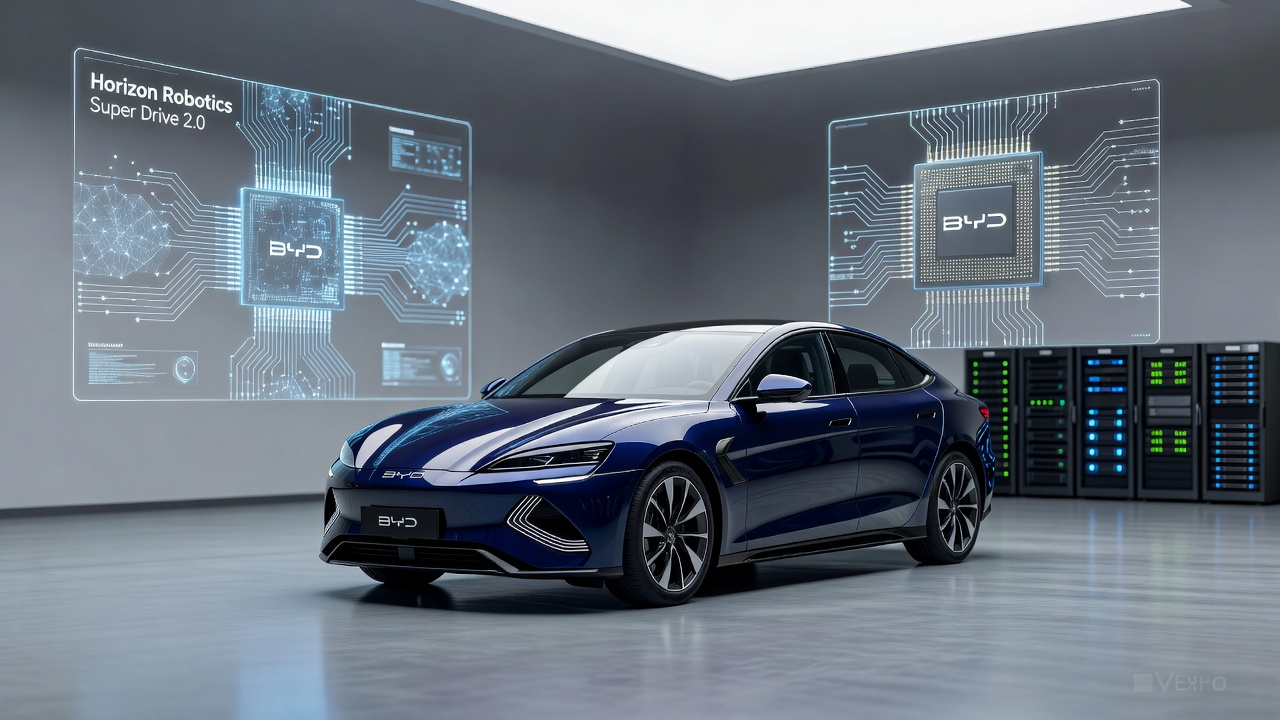
Chinese electric vehicle leader BYD has begun road testing a next-generation driver assistance platform in its popular Seal sedan. The move signals the company’s determination to accelerate autonomous capabilities across its lineup. Yet it also reveals a calculated dependence on outside suppliers even as BYD pours billions into homegrown silicon.
Reports from China show BYD Chairman Wang Chuanfu recently evaluated the system alongside Horizon Robotics CEO Yu Kai. Their joint appearance behind the wheel of a test Seal underscores how close the software has come to readiness. Engineers focused on tightening the link between the car’s cameras and its central computing unit. The goal was clear. Extract more capability from current hardware before fresh chips arrive.
Digital Trends first highlighted the testing of Horizon Robotics’ upcoming Super Drive 2.0 platform. The software upgrade promises meaningful gains in how the vehicle interprets its surroundings. And it arrives at a moment when BYD faces pressure to match rivals on intelligence as much as on price or range.
Horizon has already delivered millions of processors to BYD vehicles. That track record gives the partnership a stable foundation. Switching suppliers or rushing immature in-house parts could disrupt the production cadence that lets BYD outsell almost everyone else in the electric segment. So the company hedges. It deploys proven third-party solutions today while its own technology matures.
Cost sits at the heart of this approach. Industry sources indicate that sticking with established processors trims manufacturing expense by 1,500 to 4,000 yuan per vehicle. Those savings matter enormously at BYD’s scale. They allow advanced driver assistance features to reach models priced well below premium thresholds. Buyers win. Margins hold.
BYD’s own Xuanji A3 chip made its debut in late May. The 4-nanometer design claims 700 tera operations per second of computing power. It already sits in mass production. The company says it will support Level 3 and Level 4 autonomous driving. Yet volume deployment in passenger cars won’t begin until 2027, starting with premium Denza models. The Wall Street Journal reported the launch and tied it to a broader three-year commitment exceeding $14.75 billion in intelligent technology research and development.
That figure reflects more than ambition. It marks BYD’s bet that software-defined vehicles will drive the next wave of industry profits. Pure hardware competition has grown brutally tight. Intelligence offers differentiation.
Still, NVIDIA casts a long shadow. In March the chipmaker announced that BYD would adopt its DRIVE Hyperion platform for Level 4 vehicle programs. The news came alongside similar commitments from Geely, Isuzu and Nissan. NVIDIA positioned the architecture as production-ready compute paired with sensor suites and a new safety operating system called Halos. NVIDIA’s own release quoted CEO Jensen Huang describing the momentum toward safe, scalable autonomous development.
Market data from April painted NVIDIA with 51 percent share of China’s ADAS chip market. Horizon held 13.6 percent. Those numbers help explain why BYD continues to work with both. The Seal tests represent one front in a wider campaign to shrink NVIDIA’s lead without sacrificing speed to market.
BYD has taken other bold steps this year. In late May it became the first automaker to pledge full damage coverage for both its intelligent parking system and Urban Navigate on Autopilot function. The warranty applies in China under the God’s Eye intelligent driving umbrella. BYD’s announcement framed the guarantee as proof of confidence in the technology’s reliability.
Earlier, the company detailed plans to roll God’s Eye features across its entire model range. Even the low-cost Seagull, priced around $9,500 in China, stands to gain high-level assistance. Integration of reasoning models from startup DeepSeek adds another layer. The AI helps the system handle complex urban scenes where rule-based code often stumbles.
Analysts watching the space note the tension. BYD wants to control its destiny. It designs batteries, motors, semiconductors and now algorithms. Complete vertical integration remains the long-term vision. Reality demands pragmatism. Horizon’s Super Drive 2.0 gives the Seal a credible upgrade path right now. NVIDIA’s platform secures a seat at the table for higher-end autonomy later.
Observers spotted the two chief executives together in recent days. Their test drive generated buzz on Chinese social platforms and drew quick coverage from technology sites. The images showed a standard-looking Seal fitted with additional sensors. Nothing flashy. The real work happens in the software stack and the data pipelines feeding it.
Refining camera communication with central hardware sounds incremental. In practice it can unlock smoother decision-making at highway speeds or in crowded city intersections. Small gains compound when multiplied across hundreds of thousands of vehicles. BYD sold more electric cars globally last year than any other manufacturer. Its installed base offers a data advantage few can match.
Yet challenges persist. Regulatory approval for higher levels of autonomy varies by region. Consumer trust must be earned through transparent performance and, in BYD’s case, explicit warranties. Competition from domestic players such as Huawei’s smart-driving ecosystem adds pressure. International expansion brings fresh scrutiny over data security and technology transfer.
BYD’s $14.75 billion investment pledge stretches across three years. That averages roughly $4.9 billion annually. For context, the sum rivals what some established automakers spend on all research combined. The money will fund not only chips but also the vast simulation farms, labeling operations and validation fleets required to train modern driving systems.
Production timelines for the Xuanji A3 remain firm. 2027 for broader rollout. Until then the Seal and its siblings will lean on Horizon silicon and software tuned to squeeze every drop of performance from it. The strategy buys time. It also buys volume. Every car shipped with capable assistance today feeds tomorrow’s models with real-world miles.
Wang and Yu’s joint appearance carried symbolic weight. Two leaders of major Chinese technology firms stood together to showcase progress. Their collaboration hints at a maturing domestic supply chain less beholden to foreign dominance. NVIDIA still leads. Its ecosystem, tools and software maturity remain formidable. But the gap narrows.
Look closer at the Seal tests and the picture sharpens. This isn’t a full break from NVIDIA. It’s a deliberate broadening of options. BYD will likely continue using DRIVE platforms in select vehicles, especially those targeting global markets or robotaxi ambitions. At the same time it accelerates in-house development to capture more value and reduce exposure to export controls or supply shocks.
The automotive AI race has entered a phase where hardware specifications matter less than system-level results. How quickly can the car react? How few interventions does the driver make? How safely does it handle edge cases? BYD’s latest efforts target all three. Super Drive 2.0 in the Seal represents one data point in a much larger experiment.
Industry watchers expect the company’s market share in intelligent driving chips to grow as its Xuanji processors scale. Whether that growth comes at NVIDIA’s direct expense or Horizon’s depends on pricing, performance and integration ease. Early signs suggest all three will coexist inside BYD vehicles for years. Different models. Different missions. One overarching goal.
Drivers may not notice the silicon inside their doors. They will notice when the car glides through traffic with fewer corrections or parks itself without drama. BYD aims to make those experiences standard, not optional. The Seal tests mark another step on that road. The destination stays the same. Safer, smarter mobility at prices ordinary buyers can afford.
And the rivalry with NVIDIA? It simmers. Each new test, each new chip, each new warranty pushes the boundary. BYD refuses to wait for permission or perfect technology. It ships what works today and improves what comes tomorrow. That pragmatism has served the company well in batteries and EVs. Now it shapes the future of driving itself.


 WebProNews is an iEntry Publication