
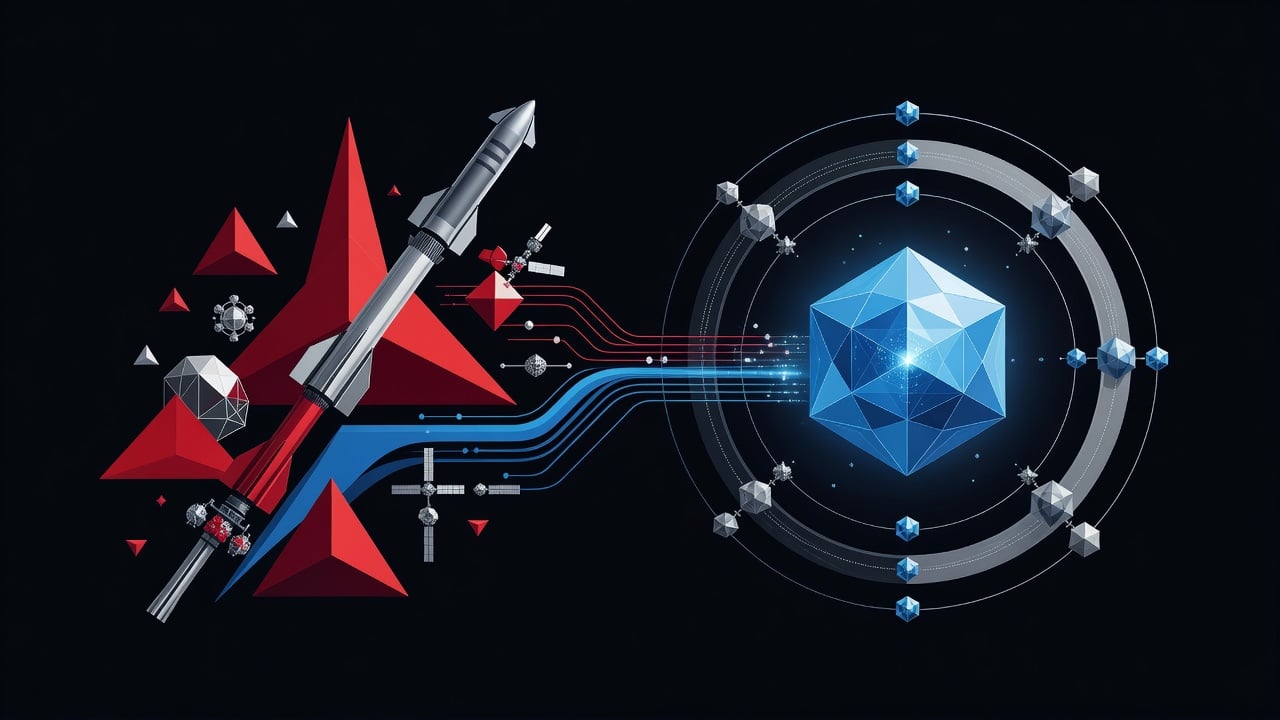
Elon Musk dropped a short post on X Sunday. It carried heavy implications. “The SpaceXAI cadence of model and harness improvement is speeding up tremendously, particularly due to a few dozen of the top Starlink/Starship engineers shifting much of their time to AI,” he wrote. Business Insider reported the details hours later.
Just like that, talent that once optimized reusable rockets and global satellite networks now pours hours into neural weights. The move signals more than resource reallocation. It marks a deeper fusion between SpaceX’s engineering culture and xAI’s model development. One that Musk has pursued since merging the entities earlier this year.
Rebuilding From the Ground Up
Musk had already signaled frustration months earlier. In March he admitted xAI was “being rebuilt from the foundations up.” Cofounders departed. Leadership changed. The Grok series lagged on coding benchmarks against models from OpenAI and Anthropic. Something had to give.
Enter Cursor. The AI-powered code editor, founded by then-25-year-old Michael Truell, caught Musk’s attention. SpaceX agreed to buy the startup for $60 billion in stock this month, days after its own record $85 billion IPO. The deal gave Cursor engineers direct access to SpaceX supercomputers. In return, their training data fed into Grok’s foundation models. Business Insider laid out the exchange clearly.
But the real acceleration came from those Starship and Starlink veterans. Dozens of them. Their systems thinking, honed on missions where failure means literal explosions, now attacks training instability, inference efficiency, and the elusive “harness” that wraps models into usable tools. The results appeared fast. Grok 4.5, built on a 1.5-trillion-parameter V9 foundation model supplemented with Cursor coding data, entered private beta at both SpaceX and Tesla.
Musk shared the eval numbers himself. Early tests placed it close to, perhaps exceeding, Anthropic’s Claude Opus on internal benchmarks. Reinforcement learning continues. The Grok Build harness shows daily gains. And SpaceX now plans to train and release entirely new models from scratch every month for the rest of 2026. No incremental patches. Fresh foundations. Repeatedly.
And the ambition stretches further. Musk has spoken of building orbital data centers. Up to a million of them, launched by Starship, powered and networked by Starlink. These would train ever-larger models far from terrestrial power grids and regulatory constraints. SpaceX’s pre-IPO investor materials projected a total addressable market of $28.5 trillion. AI alone accounted for $26.5 trillion of that figure. The numbers make clear where the company sees its future value.
Recent coverage reinforces the momentum. A post on ExplainX.ai from two days ago detailed the V9 model specifics and confirmed the supplemental Cursor data improved coding fluency without sacrificing reasoning. Another analysis in Los Angeles Times framed the Cursor purchase as a direct bid to close the gap with Anthropic and OpenAI on enterprise-grade coding agents.
Critics wonder about trade-offs. Starlink’s rapid constellation growth demands constant engineering attention. Starship’s path to full reusability and high flight rates still faces technical hurdles. Diverting top talent carries risk. Yet Musk appears to calculate that superior AI will ultimately speed up those very programs. Better code generation, faster simulation, automated verification. The same engineers who once debugged plasma physics might now teach models to do it instead.
The integration runs deep. Cursor’s Composer model already showed strong performance on cost-per-output metrics in developer discussions. Pairing that with Grok’s lower hallucination rate and SpaceX’s Colossus-scale compute creates a potent combination. Early internal users at Tesla and SpaceX now test Grok 4.5 in real workflows. Feedback loops tighten. Models improve weekly rather than quarterly.
So what does this mean for the broader industry? Other AI labs rely on cloud providers and generalist talent. Musk’s approach binds specialized aerospace engineering discipline directly to model training. It treats AI development like a rocket program: rigorous, iterative, intolerant of sloppy abstractions. The monthly “from scratch” releases set a pace few competitors will match.
Challenges remain. Scaling orbital infrastructure will test Starship’s cadence like nothing before. Regulatory questions around space-based compute have yet to surface fully. Talent retention across the merged organizations could prove tricky after the xAI reorganization. Still, the early signals point to genuine velocity.
One line from Musk’s original post stands out. “Shifting much of their time to AI.” Not all of it. Not permanently. But enough to change the trajectory. Those few dozen engineers represent a bet that the hardest problems in rocketry and communications have lessons that transfer to intelligence itself. If the private beta results hold, that bet may already be paying off.
Watch the next monthly model. The one after that. Each trained fresh. Each informed by engineers who have landed rockets on drone ships and connected remote villages to the internet. The fusion of those mindsets with frontier-scale compute could produce something distinctly different from today’s chatbots. More grounded. More capable of turning speculation into working systems. Exactly the kind of AI Musk claims the world needs.


 WebProNews is an iEntry Publication