
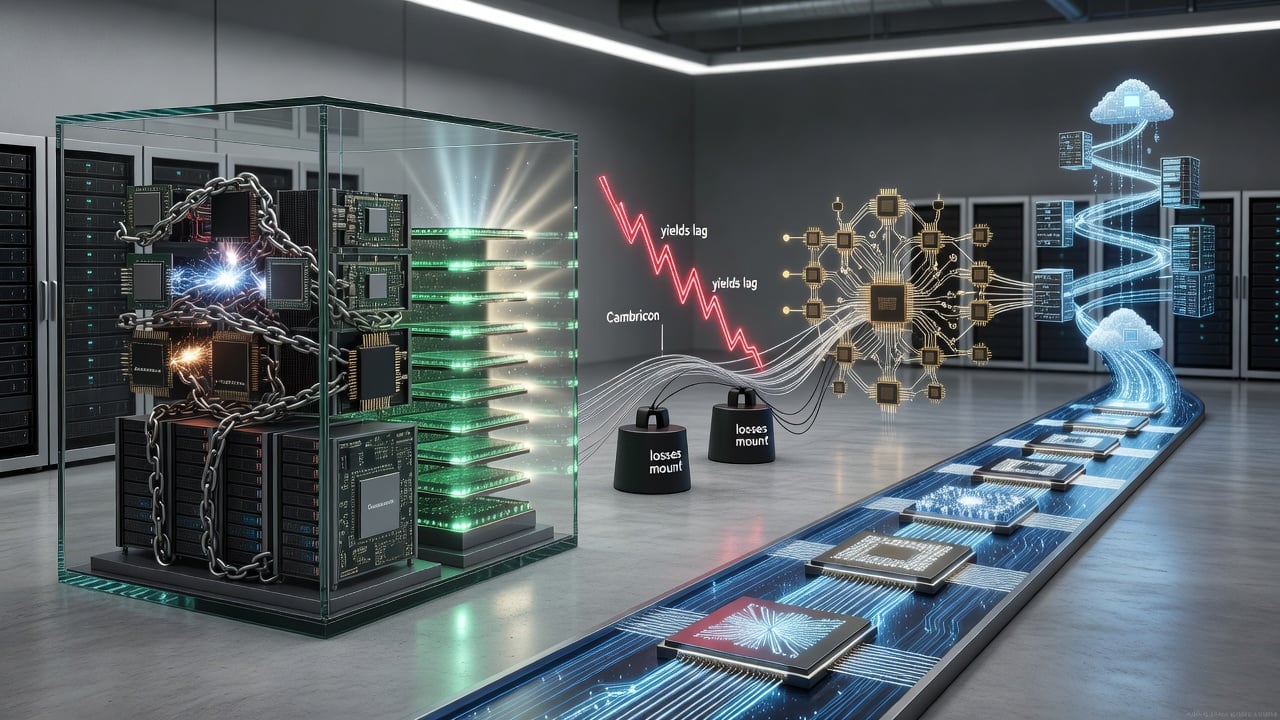
BEIJING — U.S. export controls were supposed to kneecap China’s artificial-intelligence ambitions. They haven’t. Instead, domestic chip firms have seized the moment. Revenue has exploded at some players. Losses remain heavy at others. And the market has responded with a flood of capital and IPO filings that few predicted even a year ago.
Cambricon Technologies secured a massive order from ByteDance. Its first-half revenue surged 43 times to $404 million. Shares briefly became the most expensive in China. Moore Threads, still unprofitable with 4.6 billion yuan in cumulative losses from 2022 to 2024, is fast-tracking an IPO that could raise 8 billion yuan. Small stakes in these ventures have sent related stocks soaring. One firm with just a 0.02% holding in Moore Threads jumped more than 56% in three days on IPO speculation. Beijing’s push for self-reliance has created its own momentum.
Yet the picture is uneven. AI chip yields sit below 20% at domestic foundries. Intelligent computing center utilization rates hover under 30%. Bernstein analysts pegged China’s 2025 AI chip demand at $39.5 billion, with the supply gap exceeding $10 billion after Nvidia’s H20 chips failed to return in volume. Foreign chips’ share of AI servers is forecast to fall from 63% to 42%. The gap persists. So does the scramble to fill it.
Huawei has deployed clusters built on its Ascend chips. Baidu rolled out a 30,000-card Kunlunxin system. Tencent scaled Enflame silicon. Alibaba’s T-Head processor is said to match Nvidia’s H20 in some tasks. And in a striking recent development, DeepSeek’s V4 model — one of China’s most capable open-source offerings — was optimized to run on Huawei hardware, marking a clear break from CUDA dependence. The New York Times reported the milestone in May, noting how it bolsters Beijing’s confidence ahead of trade talks.
These advances come despite real constraints. Chinese chips often deliver lower raw performance per card. They consume more power. System-level optimizations and software adaptations help close the gap. Founders with experience at Nvidia, AMD and SenseTime have steered many of the startups. Zhang Jianzhong, a former Nvidia China general manager, leads Moore Threads. Similar pedigrees appear across Biren, Enflame and MetaX. Talent alone doesn’t solve manufacturing bottlenecks. It does accelerate iteration.
Investors have poured in anyway. Cambricon’s stock run created at least one new billionaire. MetaX posted 2.72 billion yuan in losses over the same 2022-2024 period as Moore Threads. Unprofitability has not slowed IPO plans. Regulators eased rules in June 2025, clearing a path for several AI chip hopefuls to list on the STAR Market. The policy shift aligns with broader goals. Beijing wants domestic alternatives at scale.
Recent data shows the bet gaining traction. Chinese semiconductor firms posted record revenues in 2025, driven by AI demand and memory chip shortages. SMIC and Hua Hong both hit highs, with analysts expecting further gains. CNBC detailed the surge in April, tying it directly to self-sufficiency efforts sparked by U.S. curbs. Capacity expansion is underway. China’s share of global chip output is projected to climb toward 42% by 2028.
But challenges stack up. Equipment and talent shortages strain the supply chain. Executives at SEMICON China in March admitted a five-to-ten-year lag in advanced data-center chips compared with global leaders. AI-driven demand has booked some production lines into next year. Memory makers are adding fabs. The entire chain is expanding faster than many forecasts. Reuters captured the optimism — and the pressure — from industry voices in late March.
On the model side, progress has surprised outsiders. DeepSeek’s V4 achieved strong results while migrating inference to domestic compute. It supports million-token contexts at reduced costs. Multiple Chinese models now train on Huawei Ascend, Cambricon, Moore Threads and other local hardware. Day-zero support across eight chip families for one major release, coordinated in part through national software stacks, signals maturing infrastructure. Recent X discussions and reports highlight this shift, with pre-orders for Ascend units reportedly pushing prices higher before launch.
The IPO wave adds another layer. Nearly 50 semiconductor and robotics companies have filed for Shanghai and Shenzhen listings, targeting at least 126.1 billion yuan. ChangXin Memory Technologies alone aims for a 29.5 billion yuan debut — the largest this year. Technology IPO proceeds have already hit $3.1 billion through mid-June, more than five times the prior-year pace. This marks the strongest onshore tech listing year since 2023. Reuters reported the rebound just yesterday, linking it to Beijing’s explicit support for chip and AI firms amid U.S. rivalry.
Li He, co-head of Davis Polk’s Asia practice, called the acceleration “long-awaited exit opportunities for private equity and venture capital funds.” Kenny Ng at China Everbright Securities noted that CSRC backing for Hong Kong-listed firms to pursue mainland floats could broaden capital access and liquidity. Zhipu AI, fresh from a Hong Kong raise, now eyes a 15 billion yuan STAR Market listing. Baidu’s Kunlunxin unit is weighing a smaller domestic float alongside its Hong Kong plans.
Recent listings have rewarded buyers. SJ Semiconductor shares surged more than eightfold from IPO price. Semight Instruments jumped nearly 28 times. “The pickup in Chinese tech issuance is part of a broader global AI wave,” said James Wang, head of Asia ex-Japan equity capital markets at Goldman Sachs, “with China and the U.S. the two markets that set the tone.”
Profitability remains the missing piece. Most pure-play AI chip designers continue to bleed cash. Manufacturing yields lag. Power consumption runs high. Software fragmentation across vendors complicates deployment. And U.S. controls keep tightening on the most advanced tools. None of that has stopped deployment. Hyperscalers need capacity now. They are buying what works today even if it costs more to run.
Longer term, the bet is on iteration. Chinese teams optimize algorithms for available silicon. They design around constraints. They scale clusters that deliver competitive effective performance despite per-chip deficits. Huawei’s Atlas systems demonstrate the approach — linking hundreds of Ascend chips into nodes that approach or exceed foreign benchmarks on certain metrics, albeit at higher energy cost.
Global implications are already visible. Chinese AI models have captured roughly 15% of the worldwide market by late 2025, per TrendForce data cited across reports. Platforms like DeepSeek, Qwen and others spread quickly in emerging markets. The hardware foundation that supports them is no longer purely imported. It is increasingly local. And the capital markets are pricing that transition in real time.
So the old narrative fractures. Sanctions did not freeze progress. They redirected it. Chinese firms now drive a parallel stack — chips, frameworks, models, clouds. It is less efficient in some dimensions. It is advancing faster than many Western analysts expected in others. The result is a bifurcated technology world. One where Nvidia still dominates high-end exports where permitted. And one where domestic alternatives claim ever-larger slices of the world’s largest AI infrastructure buildout.
Investors have noticed. So have policymakers in both capitals. The question now is speed. How quickly can yields improve? How fast will software unify? Can domestic equipment makers close the gap on lithography and deposition tools? Answers will determine whether this surge becomes sustainable dominance or a prolonged, expensive catch-up.
For now, the data points upward. Revenue records. IPO filings. Model breakthroughs on homegrown silicon. China’s AI chip sector is no longer just reacting to restrictions. It is shaping its own trajectory. And the market is paying attention.


 WebProNews is an iEntry Publication