
Swift is falling. After more than two decades scanning the sky for the universe’s most violent explosions, NASA’s Neil Gehrels Swift Observatory faces an uncontrolled plunge into Earth’s atmosphere by late 2026. Intense solar activity has thickened the upper atmosphere. Drag has accelerated. The gamma-ray telescope, never built with propulsion for orbit maintenance, now sits at roughly 224 miles altitude. Without action it drops below 185 miles by October. Then it’s gone.
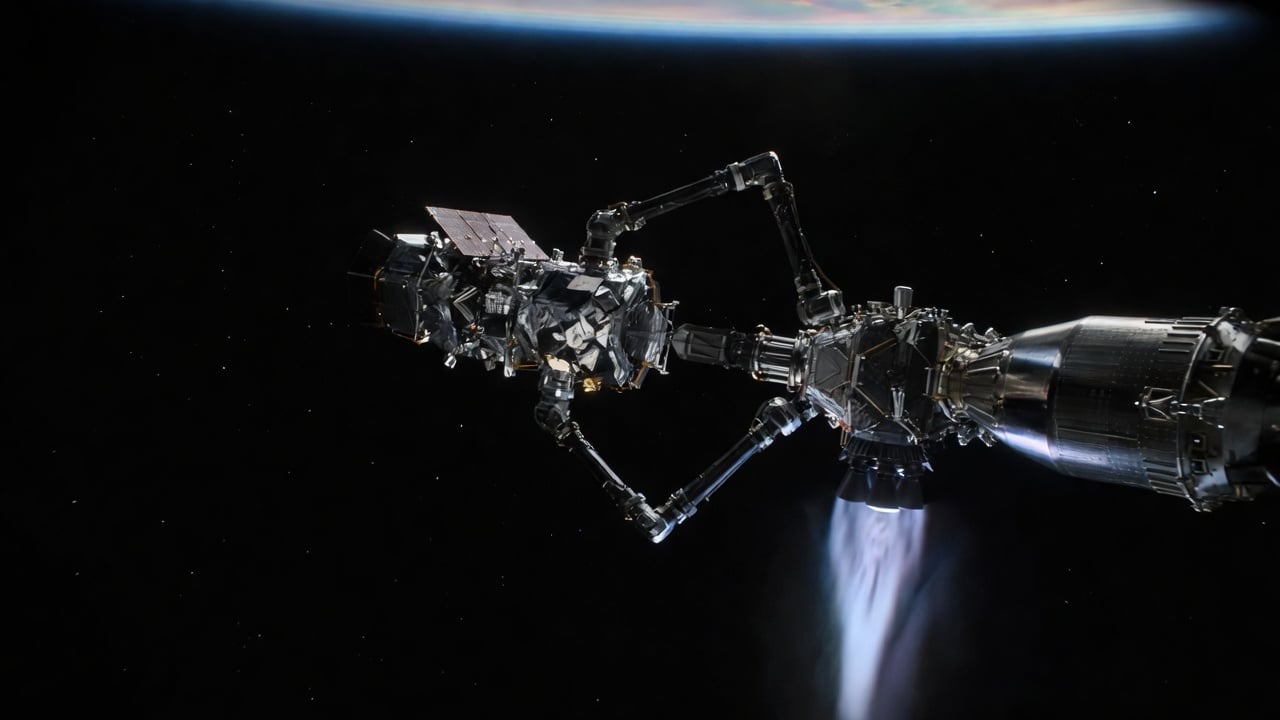
Enter a small Arizona startup and a refrigerator-sized robot named LINK. On July 2, aboard the final flight of Northrop Grumman’s Pegasus XL rocket dropped from a modified L-1011 Stargazer jet over the Marshall Islands’ Kwajalein Atoll, that robot launches. Its assignment sounds straightforward on paper. Catch an unprepared government satellite. Hold it steady with three robotic arms. Then fire ion thrusters for months to lift the combined mass 150 miles higher. Success buys Swift another decade of science. Failure writes off a still-productive observatory worth hundreds of millions.
The entire operation costs NASA just $30 million. A contract awarded to Katalyst Space Technologies in September 2025 under a rushed SBIR Phase III deal. The agency canceled its own costly OSAM-1 servicing mission earlier due to ballooning expenses. Private industry offered a faster, cheaper path. No one expected it to reach the pad this quickly.
“I have to be honest. No one thought it was going to be possible. No one thought we would get as far as we’ve already gotten today,” said Shawn Domagal-Goldman, NASA’s astrophysics division director, in a PBS News report.
Swift launched in November 2004 as a medium-class Explorer mission operated by Pennsylvania State University. Designed for a two-year life, it has delivered far beyond that. The observatory swings rapidly to new targets. It coordinates with ground and space telescopes worldwide. Gamma-ray bursts, supernovae, neutron star mergers — Swift spots them first and alerts the community. Its data helped confirm heavy elements like gold and platinum form in kilonovae. Recent observatories such as James Webb and the upcoming Nancy Grace Roman Space Telescope rely on such early warnings. Without Swift, NASA loses its fastest responder in the high-energy sky.
“If we let Swift reenter, we would lose that telescope. We would lose a lot of capability,” NASA’s science mission chief Nicky Fox told the AP. “We don’t currently have the budget to build another one to replace that.” Observations stopped in February. Controllers oriented the solar arrays to minimize drag, buying precious weeks. The spacecraft’s multi-layer insulation has begun to embrittle. Every passing month raises the risk that capture points become unusable.
Katalyst’s LINK spacecraft weighs 425 kilograms at launch. It stands 1.5 meters tall, deploys to a 6-meter width with solar arrays producing up to 40 kilowatts at peak. Three parallel manipulator arms, each with lidar and three-degree-of-freedom grippers, will attempt the grab. One arm could suffice in theory. Three provide better control and redundancy during the delicate dance. The arms target existing ground-handling flanges on Swift’s bus. No docking port exists. No prior preparation. This marks the first time a private U.S. spacecraft attempts to capture an uncrewed government satellite.
After separation from the Pegasus third stage, LINK spends three to four weeks performing rendezvous proximity operations. It studies the target. Chooses the safest grapple point. Then closes in. Capture could take days of careful adjustment. Once secured, three gimbaled xenon Hall-effect thrusters plus 16 reaction control thrusters begin the slow climb. Over four to six weeks the pair rises from 360 kilometers to 600 kilometers. LINK then undocks, demonstrates additional maneuvers with remaining propellant, and deorbits itself.
Weather already scrubbed the first attempt on June 30. A second try faces similar Pacific launch-range constraints. Yet the technical hurdles dwarf the schedule pressure. Testing occurred on an air-bearing table with a full-scale Swift mockup. Engineers practiced the exact capture sequence. Still, real orbital dynamics, lighting variations, and potential tumbling introduce unknowns. China performed a similar boost on one of its own satellites four years ago. The U.S. has never tried this with a robot on an aging asset not built for servicing.
The Stakes Extend Far Beyond One Telescope
Katalyst CEO Ghonhee Lee sees the mission as proof of concept for an entire industry. “This is the first American space robot to go up and do anything like this,” he said in the same PBS interview. “NASA has all these big senior observatories … all of them can benefit from a service like this. So what we’re proving with this mission is this is a new play in the playbook that’s available.”
The company’s next-generation servicer, already in development, targets satellites in much higher orbits. Lee envisions fleets of robots that not only boost and repair but refuel, assemble solar power arrays, and construct orbital data centers. Hubble, now 36 years old and also suffering from solar-driven drag, sits on the candidate list for a 2028 assist. “It’s a national treasure,” Fox said. “People love Hubble.”
NASA’s TechRepublic coverage highlights the mission’s dual purpose. Save Swift. Demonstrate commercial on-orbit servicing at scale. The $30 million price tag stands in stark contrast to the cost of designing, building, and launching a replacement observatory. LINK’s success would validate a policy shift toward buying services rather than owning every spacecraft end-to-end.
Recent reporting adds urgency. A Space.com update from July 1 confirms the July 2 launch window at 5:09 a.m. EDT after multiple weather scrubs. Pegasus XL, 55 feet long and capable of lofting 1,000 pounds to low-Earth orbit, will place LINK in minutes. The spacecraft itself measures about 4.9 feet tall. Swift stretches 12.7 feet. Precision matters. Centimeter-level control during grapple. Gentle thrust to avoid stressing either vehicle.
Phys.org and Wikipedia entries released in the past 48 hours echo these parameters while noting the mission’s high-risk, high-reward profile. If LINK fails to capture cleanly, NASA gains valuable data on why. If it succeeds, the astrophysics community regains a workhorse just as new telescopes flood the calendar with targets. Swift’s rapid-slew capability complements Webb’s deep stares. The observatory has already contributed to breakthroughs in multi-messenger astronomy. Its continued operation supports decades of follow-up science.
Critics question whether $30 million buys genuine insurance or merely delays the inevitable. Solar cycles will continue. Atmospheric density will fluctuate. Yet engineers calculate at least ten additional years of stable orbit at 600 kilometers. Enough time for new servicing technologies to mature. Enough time to plan a graceful retirement when the moment finally arrives.
So the countdown continues at Kwajalein. A jet taxis down the runway. A rocket drops, ignites, arcs into space. A small robot with three arms chases an aging sentinel across the sky. The outcome remains uncertain. The implications feel immediate. Satellite operators worldwide watch closely. What NASA and Katalyst achieve here could reshape how agencies and companies manage assets already in orbit. No longer discard at first sign of trouble. Service them. Extend them. Build the infrastructure that treats space as a sustainable operating environment rather than a one-way ticket.
Swift taught astronomers to respond swiftly to cosmic alerts. Now the mission named after it demands the same speed from engineers on the ground. The clock ticks. The robot waits in its carrier aircraft. And an entire field of orbital logistics holds its breath.


 WebProNews is an iEntry Publication