
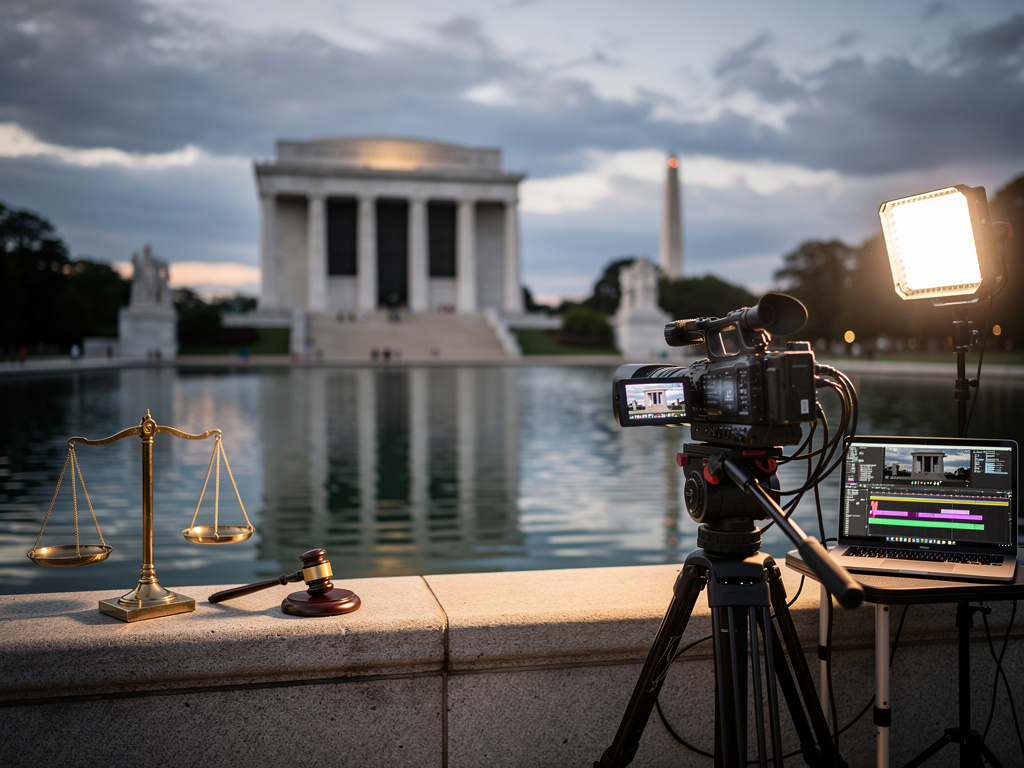
According to a report from Investing.com, former President Donald Trump announced plans to file a lawsuit against ABC News, claiming the network deliberately misrepresented facts during a high-profile interview segment involving a reflecting pool at the World War II Memorial in Washington, D.C. The announcement came amid ongoing tensions between Trump and major media outlets, highlighting persistent disputes over accuracy in political coverage.
Trump made the statement during a rally in a battleground state, where he accused ABC of airing footage that falsely suggested he had mishandled a moment of silence at the memorial. The reflecting pool, a central feature of the monument that honors those who served in World War II, became the focal point of the controversy after ABC broadcast images showing what appeared to be Trump standing near the water’s edge in a way that some viewers interpreted as disrespectful. Trump insists the network edited the clip to create a misleading impression, omitting context that showed him paying proper respects before a sudden gust of wind disturbed the water’s surface.
Legal experts following the case suggest the potential suit could center on defamation claims, arguing that ABC knowingly broadcast altered material to damage Trump’s public image. Trump has repeatedly described the network’s actions as part of a broader pattern of biased reporting aimed at undermining his political standing. In his public remarks, he emphasized that the footage failed to capture the full sequence of events, including his private conversation with veterans present at the site. The former president stated that his legal team had already begun gathering evidence, including witness statements from individuals who attended the memorial visit.
The incident traces back to a campaign stop where Trump visited the World War II Memorial to honor the anniversary of a significant military victory. During the event, he paused near the reflecting pool to lay a wreath and speak briefly with attendees. ABC News later aired a package that included drone footage of the pool area, with narration implying that Trump had lingered inappropriately or shown disregard for the site’s solemn nature. Critics of the coverage point out that the broadcast did not include audio from Trump’s actual remarks, which focused on gratitude toward American service members.
This latest development adds another chapter to Trump’s long history of legal confrontations with media organizations. Over the years, he has pursued or threatened litigation against several networks and publications, often citing what he calls intentional distortions of his words and actions. ABC News has not yet issued a detailed response to the threatened lawsuit, though spokespeople for the network previously defended their reporting as accurate and based on multiple sources present at the memorial. The organization maintains that the footage was obtained through standard journalistic practices and reflected the visual reality of the event without manipulation.
Observers note that such disputes frequently test the boundaries of First Amendment protections and defamation law. For a public figure like Trump to succeed in a libel case, he would need to demonstrate that the network acted with actual malice, meaning it either knew the information was false or showed reckless disregard for the truth. Legal analysts suggest that proving this standard can be challenging, particularly when dealing with visual media where interpretations of body language or context can vary widely among viewers.
The reflecting pool itself holds deep symbolic value in American history. Completed in 1995 as part of the World War II Memorial, the pool stretches 246 feet in length and features fountains at both ends that represent the Atlantic and Pacific theaters of war. Thousands of visitors pass by the site daily, many leaving notes or tokens of remembrance along its edges. Trump’s visit coincided with heightened security measures due to the sensitive nature of the location, and several news organizations had pooled resources to capture images of the proceedings.
Trump’s announcement of the impending lawsuit quickly spread across social media platforms, generating thousands of reactions from supporters who view mainstream media with skepticism. Many echoed his claims that networks routinely edit material to fit predetermined narratives. On the other side, commentators from various outlets pushed back, arguing that public figures must accept scrutiny of their actions, especially during campaign events staged at nationally significant locations. The debate reflects larger divisions in American society about trust in institutions, including both political leadership and the press.
As preparations for the lawsuit move forward, Trump’s attorneys are reportedly compiling a dossier of comparable incidents where they believe ABC and other networks have presented incomplete or slanted versions of events. One example cited involves previous coverage of Trump’s statements about military personnel, where context was allegedly stripped away to create negative impressions. The legal team plans to request internal communications from ABC that might reveal editorial decision-making processes behind the reflecting pool segment.
Network executives face the difficult task of balancing aggressive reporting with the risk of litigation. ABC, owned by The Walt Disney Company, has faced similar challenges in recent years as political polarization intensifies. Past settlements or retractions by media organizations in high-profile cases have sometimes encouraged further legal action from public figures seeking to challenge unfavorable coverage. However, many First Amendment scholars warn that frequent lawsuits against news outlets could chill legitimate journalistic inquiry, particularly when it involves elected officials or candidates.
The timing of Trump’s announcement carries political weight as well. With election cycles continuously influencing public discourse, the former president appears to be using the controversy to reinforce his narrative of fighting against what he terms fake news. At the rally where he first mentioned the lawsuit, the crowd responded with chants criticizing major networks. Trump promised that if successful, the case would set a precedent making media organizations more accountable for their reporting standards.
Meanwhile, historians and memorial staff have attempted to remain neutral in the unfolding dispute. The National Park Service, which maintains the World War II Memorial, issued a statement reminding the public that the site serves as a place of reflection for all Americans regardless of political affiliation. Officials emphasized that the reflecting pool was designed to provide a space for quiet contemplation rather than political theater, though they acknowledged that modern campaigns often incorporate visits to such landmarks.
Technical aspects of the disputed footage have also drawn attention from media analysts. The drone shots in question were captured from an elevated position, showing the full expanse of the pool and surrounding plaza. Some video experts argue that the angle can distort perceptions of proximity and intent, making it appear as though a person is interacting with the water when they are actually standing several feet away. Others counter that professional journalists should account for such optical effects when preparing broadcast material.
Trump’s legal history includes both victories and setbacks in media-related cases. While some threats of litigation have resulted in corrections or apologies from news organizations, others have been dismissed by courts citing insufficient evidence of malice. The outcome of this particular matter may depend heavily on whether Trump’s team can produce concrete proof that ABC editors knowingly selected misleading clips despite having access to complete raw footage.
As the story continues to develop, both sides are likely to release additional statements and possibly competing video evidence. Supporters of the former president have called for boycotts of ABC programming, while defenders of the network urge patience until all facts emerge through proper legal channels. The controversy serves as a reminder of how visual media can shape public perception in powerful ways, especially when the images involve symbolically charged locations like the World War II Memorial’s reflecting pool.
Further complicating matters, several other news organizations covered the same event from different perspectives. Some outlets focused on Trump’s interactions with veterans, highlighting positive exchanges and moments of apparent camaraderie. Others emphasized logistical challenges at the site or questions about campaign scheduling that placed the visit during peak visitor hours. This diversity of coverage illustrates how the same set of circumstances can generate widely varying interpretations depending on editorial priorities.
Trump has indicated that the lawsuit would seek substantial damages, though specific figures have not been disclosed. Legal observers suggest that any monetary award would likely be secondary to the public validation Trump seeks through the court system. By framing the action as a defense of truth in media, the former president positions himself as a champion against perceived institutional bias.
ABC News continues its regular programming while monitoring the situation. Industry insiders report that the network’s legal department has begun preliminary reviews of the segment in question, checking compliance with internal fact-checking protocols. The organization has a reputation for thorough vetting processes, yet critics maintain that political coverage sometimes falls short of those standards when high-profile figures are involved.
The reflecting pool controversy also raises broader questions about appropriate behavior at national memorials. Etiquette at such sites traditionally calls for respectful conduct, quiet voices, and avoidance of overtly political displays. Trump’s team argues that he adhered to these expectations, while some detractors claim his presence itself turned the location into a campaign backdrop. These differing viewpoints mirror larger societal disagreements about the intersection of politics and sacred public spaces.
Looking ahead, the case could take months or even years to resolve through the court system. During that time, public interest will likely fluctuate with other political developments. Nevertheless, the initial announcement has already succeeded in drawing fresh attention to questions of media accuracy and accountability. Whether the lawsuit ultimately proceeds to trial or finds resolution through other means, it adds to the complex relationship between American politics and the press that has characterized recent decades.
Witness accounts collected so far appear to support Trump’s version of events. Several veterans who stood near him during the visit have signed affidavits describing his demeanor as appropriately solemn. One former Marine recounted how Trump spent several minutes listening to personal stories before moving to the wreath-laying area. These testimonies could prove significant if the matter reaches discovery phases where both sides must exchange evidence.
Media watchdog groups have offered mixed reactions to the threatened legal action. Some praise efforts to hold powerful news organizations responsible for their content, while others express concern that such suits might discourage aggressive reporting on political candidates. The balance between accountability and press freedom remains delicate, particularly in an era when video evidence can be captured from multiple angles and distributed instantly across various platforms.
The World War II Memorial attracts millions of visitors annually, many of whom pause at the reflecting pool to read inscriptions or simply absorb the atmosphere of remembrance. Its design encourages personal reflection, with the water’s surface creating ever-changing patterns that mirror the sky above. In this context, the recent dispute takes on additional layers of meaning, as competing narratives struggle to define what happened beside those still waters on a particular afternoon.
Trump’s legal representatives have indicated they will file the complaint in a jurisdiction they believe will be receptive to claims of media misconduct. Selection of venue often plays a strategic role in defamation cases, as different courts interpret standards of proof with varying degrees of strictness. ABC will likely seek to have the case heard where precedents favor media defendants, setting up potential procedural battles before any substantive arguments are heard.
Public polling on media trust has shown declining confidence in traditional news sources across much of the political spectrum. This environment creates fertile ground for legal challenges like the one Trump proposes. Whether his action will change journalistic practices remains uncertain, but it certainly ensures that the reflecting pool incident will remain part of the conversation for some time to come. As additional details emerge from both the campaign and the network, Americans will continue to form their own judgments about what the footage truly showed and what responsibility news organizations bear for how they present reality.


 WebProNews is an iEntry Publication