
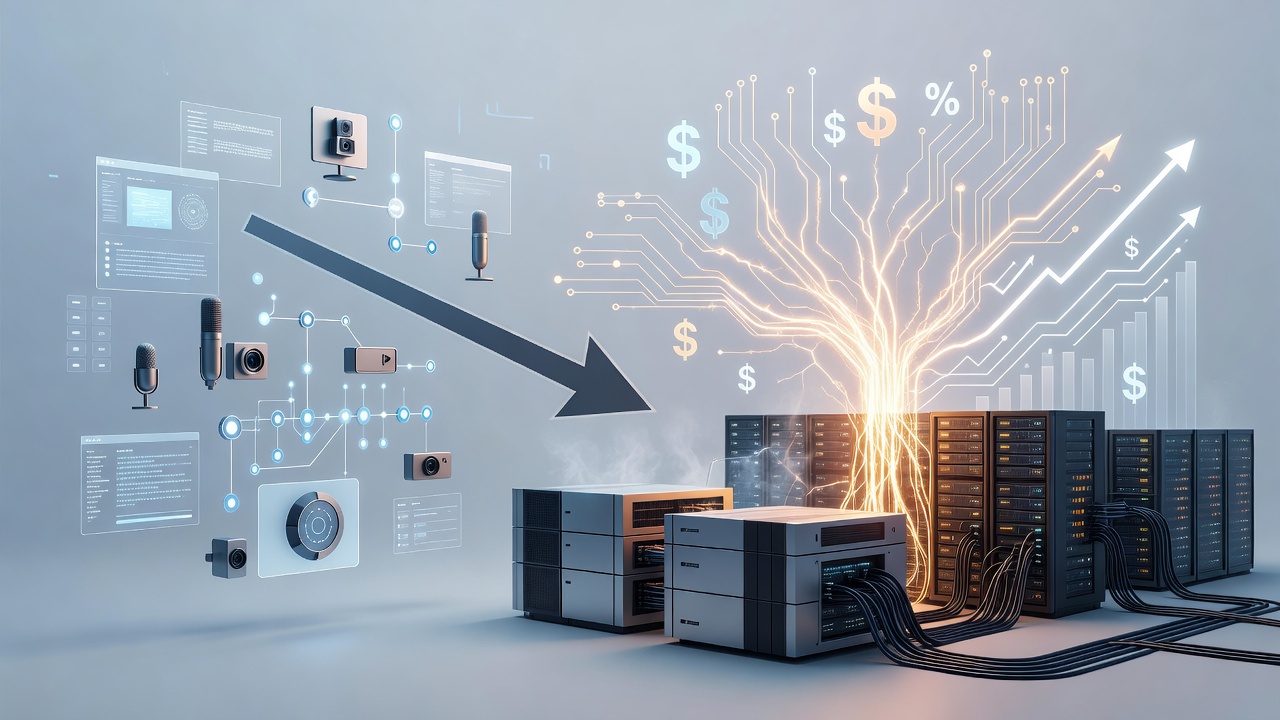
Leonhard Soenke built a business around influencers and their fans. Now he powers the machines that train the models changing everything else. The shift happened fast. One day he managed a platform where followers sent gifts to online stars. The next he chased deals for solar panels, batteries and gas turbines outside Austin.
Soenke and his co-founder Patrice Becker started Throne in 2021. The service let creators build wish lists. Fans bought items and sent them directly. It caught on. Partnerships with big retailers followed. Amazon came on board. The company grew into a sizable organization. Yet by the middle of last year both founders felt restless.
“We’re very, I would say, spiky personalities,” Soenke told Business Insider. They wanted a fresh start. They also wanted impact on a different scale. The creator space had matured. Competition filled every corner. Meanwhile artificial intelligence infrastructure looked wide open.
They left New York. They set up in San Francisco to talk with researchers and compute providers. Problems piled up quickly. Chips needed more electricity. Data centers struggled to get it. Soenke and Becker zeroed in on behind-the-meter energy systems. Their new company TAR, short for Transformative American Resources, designs modular setups. Solar arrays. Battery storage. Wind turbines. Natural gas generators. All deployed faster than traditional utility projects.
The bet paid early. TAR raised $27 million in seed funding at a $500 million valuation from a strategic investor whose name remains undisclosed. The round closed recently. Word spread on the same day the original Business Insider story appeared. Analysts immediately connected the move to broader tension in the sector.
Power has become the binding constraint. Goldman Sachs researchers forecast U.S. data center demand will climb from 31 gigawatts in 2025 to 41 gigawatts in 2026 and then 66 gigawatts in 2027. That doubling arrives just as models grow more capable. Training one frontier system could soon demand five gigawatts on its own, according to estimates shared by Anthropic. The company projected the entire U.S. AI sector may need 50 gigawatts of fresh capacity by 2028. Put another way, twice the peak load of New York City.
Global numbers look equally stark. The International Energy Agency expects data center electricity use to double to roughly 945 terawatt-hours by 2030. That equals nearly 3 percent of worldwide consumption. Accelerated servers tied to AI will drive 30 percent annual growth in their slice of the pie. Conventional servers lag at 9 percent. Gartner analysts put worldwide data center power demand at 132 gigawatts for 2026, up 27 percent from the prior year. AI-optimized servers alone will account for 31 percent of that total and surpass conventional ones in 2027.
Grids cannot keep pace. Northern Virginia, home to the densest cluster of facilities on earth, has seen repeated warnings. One voltage swing in 2024 tripped 60 data centers offline at once and created a sudden 1,500-megawatt surplus. Utilities delay new hookups for months or years. Some developers now build their own generation. Others sign direct contracts with producers. A few turn to natural gas generators as temporary bridges even though they burn fuel less cleanly.
TAR attacks the gap from a different angle. The company does not invent novel generation technology. It focuses on speed of deployment. Modular blocks can slot onto a site, connect quickly and scale as load increases. Mixes of renewables and firm gas provide both clean attributes and reliability. The goal is to shrink the time between request and first token. Every millisecond saved matters when models run at hyperscale.
Soenke admits the pivot felt like giving away a child. Throne represented years of work. He calls himself a control freak. Yet the handoff went smoother than expected. Longtime team members took the reins. The process stretched across six months. Soenke still lurks in Slack. When a bug appears he sometimes jumps in to fix it. “Our attitude is if ain’t broke, don’t fix it,” he said, pointing to the identical Patagonia quarter-zip he wore at both companies, now stitched with the TAR logo.
Skills transferred more easily than outsiders might guess. Both businesses solve hard problems under tight timelines. Throne took off because demand proved insatiable. Energy systems face the same pull from AI customers. Early days at Throne meant Soenke and Becker handled customer support from a shared apartment. Today they walk job sites and talk with contractors and crews who run heavy equipment. The shift from software offices in New York or San Francisco to dusty Texas fields required new empathy. Founders must understand not only users but welders, electricians and land developers.
Capital intensity changed too. Software scales with servers and code. Energy demands warehouses, land procurement and million-dollar machines. Legacy players in the power industry move slower than Silicon Valley expects. TAR spends extra time on site to build trust. That effort matters. Without cooperation from established utilities and construction firms, projects stall.
Recent developments reinforce the urgency. On the same day TAR’s story broke, discussions across X highlighted the same bottleneck. One post noted the founder pivot as evidence that even consumer internet veterans now chase electrons. Another pointed to Kevin O’Leary’s scaled-back proposal for a massive data center campus in Utah after local pushback over water, noise and electricity prices. Community resistance adds another layer of friction.
Generac, long known for home backup generators, announced a major supply deal with an unnamed hyperscaler for large megawatt-class units. The move signals how backup power itself becomes core infrastructure. A Investing.com analysis called it a strategic shift from weather-driven residential sales to steady data center demand. Predictable revenue could follow if the AI buildout continues.
Brookings Institution researchers examined how smaller communities can turn the boom into lasting gains. Their February report urged local leaders to negotiate workforce programs, university partnerships and shared pilots for load shifting. Microsoft has tried this path in Wisconsin, pairing data center announcements with investments in training and startups. Success varies. Many towns still worry about higher bills for existing residents.
Bloom Energy’s 2026 Data Center Power Report captured the shift in tone. A year earlier the conversation centered on emerging stress. By midyear the constraint had hardened into a hard boundary. Total U.S. IT load could reach 150 gigawatts by 2028, more than double some earlier forecasts. Power availability now defines where and how fast facilities can rise.
Soenke and Becker placed their company in Texas for good reason. The state offers abundant land, existing gas infrastructure and a regulatory climate friendly to new generation. Their San Francisco office still houses engineering talent close to the labs. The split geography reflects the hybrid nature of the business. Brains in one place. Heavy iron in another.
Not every founder will follow this path. Most creator-economy companies will stay focused on content, commerce and community. Yet Soenke’s move highlights a larger migration. Talent that once optimized engagement metrics now optimizes kilowatt-hours. The problems feel bigger. The capital checks run larger. The societal stakes sit higher.
AI models improve only as fast as the electrons reach them. Every new parameter trained, every inference served, draws real power from the physical world. TAR and dozens of similar startups now race to close that gap. Their success or failure will help decide whether the promised wave of intelligence arrives on time or stalls behind transformers and transmission lines.
Soenke still checks in on Throne. The original business runs smoothly under its new stewards. He keeps the same fleece. The problems have simply grown. From gift lists to gigawatts. The distance looks short in hindsight. The work ahead stretches far longer.


 WebProNews is an iEntry Publication