
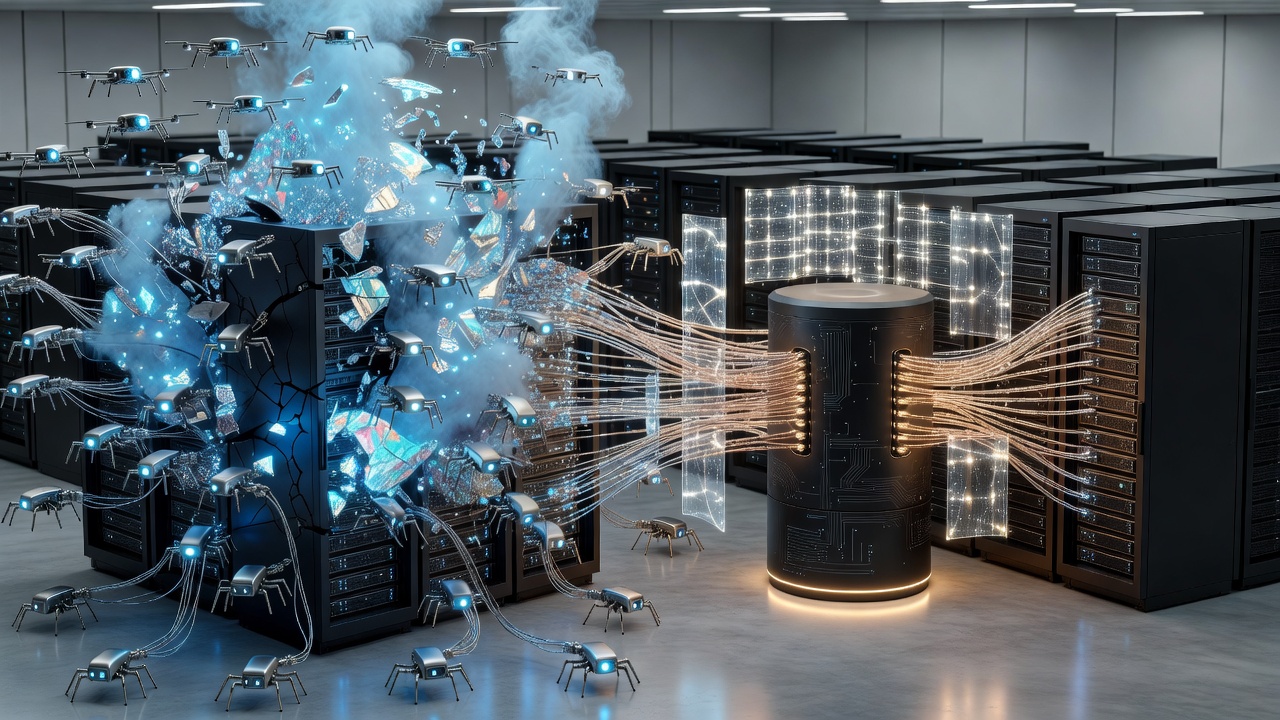
AI agents have arrived in force. They query systems at machine speed. They spawn new data stores without asking permission. And they multiply so fast that traditional database teams can’t keep up.
But the same technology driving this chaos may also tame it. Cockroach Labs CEO Spencer Kimball says manual database management is headed the way of Assembly language. “Nobody’s going to do manual work on a database, just like almost nobody’s doing manual coding anymore,” he told The Register in an article published today.
The numbers paint a stark picture. By 2028 the average Fortune 500 enterprise will run more than 150,000 AI agents. That’s up from fewer than 15 in 2025. Yet only 13% of organizations believe they have proper governance in place. The prediction comes from Gartner.
Enterprises already feel the strain. The average organization uses 12 or more agents now. Half operate in silos. That setup breeds redundant data pipelines and conflicting versions of truth. Salesforce laid out the details in its 2026 Connectivity Benchmark report.
Only 18% of organizations keep a current, complete inventory of their agents. Integration suffers. The same problems get solved repeatedly with little knowledge shared between teams. Those figures appear in analysis from the IBM Institute for Business Value.
Data fragmentation follows close behind. Lineage tracking becomes nearly impossible. Auditors struggle to trace which agent made which decision. The result? Misinformation risks rise. Oversharing grows. Data loss incidents become harder to contain.
Max Goss, senior director analyst at Gartner, captured the tension. “As CIOs and IT leaders see an explosion of AI agents across their organizations, many are contending with an ungoverned sprawl of agents that expose their organizations to a range of risks, including misinformation, oversharing and data loss.”
Shadow agents make matters worse. Employees deploy them without IT approval. These systems connect to corporate email, SaaS platforms and internal tools. They move data at scale while staying invisible to central monitoring. Google’s Cybersecurity Forecast highlighted the threat earlier this year.
Production databases take the biggest hit. Agents hammer them with queries. Traditional relational systems weren’t built for this volume or unpredictability. Polling production instances creates load spikes. Batch change data capture leaves freshness gaps. Single-store architectures force incompatible workloads into the same engine.
The pattern echoes past technology waves. Microservices sprawl hit engineering teams years ago. BI sprawl created conflicting metrics across departments. Now agent sprawl adds context fragmentation on top of identity chaos. Each agent builds its own understanding of data. Without a shared semantic layer, outputs clash.
Yet vendors see opportunity in the disorder. Kimball’s Cockroach Labs plans an Agentic Database Cloud. The architecture separates compute and storage elastically. It offers unified estate management across sprawling database collections. Database virtualization hides complexity. Agentic operations automate the grungy tasks humans avoid.
The company already builds agents internally. They handle migrations, diagnose slow queries and analyze cluster problems. A layered approach assigns sub-tasks. One agent oversees others. Prompts get engineered with care. Handoffs receive quality checks. Institutional knowledge gets indexed. Cockroach once fed two years of Zendesk history into its systems for exactly this purpose.
Models mix for best results. Fast, inexpensive open-source options manage routine work. Proprietary systems like OpenAI’s offerings and Claude Opus tackle harder reasoning. “There are things the agents can do that are so grungy you couldn’t hire a human to do it,” Kimball explained. “It’s just too boring.”
Enterprises won’t hand over production keys anytime soon. Agents serve as a second pair of eyes for now. They advise. They don’t command. That caution reflects real fear of autonomous decisions gone wrong.
Other players push similar ideas. Vector database vendor Pinecone compiles knowledge bases about data structures to cut token waste. Tiger Data, the team behind TimescaleDB, developed Ghost technology that lets AI agents interact while charging based on compute rather than database instances.
Gartner recommends six concrete steps to regain control. Organizations should establish clear governance policies first. Next comes a centralized agent inventory, often built with AI TRiSM tools that discover shadow agents. Identity, permissions and lifecycle rules follow. Information governance must cover data access and permissions. Continuous monitoring and remediation come after that. Finally, a culture of responsible AI rounds out the framework.
IBM suggests starting with an automated scan across cloud environments and APIs. Create a dynamic registry that tracks every agent’s owner, purpose, data access and model version. Orchestration layers coordinate multi-agent workflows. They make communication patterns explicit for better logging and control.
A shared context layer could prove decisive. It provides canonical definitions and real-time lineage. One study from Atlan AI Labs found that grounding agents in such a layer boosted SQL accuracy by 38%. Without it, even well-governed agents produce unreliable results because they lack common understanding.
Recent coverage reinforces the urgency. Virtualization Review reported today that Microsoft Purview now treats data sprawl as a governable security asset rather than an inevitable cost. The timing aligns with surging agent adoption.
Rubrik’s research from last week found two-thirds of organizations lack full visibility into agent actions. Only 30% can contain, reverse or recover from harmful behavior. “Two thirds of organisations cannot tell you what their agents did five minutes ago,” the company warned. When incidents unfold at machine speed, that gap matters.
Snowflake advocates zero-copy architectures to limit unnecessary data duplication. Fewer copies mean fewer places for sensitive information to leak. Policies stay attached to original data rather than proliferating across replicas.
The path forward mixes governance with smarter infrastructure. Centralized control planes provide visibility. Agent registries act as single sources of truth. Lifecycle rules automatically flag dormant agents for retirement. Yet technology alone won’t suffice. Teams must shift from reactive database administration to proactive orchestration of agentic systems.
Kimball remains optimistic about the pace of change. “Fundamentally, this is what we’re going to do for our customers,” he said. Anchoring decisions to today’s limitations misses how quickly capabilities improve. The agents that create database sprawl will soon manage it at scale. The question is whether enterprises build the right foundations before the volume overwhelms them.
That transition won’t happen overnight. But the direction looks clear. Manual database wrangling fades. Agent-driven operations take its place. Success belongs to those who treat agents as both the problem and the solution.


 WebProNews is an iEntry Publication