
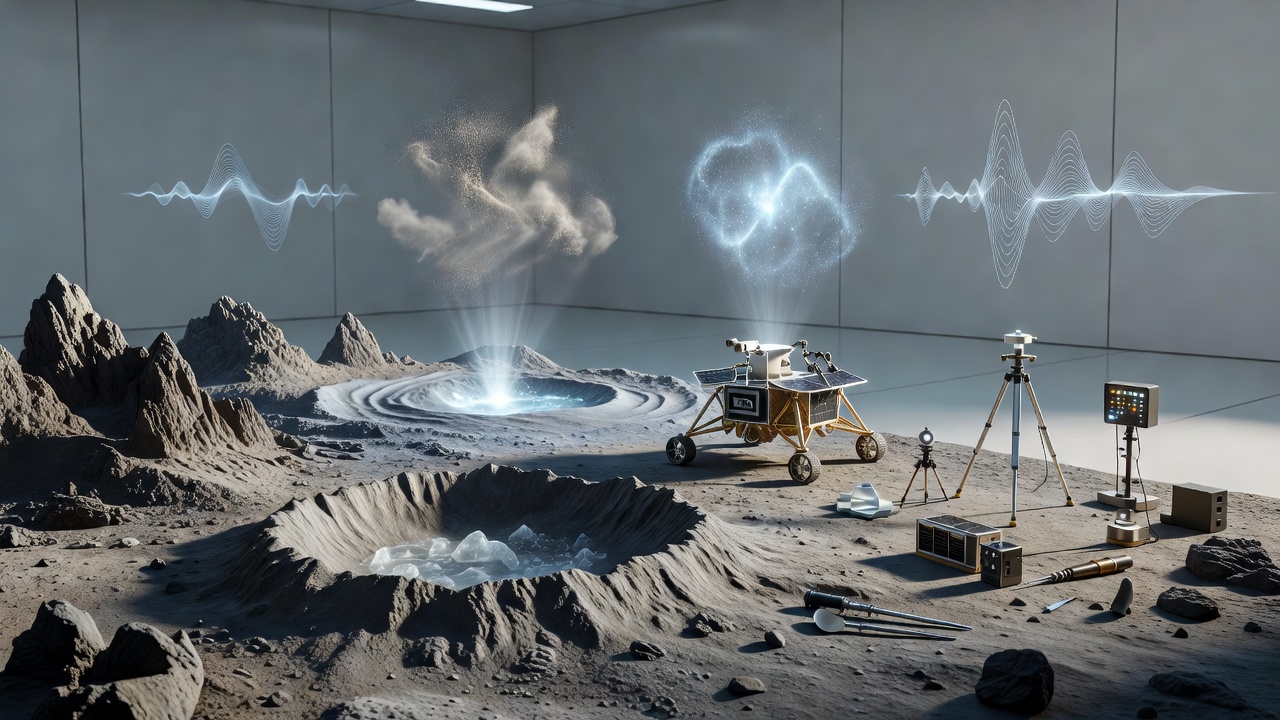
NASA has selected 21 new scientific investigations to support its Artemis program, focusing on the lunar surface and the space environment around the Moon while also announcing fresh chances for researchers to join upcoming missions. The awards, part of the agency’s ongoing efforts to prepare for sustained human presence on the Moon, will help scientists examine everything from lunar geology and resource potential to the effects of the lunar environment on technology and human health.
The selections come through two separate initiatives. The first involves the Payloads and Research Investigations on the Surface of the Moon, known as PRISM. This program funds instruments that will ride to the lunar surface aboard commercial landers under NASA’s Commercial Lunar Payload Services, or CLPS, initiative. The second opportunity falls under the Lunar Surface Science Team, which coordinates research activities for Artemis astronauts and robotic precursors. Together these awards represent a broad push to gather data that will inform both short-term crewed landings and the longer-term goal of establishing a permanent outpost near the Moon’s south pole.
Among the newly chosen PRISM investigations, several stand out for their potential to answer longstanding questions about the Moon’s composition and history. One team led by researchers at the University of California, Los Angeles will deploy a next-generation seismometer designed to listen for moonquakes over an extended period. By recording subtle vibrations in the lunar crust, the instrument can help map the interior structure of the Moon with greater precision than previous Apollo-era experiments. Such information is essential for understanding how the Moon formed and evolved, and it will also assist engineers in designing habitats that can withstand any seismic activity.
Another selected proposal targets the search for water ice and other volatiles trapped in the permanently shadowed regions near the lunar poles. A group from the Johns Hopkins Applied Physics Laboratory plans to fly a compact neutron spectrometer and a near-infrared spectrometer on a future CLPS flight. These tools will measure hydrogen abundance and identify specific minerals associated with water ice. Because water ice could serve as a source of oxygen and rocket propellant, confirming its quantity, purity, and accessibility ranks among the highest priorities for Artemis planners. The data collected will directly influence decisions about where to locate future landing sites and resource-extraction hardware.
Additional PRISM investigations will examine the lunar exosphere, the thin layer of gases surrounding the Moon. One experiment from the Southwest Research Institute will study how solar wind and micrometeorite impacts release atoms and molecules from the surface. Understanding these processes helps scientists predict how the lunar environment might affect sensitive instruments and solar panels over time. Another proposal from NASA’s Goddard Space Flight Center will test a new type of mass spectrometer capable of identifying rare isotopes in the exosphere. The results could reveal clues about the Moon’s volatile history and its connection to Earth’s early atmosphere.
Beyond surface payloads, NASA also selected several investigations that will operate from orbit or during transit to the Moon. These include studies of how galactic cosmic rays and solar particle events interact with lunar regolith, research that will improve radiation shielding designs for both robotic and crewed missions. One selected project from the University of Colorado will analyze how lunar dust behaves in the plasma environment created by the solar wind. Dust remains one of the most persistent engineering challenges for lunar operations, as its fine, jagged particles can clog mechanisms, abrade surfaces, and pose respiratory hazards to astronauts.
The Lunar Surface Science Team awards focus on preparing for human exploration. These selections support research that will be conducted by astronauts during Artemis III and subsequent missions. One team from Brown University will develop procedures for collecting and documenting geological samples in the south polar region, where overlapping crater rims and ancient lava flows create a complex stratigraphic record. Their work will help train crews to recognize high-priority samples that could contain records of the Moon’s volcanic past and the late heavy bombardment period.
Another selected investigation addresses the biological effects of lunar dust. Researchers from Stony Brook University will examine how lunar regolith particles interact with human lung cells and immune systems in laboratory simulations. Although previous Apollo astronauts reported respiratory irritation after tracking dust into the lunar module, the long-term health consequences remain poorly understood. The new study will inform the design of dust mitigation systems for habitats, airlocks, and spacesuits.
Several awards also target technology demonstrations that could become standard equipment for future missions. A proposal from Honeybee Robotics seeks to test a robotic drill capable of reaching depths of up to two meters in search of subsurface ice. Drilling into the lunar surface presents unique difficulties because of the abrasive nature of regolith and the extreme temperature swings between sunlight and shadow. Data from this experiment will help refine drilling techniques and power requirements for larger-scale resource prospecting systems.
NASA’s announcement also highlights opportunities for the broader scientific community to participate in upcoming CLPS flights. The agency released a new call for payload proposals that will remain open for the next several years, allowing investigators to respond quickly as commercial landers become available. This flexible approach contrasts with traditional, schedule-driven NASA missions and reflects the agency’s strategy of buying rides on privately developed spacecraft. By maintaining an open solicitation, NASA hopes to encourage a steady stream of innovative ideas from universities, industry partners, and international collaborators.
The commercial lunar payload program has already flown several successful missions, including Intuitive Machines’ Odysseus lander in early 2024. Although that flight encountered challenges during its final descent, it still returned valuable engineering data and demonstrated that commercial entities can deliver payloads to the lunar surface. Future flights scheduled over the next two years will carry instruments selected in previous rounds, gradually building a network of scientific stations across different lunar terrains.
One area receiving increased attention is the study of lunar polar volatiles. The south pole contains craters that have remained in permanent shadow for billions of years, preserving water ice delivered by comets and asteroids. NASA’s VIPER rover, scheduled to launch in late 2024, will perform the first mobile survey of these shadowed regions. The newly selected PRISM investigations will complement VIPER by providing ground-truth measurements at additional sites. Together these efforts aim to create a comprehensive map of where ice is located, how deeply it is buried, and whether it exists in forms that can be economically extracted.
Scientists also plan to investigate the Moon’s magnetic field, or rather its lack of one. Unlike Earth, the Moon does not generate a global magnetic field today, yet some lunar rocks show evidence of magnetization from an ancient dynamo. A selected investigation from the Massachusetts Institute of Technology will place sensitive magnetometers on the surface to measure any residual magnetic anomalies. The data could help explain why the dynamo shut down and what that means for the Moon’s thermal evolution.
In parallel with these scientific efforts, NASA continues to develop the Artemis Base Camp concept. The base camp would serve as a hub for long-duration stays, featuring habitats, power systems, rovers, and resource utilization equipment. The investigations announced today will supply critical information needed to finalize the base camp’s location and design. For example, understanding the distribution of ice will determine how far crews must travel to reach usable resources, while seismic and radiation measurements will shape structural requirements for habitats.
International partners are also contributing to the growing body of lunar science. The European Space Agency, the Canadian Space Agency, and the Japan Aerospace Exploration Agency have all signed agreements to participate in Artemis. Several of the selected investigations include co-investigators from these organizations, reflecting the global nature of modern space exploration. Data sharing protocols established under these agreements will ensure that findings benefit the entire scientific community.
Education and public outreach remain central to the program. Many of the selected teams include plans to engage students through classroom activities, virtual mission control experiences, and open-source data portals. By involving the next generation of scientists and engineers, NASA hopes to sustain public interest in lunar exploration for decades to come.
The pace of lunar science is accelerating. With multiple commercial landers in development and crewed landings on the horizon, researchers now have opportunities that were unimaginable just a decade ago. The 21 newly selected investigations cover a wide spectrum of disciplines, from geophysics and planetary science to biology, engineering, and astronomy. Each contributes a piece to the larger puzzle of how humans can live and work on another world.
As these projects move forward, they will generate a steady flow of new data that will shape every aspect of Artemis. Instruments will measure temperatures, radiation levels, dust properties, and ice concentrations. Astronauts will collect samples guided by decades of orbital remote sensing. Robotic drills will probe beneath the surface while orbital sensors monitor the space environment. All of this information will feed into iterative design cycles for habitats, vehicles, and life support systems.
The ultimate goal remains a sustained human presence on the Moon that serves as a stepping stone to Mars and beyond. By investing in these early scientific investigations, NASA is laying the groundwork for an exploration program that is both scientifically rich and practically sustainable. The knowledge gained will help answer fundamental questions about the solar system’s history while simultaneously enabling the technologies needed for long-term lunar operations.
Future calls for proposals will continue to refine the selection process based on lessons learned from early CLPS flights. NASA has indicated that it will prioritize investigations that address strategic knowledge gaps identified by the Lunar Surface Innovation Initiative. These gaps include solar power generation at high latitudes, dust-tolerant mechanisms, and methods for extracting oxygen from regolith. By aligning research priorities with engineering needs, the agency aims to create a virtuous cycle in which science enables exploration and exploration generates new scientific discoveries.
The announcement signals NASA’s commitment to a science-driven approach to lunar exploration. Rather than treating scientific payloads as secondary passengers, the agency has integrated them into the core architecture of the Artemis program. This strategy increases the probability that the data returned will directly support decision-making for future missions. It also encourages collaboration across traditional boundaries between science, engineering, and operations teams.
Over the coming years, the selected investigations will begin their journeys to the Moon aboard a variety of commercial landers. Some will land near the equator to study volcanic features, while others will target the south pole to prospect for ice. A few will operate during transit, collecting data on the deep space radiation environment. Each mission will add another data point to humanity’s growing body of knowledge about Earth’s nearest neighbor.
The collective effort represents one of the most comprehensive lunar research campaigns since the Apollo era. By combining robotic precursors, orbital assets, and eventual crewed expeditions, NASA and its partners are building a multi-layered understanding of the Moon. The 21 investigations selected today form an important part of that foundation, promising new insights into the Moon’s past, present, and future role in human spaceflight. As the data begin to arrive, scientists and engineers alike will pore over the results, adjusting plans, refining models, and preparing for the day when astronauts once again walk on the lunar surface—this time to stay.


 WebProNews is an iEntry Publication