
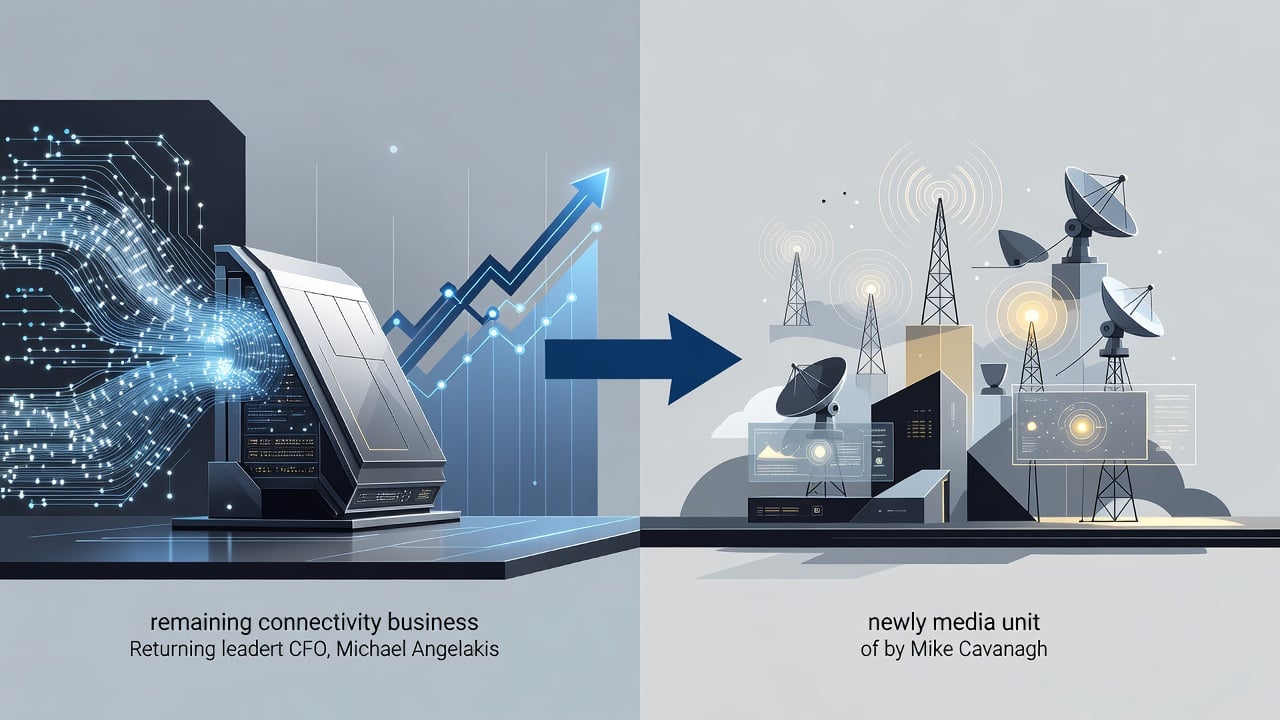
Comcast Corporation told investors and employees on Monday it would cleave itself in two. One company would keep the cable pipes, broadband service and wireless business that still throw off reliable cash. The other would carry NBCUniversal, the Peacock streamer, Universal Pictures, the NBC broadcast network and the European pay-TV operation Sky.
The move, structured as a tax-free spin-off expected to close in mid-2027, marks the latest in a string of media companies trying to separate the steady but slow-growing connectivity side from the volatile content and entertainment assets. Shares of Comcast jumped as much as 17 percent intraday before closing up about 4.5 percent, according to reports from CNBC and Yahoo Finance.
But the real story sits in the corner office. Brian L. Roberts, who has run Comcast for decades alongside a series of co-chief executives, will stay on as chairman and remain actively involved with both new entities. Day-to-day leadership, however, shifts. Mike Cavanagh, the current co-CEO, steps over to run the standalone NBCUniversal. And the cable-and-connectivity company gets a new boss: Michael Angelakis, the widely respected former chief financial officer who left in 2015 to start Atairos, Comcast’s strategic investment arm.
Roberts did not reach this decision lightly. According to The Wall Street Journal, he offered Angelakis the job only a few weeks ago during a four-hour lunch at a diner near the company’s Philadelphia headquarters. The two men have known each other for years. Angelakis joined Comcast in 2007, rose to vice chairman and CFO, and played a central role in the 2011 acquisition and integration of NBCUniversal.
“As our widely admired former CFO, Michael’s deep knowledge of the business and passion for technology – combined with the leadership of Steve Croney, Jason Armstrong and the entire Comcast management team – will serve us well as we continue to take bold actions in today’s competitive environment,” Roberts said in the official release from Comcast’s corporate site. He added that Angelakis’s “drive, proven track record and the tremendous level of respect he commands within our organization and beyond, make me exceptionally excited to work closely with him again.”
Angelakis returns first as a strategic adviser to shepherd the separation, then assumes the CEO title once the spin-off finishes. In his own statement he struck a note of continuity mixed with urgency. “Comcast’s exceptional assets, entrepreneurial roots, deep customer relationships and strong track record of innovation and technological leadership provide a powerful foundation for the future,” he said. He plans to “execute aggressively” while investing for growth and chasing new opportunities to create value.
The appointment stands out for another reason. Angelakis would become the first non-Roberts family member to serve as Comcast’s sole chief executive, the Philadelphia Business Journal noted. Analysts quickly praised the choice. One told the same publication that Angelakis represented “the best part” of the entire split plan.
This is no sudden break. Comcast has been shedding pieces of its media portfolio for months. In January it completed the spin-off of a collection of cable networks – USA, CNBC, MSNBC, Oxygen, E!, Syfy and Golf Channel – into a new publicly traded company called Versant Media Group. That earlier transaction set the stage. Now the company is going further, creating two focused enterprises rather than trying to straddle both worlds.
The pressure has been building. Streaming competitors continue to erode traditional cable revenues. Advertising and affiliate fees face persistent challenges. Meanwhile the broadband business, rebranded under Xfinity, still generates strong free-cash-flow even as cord-cutting accelerates. Management concluded that each unit would perform better with dedicated leadership, separate capital structures and the ability to pursue its own strategic path. “Growing competition in the telecom and media industries has increased the need for strategic flexibility,” the board and management team stated.
Yet executives pushed back hard against speculation that the split paves the way for future sales. “Roberts denied that this split is intended to facilitate additional transactions,” Michael Hodel, equity director at Morningstar, wrote in an investor note. “That claim doesn’t make sense to us.” Morningstar kept its $41 per-share fair-value estimate, grounded in separate cash-flow forecasts for the connectivity and media businesses.
The broader trend is unmistakable. Finance chiefs are stepping into corner offices more often. In 2025 the share of CFO-to-CEO promotions in the Fortune 500 and S&P 500 hit 10.26 percent, the highest level in a decade, up from 6.5 percent in 2015. Data comes from Crist Kolder Associates’ Volatility Report, cited in the original Fortune coverage.
Warner Bros. Discovery offers a recent parallel. Last year that company laid out its own split into two standalone businesses. CFO Gunnar Wiedenfels was named CEO of the global networks piece, while David Zaslav would lead the studio and streaming operations. The pattern repeats. Boards increasingly believe operators who understand the numbers can steer companies through capital-intensive transitions, whether building out fiber networks or funding content libraries.
Angelakis spent the past decade at Atairos, the investment firm he built in partnership with Comcast. There he focused on long-term bets in growth companies. He also kept a hand in Comcast’s affairs as a senior adviser to the executive management committee. That continuity matters. The new connectivity-focused Comcast will still need to invest heavily in network upgrades, compete with fiber providers and wireless carriers, and defend its residential and business customer base.
Cavanagh, for his part, inherits a media company that includes film and television studios, a broadcast network, theme parks, the Peacock streaming service and Sky’s operations across Europe. The standalone NBCUniversal should, in theory, enjoy greater freedom to strike content deals, pursue international expansion or even entertain acquisition interest once separated from the cable cash engine. But it will also face the full force of streaming economics without the cushion of broadband profits.
Roberts will not disappear. The founder’s son has made clear he intends to stay deeply engaged. He will work in partnership with both new CEOs. The arrangement echoes past Comcast leadership experiments with co-CEOs, though the formal titles have now been split across corporate boundaries.
Analysts and investors will spend the next year dissecting the financial mechanics of the separation. How will debt be allocated? What will the two companies’ capital-return policies look like? Can the media entity sustain its dividend once cut loose? Those questions matter. Yet many observers point first to the human element. Bringing back a battle-tested operator who knows every corner of the business and commands respect across the ranks may prove the single biggest variable in whether the split succeeds.
Comcast has executed big transactions before. The NBCUniversal deal itself was complex. So was the earlier acquisition of Sky. Each time the company integrated, rationalized and eventually spun off pieces. This time the spin-off itself is the transaction. And the man chosen to run what remains of the original Comcast is someone who helped shape its modern form more than a decade ago.
Angelakis returns at a moment when the cable industry faces structural decline but the connectivity business still holds durable advantages: scale, last-mile infrastructure and sticky residential relationships. His task is straightforward in description and brutal in execution. Protect the cash flows that have funded so much of the company’s past ambition. Invest wisely in technology that keeps Comcast relevant against fiber upstarts and fixed-wireless alternatives. And do it all while the media sibling charts its own independent course.
The market gave an initial thumbs-up. Whether that enthusiasm lasts depends on how cleanly the separation executes and how convincingly Angelakis demonstrates that a finance mind can still drive operational performance in a changed industry. He has the pedigree. He has Roberts’s confidence. Now he has the mandate.
But first comes the year-long process of carving the company apart. Legal, regulatory and financial details must be settled. Employee transitions arranged. Investor communications sharpened. Angelakis will advise on all of it before he officially takes the wheel. The role of strategic adviser is more than ceremonial. It lets him help design the very structure he will later run.
That may be the quiet genius of the move. By installing the former CFO at the top of the connectivity business, Comcast signals that capital allocation, cost discipline and strategic clarity will define its next chapter. In an environment where traditional video revenue shrinks and broadband growth slows, those skills could matter more than ever.
Roberts, for all his decades at the helm, appears ready to let others steer the two new ships while he watches from the chairman’s chair. The company he built is about to become two. One led by a longtime lieutenant. The other by a man who once balanced its books and now returns to test whether the numbers still add up in a world without the other half.


 WebProNews is an iEntry Publication