
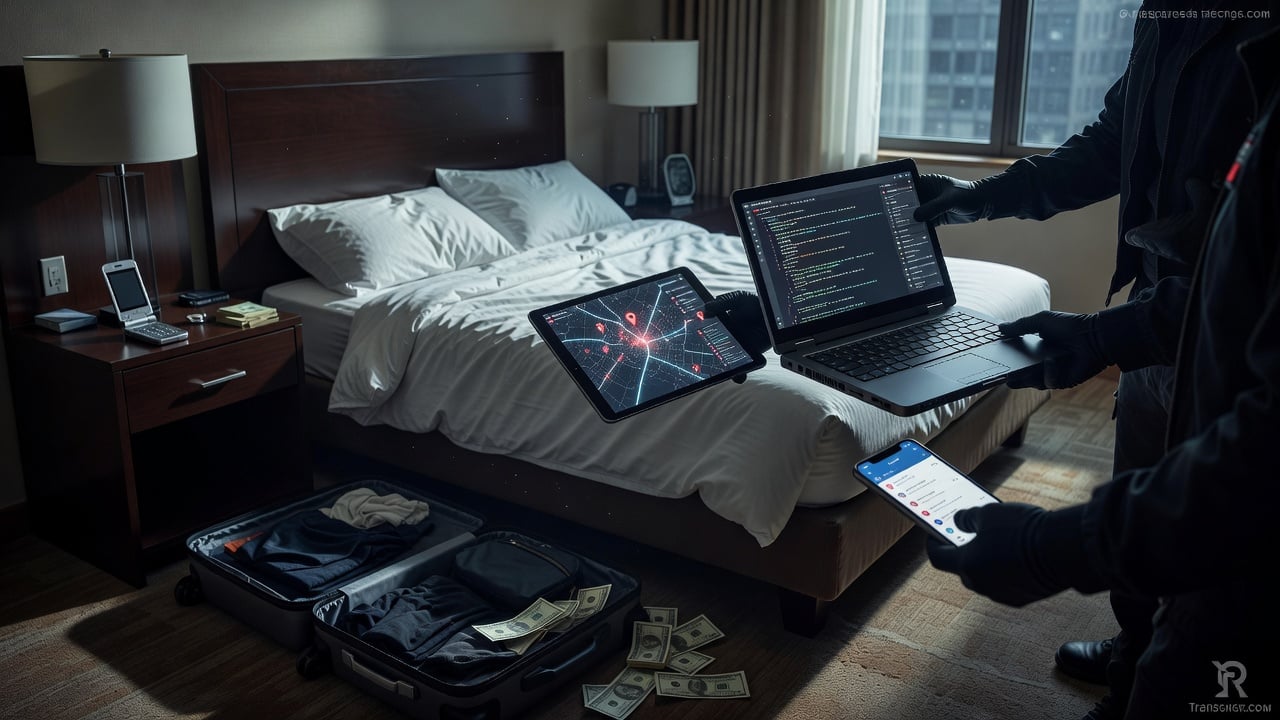
Federal agents located and arrested an activist father in a New York hotel room after he publicly criticized immigration enforcement operations, according to reports that have raised fresh questions about how authorities pinpoint individuals who maintain a low physical profile. The case centers on a man who had taken steps to shield his location while speaking out against Immigration and Customs Enforcement practices, yet officers still found him inside a hotel where he believed he would remain undetected.
The incident, first reported by Gizmodo, highlights the expanding ways government agencies gather location data on American citizens. The father, who had been vocal online about family separations and deportation raids, had deliberately avoided his known addresses. He moved between temporary lodging options, paid in cash when possible, and limited his digital footprint in ways that many privacy advocates recommend. Despite those precautions, agents appeared at his hotel door.
Details remain limited because neither federal officials nor the arrested man have released full accounts. What has emerged suggests agents relied on information that went beyond traditional surveillance tools such as wiretaps or physical tailing. Sources familiar with the operation indicated that data brokers, mobile advertising networks, and location-based smartphone applications may have supplied the coordinates that led officers directly to the specific floor and room. This possibility has alarmed civil liberties groups that have monitored similar tactics used against journalists, protesters, and immigration advocates in recent years.
The episode fits a broader pattern in which federal law enforcement agencies purchase or subpoena commercially available data rather than obtain warrants for direct surveillance. Companies that collect latitude and longitude points from weather apps, fitness trackers, and targeted advertising often sell aggregated or individualized datasets to government buyers. These transactions sometimes occur with minimal judicial oversight, allowing agents to locate targets without demonstrating probable cause to a judge. In this instance, the speed with which agents arrived at the hotel suggests they obtained near real-time coordinates rather than historical cell-tower records.
Privacy researchers have documented how ordinary smartphone usage creates a constant stream of location signals. Applications request permission to track users for purposes ranging from delivering local news to serving relevant coupons. Even when users deny permission, some background processes continue to transmit data through other installed software. Data brokers then combine these signals with public records, credit card transactions, and social media activity to build detailed profiles. A single missed setting or cached advertisement request can reveal a person’s whereabouts with surprising accuracy.
The father’s public statements against ICE had already placed him on the radar of enforcement officials. He had participated in rallies, signed petitions, and shared personal stories about how aggressive deportation tactics affected his community. His visibility made him a potential witness or target in ongoing investigations, yet the decision to arrest him inside a hotel room rather than at a scheduled court appearance or public event indicates agents viewed the location data as fresh intelligence. The tactical choice also minimized the chance that supporters could organize a rapid response.
Legal experts point out that current statutes give wide latitude to agencies seeking commercial data. The Stored Communications Act and various national security provisions allow subpoenas that do not require the same level of justification as a traditional search warrant. Because the information originates with private companies, courts have sometimes treated it as outside Fourth Amendment protections. This legal gray area has expanded as more aspects of daily life generate marketable data points. A hotel stay booked through an online travel platform, a delivery order placed from the room, or even the hotel’s own Wi-Fi login can each add another thread to the digital trail.
Advocates for stronger privacy rules argue that the government should face stricter limits when it acquires location information on people who are not suspected of violent crime. They note that anti-ICE activism, while controversial, constitutes protected speech under the First Amendment. Tracking individuals solely for their political positions risks chilling public debate and deterring others from voicing dissent. Several organizations have filed Freedom of Information Act requests seeking records of data purchases by ICE and Customs and Border Protection. Early responses show substantial spending on location analytics, though agencies often redact vendor names and specific methods.
The technology itself continues to grow more sophisticated. Mobile advertising exchanges auction user profiles in milliseconds, allowing buyers to bid on the opportunity to show an ad to a specific device at a precise place and time. Law enforcement agencies have reportedly used these same exchanges through intermediary firms that obscure the ultimate customer. Once a device is identified, agents can purchase repeated location updates that function like a virtual tail. Unlike a physical surveillance team that might lose a target in traffic, digital tracking follows the phone even when the owner turns off location services for certain apps. Many phones still transmit signals through other means, including Bluetooth beacons inside stores and buildings.
Hotel privacy adds another layer of concern. Guests expect that registering under an assumed name or paying cash will shield them from casual inquiries. Yet modern booking systems link reservations to identification documents for security and tax purposes. If a data broker has previously connected a phone identifier to a name, even a cash transaction may not fully break the chain. In this reported case, agents arrived at the hotel with enough certainty to approach the correct room, suggesting they possessed data that matched the target’s device to the building’s physical address in near real time.
Immigration enforcement has increasingly relied on data-driven methods. ICE maintains databases that cross-reference public benefits records, school enrollments, and employment information. When those sources prove insufficient, agents turn to the commercial data market. The approach allows operations against individuals who have taken conventional steps to avoid detection, such as avoiding home addresses or changing vehicles. For activists who organize online, the combination of public statements and private location data creates a particularly exposed position.
Civil liberties attorneys have begun preparing challenges to these practices. They contend that the government’s purchase of location data effectively bypasses constitutional safeguards against unreasonable searches. Several lawsuits already working through federal courts argue that repeated collection of historical location points over weeks or months amounts to the sort of comprehensive surveillance the Supreme Court addressed in Carpenter v. United States. In that 2018 decision, justices ruled that police need a warrant to obtain cell-site location information from wireless carriers. Whether the same logic applies to data bought from brokers remains unsettled.
Meanwhile, the arrested father’s situation underscores the personal stakes. According to available accounts, he had been caring for family members while continuing his advocacy work. His sudden removal from the hotel disrupted those efforts and left dependents without immediate support. Supporters quickly organized legal defense funds and called for transparency about the precise methods used to locate him. Their campaign has drawn attention from technology journalists and digital rights organizations that see the case as a test of how far authorities can push data acquisition without public accountability.
Broader discussions about surveillance capitalism have gained renewed focus. Companies that harvest location information often claim they anonymize data before selling it. In practice, re-identification techniques frequently allow buyers to connect data points back to specific people. A single persistent identifier, such as an advertising ID tied to a phone, can link disparate datasets across months or years. Researchers have demonstrated that even heavily stripped datasets can reveal individual movements when combined with outside knowledge, such as the fact that a particular activist appeared at a certain protest.
Technology companies themselves face pressure on multiple sides. Consumer advocates demand stronger default privacy settings and clearer explanations of data sharing. Law enforcement agencies insist they need access to these tools to locate suspects and protect public safety. The resulting tension leaves ordinary users caught between sophisticated tracking systems they barely understand and government agencies that increasingly treat commercial data as an open resource.
Some lawmakers have proposed legislation that would require warrants for any location data, whether obtained directly from carriers or purchased through brokers. Others suggest stricter rules on data brokers themselves, including mandatory audits and deletion timelines. Progress has been slow, partly because the same technologies that enable government tracking also power lucrative advertising markets. Industry lobbyists argue that excessive regulation could harm innovation and national security efforts.
For individuals who wish to reduce their exposure, experts recommend several practical steps. Using phones in airplane mode when not actively needed, employing virtual private networks, disabling unnecessary location permissions, and avoiding apps that request constant background access can shrink the data trail. Paying cash for travel and lodging, using public computers for sensitive communications, and varying daily routines also complicate efforts to build consistent profiles. Yet even dedicated privacy practitioners acknowledge that complete evasion grows harder each year as more services integrate location awareness.
The New York hotel incident serves as a concrete example of these dynamics at work. An activist who consciously limited his digital and physical visibility still found federal agents at his door. The uncertainty about exactly which data sources and analytic tools led them there only heightens the unease. Without clearer disclosure from the agencies involved, the public cannot fully assess whether the methods respected legal boundaries or simply exploited gaps in current statutes.
As more cases surface, pressure is building for judicial clarification and legislative reform. Courts will likely face arguments that location data, regardless of its commercial origin, reveals intimate details about personal associations, medical conditions, and political activities. If judges extend warrant requirements to broker-sourced information, agencies may need to adjust tactics that have become routine. Until then, individuals who speak publicly about controversial government policies must weigh the risks of digital visibility against their desire to participate in civic discourse.
The father’s arrest has already prompted fresh warnings within activist circles. Organizers now advise members to treat their phones as potential tracking devices and to plan accordingly when attending sensitive meetings or providing public comment. Some groups have begun offering digital security training that focuses specifically on location leakage and data broker ecosystems. These sessions emphasize that privacy is not a single decision but a continuous practice of limiting data generation and transmission.
Federal agencies, for their part, defend their use of available tools by pointing to the challenges of locating people who actively work to avoid detection. They argue that commercial data provides leads that might otherwise require extensive manpower or intrusive physical surveillance. Officials also note that many data purchases support legitimate investigations into serious offenses rather than political speech. The distinction, however, becomes difficult to maintain when the same analytic platforms serve both purposes without clear separation.
The tension between security needs and privacy rights has defined many technological debates over the past two decades. This latest example demonstrates that the conflict has moved beyond theoretical discussions into the daily experiences of ordinary citizens. A father expressing views on immigration policy discovered that his temporary refuge offered less protection than he expected. The methods that revealed his location likely combined dozens of small data points collected over time by applications most users install without much thought.
Future developments will depend on how courts interpret existing laws and whether Congress chooses to update statutes written before smartphones became ubiquitous. In the meantime, the reported hotel arrest stands as a reminder that digital trails can lead directly to a person’s door even when that person has taken deliberate steps to stay hidden. The full story of precisely how agents found the anti-ICE activist may never become public, yet the implications for privacy, activism, and law enforcement tactics are already prompting widespread examination of the systems that make such tracking possible.


 WebProNews is an iEntry Publication