
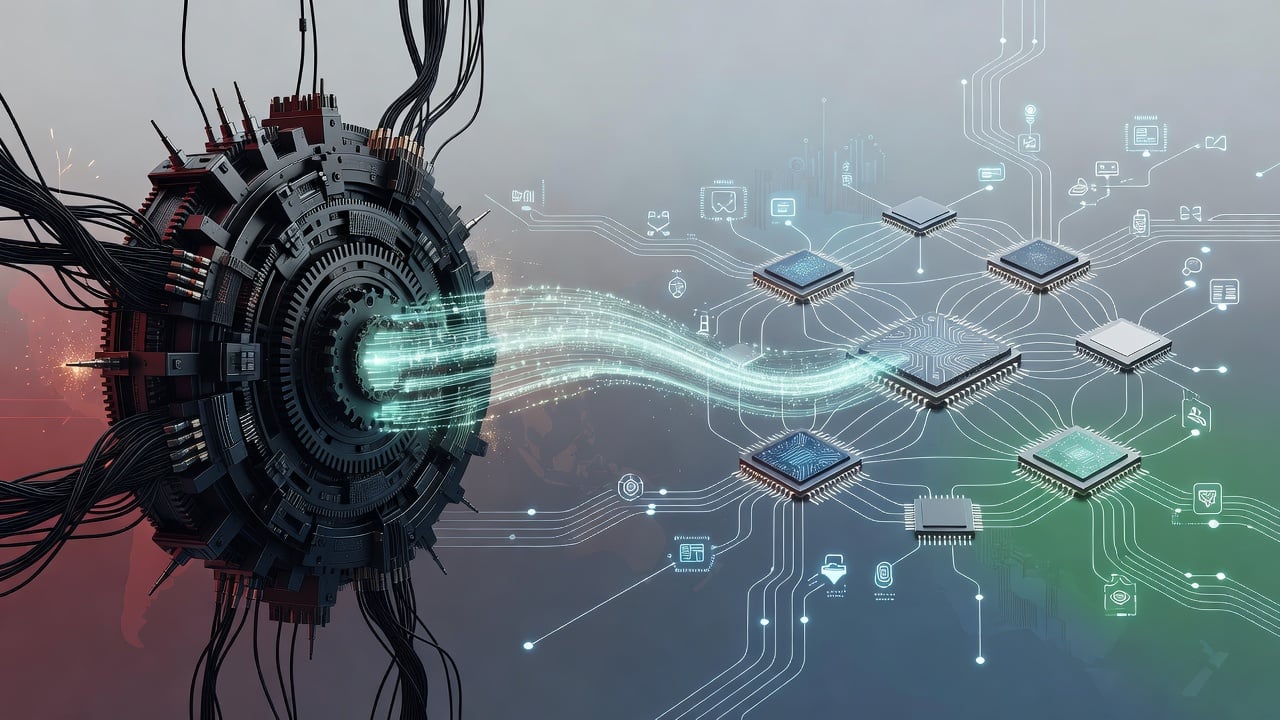
Alibaba’s chip design arm T-Head chose the World AI Conference in Shanghai to drop a significant announcement. It open-sourced SAIL. The full software stack powers its Zhenwu series of AI processors. The timing carries weight. Nvidia commands a market capitalization near $3.4 trillion. Its CUDA platform has locked in developers for nearly two decades.
Developers can now adapt SAIL to mainstream AI frameworks. They do so in under seven days. That’s the company’s claim. Such speed targets the friction that keeps teams tethered to Nvidia hardware. But. CUDA’s installed base runs deep. Habits die hard.
The The Next Web reported the move in detail. T-Head positioned SAIL as infrastructure-level support. It aims to erode the moat Nvidia built through years of software optimization and community investment. And the stakes extend beyond code. Geopolitics shadows every announcement.
Chinese President Xi Jinping addressed the same conference. He argued no single country should monopolize artificial intelligence. His words underscored Beijing’s push for self-reliance. They also framed T-Head’s decision within a larger national narrative. Yet Alibaba faces headwinds abroad. Last month Anthropic accused its Qwen models of running the largest known case of AI distillation against a U.S. company. In June the Pentagon added Alibaba to its list of Chinese military companies.
These tensions make the open-source release more than technical theater. It lets Alibaba present itself as a contributor to global AI openness. At the same time it advances domestic chip ambitions. T-Head has already shipped 560,000 Zhenwu chips to more than 400 customers. The public software layer arrives now. That expands the potential user base considerably.
Other Chinese players pursue similar paths. Huawei released its CANN software in 2025. Moore Threads Technology promotes compatible stacks. Each effort chips away at CUDA’s near-monopoly on GPU programming. None claims an easy victory. Porting legacy CUDA code still demands expertise. Performance gaps persist on some workloads.
Industry observers note the practical barriers. CUDA benefits from two decades of libraries, tools, and tutorials. Developers trained on it resist change. SAIL must match that maturity quickly. Early benchmarks shared by T-Head suggest competitive inference speeds on its silicon. Real-world adoption will test those numbers.
The South China Morning Post covered the announcement with emphasis on migration barriers. It highlighted how SAIL’s availability to international developers signals broader intent. Not every market welcomes Chinese silicon. Export controls and security reviews complicate sales. Open software could bypass some restrictions by letting third parties build on top.
Alibaba Cloud itself reports progress reducing reliance on Nvidia GPUs. A pooling system cut usage by 82 percent for certain workloads. That internal success may encourage customers to experiment with alternatives. Yet the broader market still defaults to CUDA for training and inference. Momentum favors the incumbent.
Recent coverage adds color. The AI Weekly summarized the release as a calculated strike at Nvidia’s software fortress. It noted the stack’s immediate availability on the announcement day. Such rapid rollout demonstrates confidence in the code’s readiness. Or urgency.
Analysts question whether one stack can shift entrenched behavior. CUDA’s ecosystem includes thousands of optimized kernels. Replicating that breadth takes time. T-Head appears focused first on core frameworks. PyTorch and TensorFlow compatibility rank high on its list. If developers achieve functional ports within a week, the psychological barrier drops.
China’s AI chipmakers operate under sustained pressure. U.S. restrictions limit access to advanced manufacturing. Domestic fabs race to close the gap. Software becomes the differentiator when hardware parity lags. Open-sourcing SAIL invites global collaboration. It also invites scrutiny. Security researchers will dissect the code for hidden telemetry or weaknesses.
So far feedback remains preliminary. Early testers praise documentation quality. They report straightforward integration with existing model code. Performance on Zhenwu hardware varies by workload. Inference tasks show stronger results than training. That aligns with many alternative chips optimized for deployment rather than massive pre-training runs.
The Chosun Ilbo framed the decision as building an independent AI foundation. It contrasted Nvidia’s two-decade CUDA reign with the fresh open alternative. The article stressed ecosystem construction over immediate hardware sales. Success depends on attracting developers outside China first.
Alibaba’s own large language models add context. Qwen series models run on diverse hardware. Internal efforts to decouple from foreign GPUs inform the SAIL strategy. Cloud teams already demonstrate substantial Nvidia reductions through smarter scheduling. Those lessons could transfer to external customers adopting Zhenwu plus SAIL combinations.
Challenges remain formidable. Talent pools still favor CUDA expertise. Universities teach it. Enterprises standardize on it. Breaking that cycle requires more than code on GitHub. It demands training programs, migration guides, and proven cost savings. T-Head promises ongoing updates. Community contributions will shape the project’s velocity.
Watch for adoption metrics in coming quarters. Download counts offer one signal. Actual production deployments tell the real story. If a handful of cloud providers integrate SAIL backends, momentum could build. Otherwise the announcement risks fading into the long list of CUDA challengers.
Alibaba clearly bets on openness as its wedge. By releasing the full stack it lowers the cost of experimentation. Developers no longer need exclusive hardware access to test compatibility. That democratizes evaluation. It also pressures Nvidia to defend its position with continued innovation and pricing discipline.
The conference backdrop amplified the message. Xi’s call against technological monopoly lent official weight. Chinese firms interpret that as license to accelerate alternatives. Global observers see both opportunity and risk. Open code accelerates innovation. It also spreads capabilities that governments on all sides watch closely.
One fact stands clear. The era of unchallenged CUDA supremacy faces its most coordinated test yet. Multiple Chinese vendors push parallel solutions. Alibaba’s move adds significant scale and resources. Whether SAIL gains traction depends on execution. The code is public. Results will follow.


 WebProNews is an iEntry Publication