|
Friday Feb 21, 2025 |
Today's Exclusive
3 min read
Nvidia’s Jensen Huang Rebuffs Investor Panic Over DeepSeek Sell-Off: “They Got It Wrong”Huang dismissed the notion that DeepSeek’s breakthroughs signal a threat to Nvidia’s dominance in the artificial-intelligence chip market. “Investors got it wrong,” he declared, framing the episode not as a crisis but as a validation of Nvidia’s long-term strategy. |
|
Sponsored
|
|
In an interesting conversation that just became available, Nvidia Corp.’s chief executive, Jensen Huang, has pushed back against the market’s dramatic sell-off sparked by advancements from Chinese AI upstart DeepSeek. Speaking in a pre-recorded interview released Thursday with Alex Bouzari, CEO of DataDirect Networks, Huang dismissed the notion that DeepSeek’s breakthroughs signal a threat to Nvidia’s dominance in the artificial-intelligence chip market. “Investors got it wrong,” he declared, framing the episode not as a crisis but as a validation of Nvidia’s long-term strategy. The controversy erupted late last month when DeepSeek, a relatively obscure Hangzhou-based firm, unveiled its open-source R1 reasoning model—a feat that rattled Wall Street. On January 27, Nvidia’s stock plummeted 17%, erasing roughly $600 billion in market value in a single day, as investors fretted that DeepSeek’s ability to rival Western AI models with less funding and weaker hardware could erode Nvidia’s position as the go-to supplier of high-octane chips for AI development. Huang’s personal fortune took a hit too, shrinking nearly 20% at the trough, though both his wealth and Nvidia’s share price have since clawed back most of the losses. 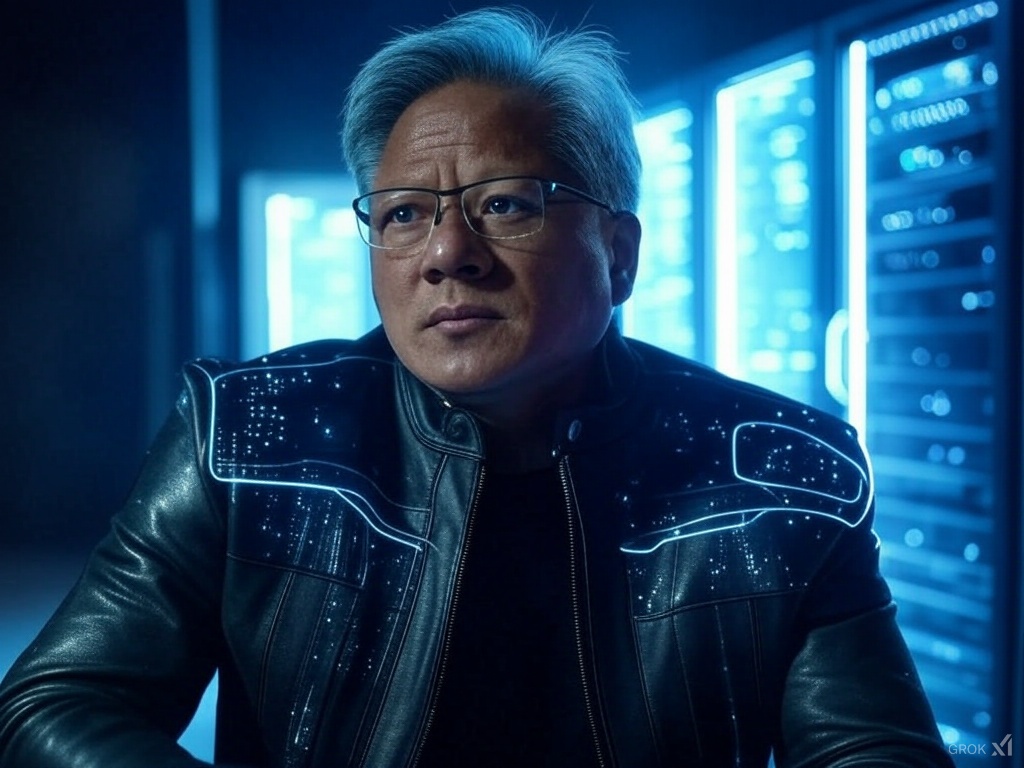 Huang, clad in his trademark leather jacket, appeared unruffled in the interview, calling DeepSeek’s R1 “incredibly exciting” and arguing that its implications have been misread. “The market thought this was the end of something,” he said. “It’s exactly the opposite—it’s the beginning.” His thesis hinges on a nuanced shift in AI’s evolution: While DeepSeek demonstrated remarkable efficiency in pre-training its model—a phase that involves feeding vast datasets into an AI system—the subsequent “post-training” stage, where models learn to reason and solve complex problems, remains a computational behemoth. That, Huang contends, is where Nvidia’s chips remain indispensable. Analysts say there’s merit to his argument. Pre-training, though resource-intensive, is increasingly being optimized by firms like DeepSeek, which reportedly slashed costs by leveraging older hardware and innovative algorithms. But post-training—fine-tuning models to think creatively and handle real-world tasks—demands the kind of raw horsepower Nvidia’s GPUs deliver. “The market overreacted to the pre-training story and ignored the bigger picture,” said Stacy Rasgon, a senior analyst at Bernstein. “Nvidia’s growth isn’t tied to one phase of AI—it’s the whole pipeline.” |
Sponsored by Cisco Upgrade Your Firewall: Simplify Migration with Cisco Secure FirewallAs cyber threats evolve, ensuring your Cisco Secure Firewall remains optimized and up to date is essential. Join us for a 45-minute webinar designed for Cisco Firewall customers renewing their licenses, where we’ll walk through the latest updates, security enhancements, and best practices to help you maximize your investment. |
|
||
|
||
|
||
|
||
|
||
|
||
|
DataScientistPro
Published by WebProNews, a leading publisher of business and technology newsletters since 1999. |
| More newsletters Advertise X Facebook LinkedIn |
|
Copyright © 2026 WebProNews, All rights reserved. Our mailing address is: 3070 Harrodsburg Road, Suite 230 Lexington, KY 40503 You're receiving this because you subscribed to DataScientistPro. |