|
Tuesday Oct 20, 2026 |
Today's Exclusive
2 min read
Japan Launches MMX Probe to Collect Samples From Mars Moon PhobosJapan's MMX spacecraft lifted off on an H3 rocket from Tanegashima, bound for Mars' moon Phobos to collect samples. The JAXA-led mission, with NASA, CNES, DLR and ESA, reaches Mars in August 2027 and is due to bring samples back in 2031. |
|
Sponsored
|
|
Japan launched its Martian Moons eXploration (MMX) spacecraft at 4:41 a.m. Tuesday, Oct. 20, Japan time (3:41 p.m. ET Monday), on a mission to collect the first samples from one of Mars' moons and bring them back to Earth. The H3 rocket, flight No. 10, lifted off from the Tanegashima Space Center, and the Japan Aerospace Exploration Agency confirmed that the spacecraft separated about 71 minutes and 13 seconds after liftoff and was injected into its planned orbit, according to JAXA's launch result release. Kyodo News reported that the rocket flew in its most powerful configuration, with two engines and four boosters. 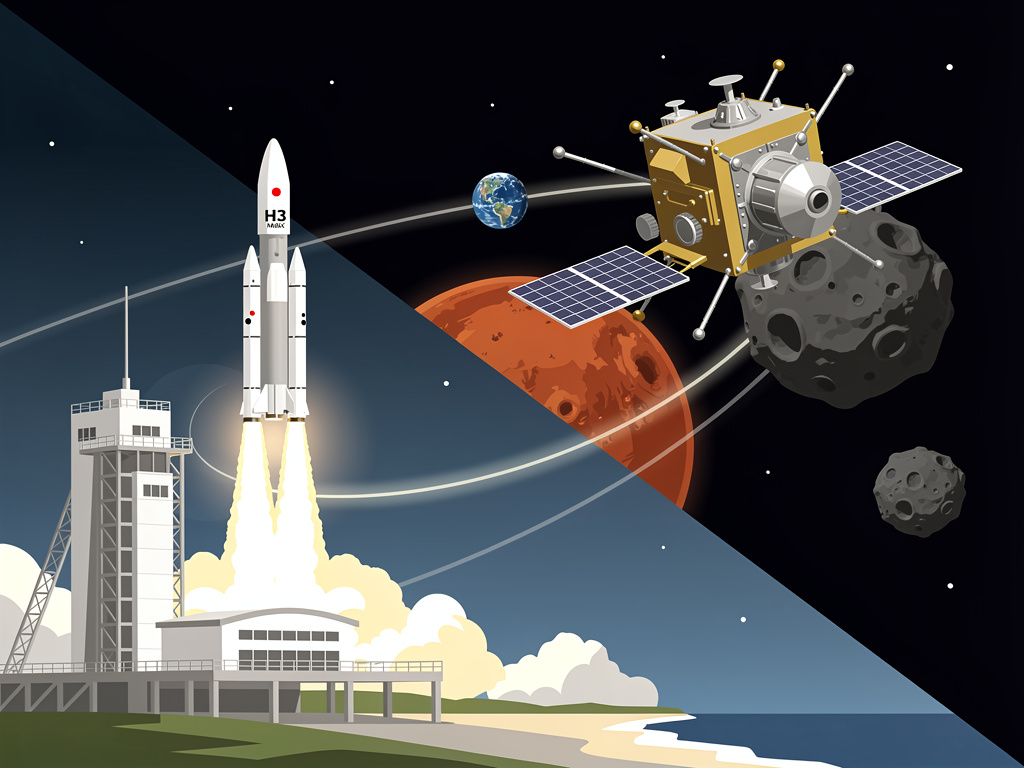 MMX is the first H3 payload sent beyond Earth orbit, AeroTime reported. Its target is Phobos, the larger of Mars' two moons, which orbits about 6,000 kilometers from the planet's surface and measures roughly 20 to 30 kilometers across. Scientists don't know whether Phobos and its sibling Deimos are captured asteroids or debris thrown into orbit by a giant impact on Mars, and the European Space Agency says samples are needed to settle the question. "I believe we were able to place it into the planned orbit with exceptional precision," Makoto Arita, JAXA's H3 project manager, said at a post-launch press conference, according to Kyodo. "I'm very happy that we were able to launch MMX, a project that has attracted worldwide attention." |
Sponsored by Harness.io [Free Virtual Summit] Master Cloud Cost Control on July 16Cloud costs can quickly spiral when finance teams lack real-time visibility into engineering spend. Join the free virtual FinOps Excellence Summit, hosted by Harness on July 16th, to learn how leading companies like United Airlines are successfully embedding cost controls into their software delivery pipelines. |
|
||
|
||
|
||
|
||
|
||
|
||
|
SpaceRevolution
Published by WebProNews, a leading publisher of business and technology newsletters since 1999. |
| More newsletters Advertise X Facebook LinkedIn |
|
Copyright © 2026 WebProNews, All rights reserved. Our mailing address is: 3070 Harrodsburg Road, Suite 230 Lexington, KY 40503 You're receiving this because you subscribed to SpaceRevolution. |